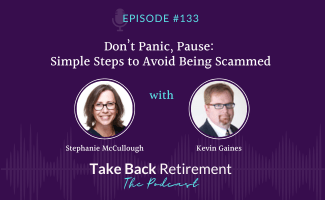
Take Back Retirement

Episode 133
Don’t Panic, Pause: Simple Steps to Avoid Being Scammed
“Scammers rely on emotion. If they can catch you in that half second of panic, then they might be able to get you to do something.”
41% of American adults have lost money to scams. And that’s only those who reported it.
Our hosts, Stephanie McCullough and Kevin Gaines, are back to talk all about money scams because the problem keeps growing, and because the scammers, as Kevin puts it, keep learning.
The core mechanism hasn’t changed either. Scams are all about manufactured panic. Whether it’s a Social Security alert, a fake IRS demand, or a “computer security team” that called out of nowhere to say you’ve been hacked, the goal is to knock your skepticism offline before it fires. According to behavioral science, acute panic literally impairs the higher-order reasoning you’d need to catch the trick.
The antidote is AARP’s three-step model: pause, reflect, protect. The research behind it illustrates that awareness of a specific scam makes you 80% less likely to fall for it. Their free Fraud Watch Network sends alerts several times a month, and Stephanie suggests that even skimming the subject lines is protective.
As Kevin likes to say, “Always independently verify.”
If someone sends you a phone number to call, that number is already suspect. The best long-term defense isn’t paranoia but connection. That means staying in regular contact with people who aren’t in panic mode when you are.
Resources:
- Take Back Retirement Ep 74: Taking Charge: Carol Marak’s Strategy for Solo Aging and Retirement Planning
- Take Back Retirement Ep 83: Combatting Fraud and Protecting Your Financial Future with AARP’s Kathy Stokes
- AARP Link: Scams & Fraud Help Center
- “Pause, Reflect, Protect” Article
Please listen and share with your friends who are in the same situation!
Key Topics
- AARP Fraud Watch Network and the 80% Awareness Effect (04:29)
- Why Smart People Still Get Caught (06:08)
- The IT Support Scam (13:05)
- IRS Impersonation and the Tax Season Warning (19:00)
- “Pause, Reflect, Protect” in Practice: Charity Call Story (21:48)
- Romance Scams, Friendship Scams, and the Loneliness Factor (24:53)
- Final Tip: Make More Friends, Call Your Mother (28:51)
Stephanie McCullough (00:00):
And that’s one of the things that the bad guys say is like, “You can’t tell anybody.” Because they don’t want anyone who’s not in panic mode to help assess.
Kevin Gaines (00:08):
Yeah, they don’t want anybody involved having clear hits. And they’ll turn around, and not only will they say, “Oh, for security reasons or whatever,” but it’s like, “Yeah, we need to keep this quiet.”
[Music playing]
Stephanie McCullough (00:28):
Hey, dear listeners, we need to let you know that Kevin and Stephanie offer investment advice through Private Advisor Group, which is a federally registered investment advisor. The opinions voiced in this podcast are for general information only and are not intended to provide specific advice or recommendations to any individual. To determine which strategies or investments may be suitable for you. Consult the appropriate qualified professional prior to making a decision. Now, let’s get on with the show.
This is Take Back Retirement, the show that’s redefining retirement for women. Retirement is an old-fashioned cultural concept. We want to reclaim the word so you can make it your own. I’m Stephanie McCullough, financial planner and founder of Sofia Financial, where our mission is to reduce women’s money stress and empower them to make wise holistic decisions so they can get back to living their best lives.
Kevin Gaines is my longtime colleague with deep knowledge in the technical stuff: investments, taxes, retirement plan rules. He’s a little bit nerdy and quantitative, I’m a little bit touchy-feely and qualitative. Together, through conversations and interviews, we aim to give you the information and motivation you need to move forward with confidence. We’re so glad you’re here.
Stephanie McCullough (01:53):
Dearest, gentle reader, I mean listener if you know, you know. We are revisiting today a very important topic, a very timely topic. Sadly, it’s always timely, and we haven’t talked about this back since episode 83 with our friend Kathy Stokes from AARP – about how to protect yourself from fraud and scams. Awareness, intentionality, and acting deliberately without haste, not in a panic, talking to your people. These are the keys, we will dive into it today.
[Music playing]
Stephanie McCullough (02:35):
Coming to you semi-live from the beautiful Westlakes office park in suburban Philadelphia, this is Stephanie McCullough and Kevin Gaines of Sofia Financial and American Financial Management Group. Say hello, Kevin.
Kevin Gaines (02:46):
Hello, Kevin.
Stephanie McCullough (02:47):
Kevin, why are we revisiting this topic?
Kevin Gaines (02:50):
I don’t know. It makes no sense to me why we would be covering this, because we did that one episode two years ago. And ever since then, everybody starts treating their neighbors much more kindly and gently. So, nobody’s getting ripped off anymore, I think. Or am I wrong?
Stephanie McCullough (03:08):
Wouldn’t that be nice? I think you’re wrong. I do, sadly, think you’re wrong. We saw a number that a 2025 report said 41% of American adults had been affected by scams and fraud, had lost money to them. And you know what? That’s only the people who’ve reported it.
Stephanie McCullough (03:30):
There was another stat from The Consumer Federation of America showing that Americans lose $119 billion (billion with a B) to scams. And the thing is, it’s not like it only happens to people who are gullible or not paying attention. The scammers, the fraudsters, they are organized criminal groups. They’re good at what they do.
Kevin Gaines (03:56):
Yes. And they’re getting slicker. It’s getting easier for them to … and not just because of AI, although, let’s face it, AI definitely makes their job easier. But just like any other industry or organization or whatever, they learn.
Kevin Gaines (04:17):
We find out, “Oh, they’re doing this trick, let’s publicize this particular scam.” So, then they tweak it so that they try to catch you unawares, and they succeed.
Stephanie McCullough (04:29):
Sadly, it is true. One of our favorite sources in this, again, coming back from our friend Kathy Stokes at AARP. AARP has a newsletter that comes out several times a month, I believe, called the AARP Fraud Watch Network. We highly recommend everyone subscribe.
Stephanie McCullough (04:49):
Even just taking a look at the headlines of the newsletters is going to stand you in good stead. Because as Kathy shared with us, if you are aware of a scam, if you have read about it, heard about the structure of it, you’re 80% less likely to be taken in, to become a victim of the scams.
Stephanie McCullough (05:11):
The headline in the most recent newsletter (which just actually came out yesterday) is “Social Security notification? Take an active pause.” One of the scams that’s very common out there is that the scammers, the fraudsters, are impersonating some type of trusted source like a government agency like the Social Security Administration. So, they’ll come at you often with a text saying, “Oh, something really drastic has happened regarding your social security number, you must act quickly.”
Stephanie McCullough (05:47):
So, they’re depending on a feeling of panic. They want to arouse strong emotions and worry. And also, quick turnaround is important, urgency. Because they don’t want you to take time to think, to second guess, to talk to people, to do a little research before you react.
Kevin Gaines (06:08):
And that’s key, because like you said, they rely on emotion for this. Because if they can catch you in that half second of panic, then they might be able to get you to do — even if you then come back a half hour later say, “Oh, what the hell was I thinking?” A lot of times, it’s too late.
Stephanie McCullough (06:27):
For sure. So, what AARP recommends is a three-step model. Y’all remember “stop, drop, and roll” from – I don’t know, for me it was elementary school training if there was a fire or something. AARP’s system, when you have some kind of thing like this that feels urgent and is asking for your immediate action, they say, “Pause, reflect, protect.”
Stephanie McCullough (06:52):
“Pause” means take a breath, like Kevin was saying. Take a minute before reacting. Think it through. Don’t do a knee-jerk reaction. Maybe even talk to someone.
Stephanie McCullough (07:03):
Step two: reflect. Ask yourself what the sender wants you to do. The sender of this message that you’ve received. What do they want you to do? Why do they want you to do it? Just bring some critical thinking back to it.
Stephanie McCullough (07:18):
Because behavioral science shows us that when we get in the state of panic, our higher-level thinking brain (our frontal lobe) goes offline. Literally, we don’t have access to that logical reasoning. So, the taking a breath, the asking the questions.
Stephanie McCullough (07:36):
There are some breathing techniques that work well. There’s the box breathing, where you breathe in for four, you hold for a count of four, you breathe out for a count of four, you hold at the bottom for a count of four.
Stephanie McCullough (07:49):
Do that a few times. That has been shown to help get that higher-level reasoning to kick back in. To get your nervous system back online. So, pause, reflect, and then protect. What do they mean by protect? Verify independently what they’re asking you to do.
Stephanie McCullough (08:09):
So, one that we’ve heard about recently is you get a text from “supposedly” your credit card company saying there’s been some type of fraud. Now, remember in the past, we’ve talked about fraudulent emails.
Stephanie McCullough (08:24):
And one of the ways to look at that is you look at the actual sending email address, and if it’s a weird-looking email address, if it doesn’t say citigroup.com or americanexpress.com, that was a sign. However, the bad guys now can spoof real email addresses. But when it’s coming from text, you don’t even have that. So, if a text comes in and it looks dangerous, it looks urgent and it’s asking you to take some action, this is when you need to pause.
Stephanie McCullough (08:55):
So, in the one we’ve heard about, you get a text supposedly from your credit card company, they say there’s been some fraud. You text back, they call you. So, now you’re talking to an actual human being. They say, “I’m going to send you a code to your phone to verify your identity.” They send you a code, you read back them the code.
Stephanie McCullough (09:19):
All sounds like a normal two-factor authentication that we are asked to do ad nauseum all day long, logging into our actual accounts. However, in this case, remember that you got an unsolicited message from out of the blue asking you to do something urgently. So, then we want your radar to be going on.
Stephanie McCullough (09:39):
What the scammer is actually doing is resetting your password on your credit card account or on your bank account. They needed that two-factor. Because remember, if you go in and say, “I forgot my password,” what happens? You put in your email address or your phone number, they send you a code. They say, “Don’t share this code with anyone.” And then you use that to reset your password.
Stephanie McCullough (10:03):
Well, someone else can go in and reset your password too, if you read them the code. So, in the story that we had heard, the bad guys were doing this, they’re resetting your password, they’re taking money out of your bank account. It’s not good.
Kevin Gaines (10:19):
Here’s the basic problem with (at least how I see it, Stephanie) being more secure about this stuff, is it’s inconvenient. And you know what?
Stephanie McCullough (10:29):
To be secure.
Kevin Gaines (10:30):
To be secure. But here’s the thing, it’s supposed to be inconvenient. If it was convenient, then would it really be secure? Because to your point (and I think we mentioned this in the last episode with Kathy was), when you get these links, whether it’s on your phone, whether it’s email, whatever, finding a number to call or website outside of what was sent to you.
Kevin Gaines (10:57):
So, what I do, actually, I literally early this morning got an email from Chase in this case, saying, “Hey, just some alerts about frauds to be aware of things.” And they even said, “You will know if it’s a fraudster,” and they say, “Call this number or whatever.” Don’t call the number. Just go to the back of your credit card or your bank statement, call that number. Is it inconvenient to do that? Yes. Is it going to keep you safe or at least safer? Yeah, it really is.
Stephanie McCullough (11:31):
Taking the inconvenient path, I like that.
Kevin Gaines (11:33):
Yeah. But the problem is when you’re emotional (and this is what they prey on), you don’t always — it’s like, “Oh my gosh, I got to get this resolved now. I’m in danger now.” And that is what they’re going to keep. So, your point about taking that breath is so important.
Kevin Gaines (11:54):
Because I’ll even go this far; when we are reading about these scams, how often do we say to ourselves, “Yeah, well, this was an obvious red flag.” Such as the IRS called and said, “Send us Walmart gift cards.” Well, yeah, okay, that seems kind of obvious. But here it is, seven o’clock in the morning, you’re barely in your first cup of coffee, or you even just got woken up. Or eight o’clock at night, you’re starting to get tired. And they call and say-
Stephanie McCullough (12:25):
11 o’clock at night for some of us. Eight o’clock for Kevin.
Kevin Gaines (12:28):
Yeah, yeah. I ain’t answering a phone at 11 o’clock. Nobody. Sorry, mom. But you’re not necessarily thinking, and then you get this, “We’re about to seize your assets,” or “your social security check is going to bounce,” or “somebody has hacked into your bank account.”
Kevin Gaines (12:47):
All of a sudden (pardon my French), shit’s starting to get real in your head. It’s like, “Oh my gosh, all these bad things can happen, and then it’s going to be a nightmare to get it all figured out. Let’s stop it immediately. Thank you for calling. Yes, I’ll gladly tell you whatever you want to know.” Because you’re scared.
Stephanie McCullough (13:05):
Yeah, exactly. So, about six months ago, a friend of mine called and she relayed what had happened with her parents. Actually, I think we were just texting, catching up, and she said, “Oh my gosh, you won’t believe what happened to my parents.”
Stephanie McCullough (13:22):
Her parents are very intelligent people. They are not who you would “think” might fall for something. My friend calls her parents one afternoon, they say, “We can’t talk now.” And they hang up on her. That’s odd behavior.
Stephanie McCullough (13:40):
She calls back. I think maybe she called her dad. Dad hung up on her. She called her mom. Mom said, “Your dad’s on the phone with the (what did they say?) computer security people, they’re helping him. We’ve been hacked, we need to get this fixed.” Immediately, my friend thinks, “Uh-oh” because parents were in panic mode, she wasn’t. She was a little bit removed. So, she could say, “Wait a minute, this sounds fishy. I’m going to go over to their house.”
Stephanie McCullough (14:07):
By the time she got to their house, I think she lived maybe half an hour away, the father was on the phone with, supposedly, the IT support people, the computer security support people. Now, did they have a computer security support contract with someone? No.
Stephanie McCullough (14:24):
This was someone who, out of the goodness of their heart, reached out to them saying, “Oh my goodness, you’ve been hacked, we want to help you.” Hmm, to my friend, again, not in panic mode, she thought, “This sounds weird.” She, my friend got there, kind of assessed the situation, she had her father hang up.
Stephanie McCullough (14:44):
She’s like, “Okay, no, you don’t know who these people are, you need to hang up now.” I think she finally convinced him to hang up. They got maybe $20,000; the scammers got from my friend’s parents. But it could have gone on.
Stephanie McCullough (15:00):
With the supposed “help” they were providing, they were actually getting access to accounts, taking money out. I think this was all maybe in the course of an hour. But what if she had been away on vacation or something and hadn’t chatted with her parents for a couple days? It could have been so much worse.
Stephanie McCullough (15:20):
And that’s one of the things that the bad guys say is like, “You can’t tell anybody.” Because they don’t want anyone who’s not in panic mode to help assess.
Kevin Gaines (15:29):
Yeah. They don’t want anybody involved having clear hits. And they’ll turn around and not only will they say, “Oh, for security reasons or whatever,” but it’s like, “Yeah, we need to keep this quiet.”
Kevin Gaines (15:42):
And this was a key point when we were talking with Kathy, I remember this. Especially with older people, it’s the yes, the sense of shame, but it’s also, “What is this going to cost me?” And not financially, but how are my children going to treat me differently now? Are they not going to allow me to do this, be on my own or whatever?
Stephanie McCullough (16:07):
Be an independent actor in the world.
Kevin Gaines (16:08):
And that gets back to the earlier stat that you were saying, Stephanie, that 41%, but that’s only the people who have reported and that 119 billion. That’s only what was reported.
Stephanie McCullough (16:19):
Exactly. A lot of people don’t report from shame, which is misplaced. It’s the bad guys who should be ashamed. They are the evil doers. They are the ones who are the bad actors. It’s not the people who have been taken advantage of.
Kevin Gaines (16:36):
And hopefully, like this AARP campaign and frankly, a lot of organizations are putting a lot of energy into making fraud more well-known. What I’m hoping one of the benefits of all this is, is it makes everybody more aware of how common this is, how easy it is to happen. So, hopefully, there is less shame for the victims, or the victims feel less shame, let’s be clear. That it’s going to be, “Yeah, this can happen to anybody at any time.”
Stephanie McCullough (17:10):
Yep. And Kevin, you mentioned you’ve seen the TV ads that AARP puts out, apparently, it’s called The Red Flags of Fraud Ad Campaign. So, I think one of the things we can do, we are trying to use our small podcast platform here to spread awareness.
Stephanie McCullough (17:28):
I think each of us needs to be talking about it with our loved ones, with our friends. Even if it’s, “Oh my gosh, did you hear about this new scam? The tips I heard are pause, reflect, protect, and to talk to your people.” Check in with your people regularly. But the more we can spread awareness of this stuff that’s going on, hopefully the more we can insulate ourselves a little bit, protect ourselves to the extent possible from being taken advantage of.
Kevin Gaines (18:00):
And we know a lot of this is easier said than done. I was laughing at the one part in this email I got this morning. Because they were talking about — one of the sections was about charity scams. And it says, “Well, they try to play on your emotions.” So, that was the part that I kind of snickered at, because most charities play on your emotions.
Kevin Gaines (18:23):
Who hasn’t seen those damn dog commercials saying … and they show all these dogs in these wretched conditions. And you don’t have to listen to many episodes to know how I feel about canines. And yeah, they’re playing on your emotions and they’re legit.
Stephanie McCullough (18:39):
Right. This is true. I mean, come on, marketers do it all the time: comparing yourself to your neighbors, wanting to look younger, yeah.
Kevin Gaines (18:47):
No, be careful of any of these playing on your emotions. Yes, that’s true. But yeah, for some of these scams, that’s not necessarily the most useful advice.
Stephanie McCullough (19:01):
That’s true. Well, and I think I like the verify. “Pause, reflect, protect.” The protect part being verify from an independent source. Meaning you know this is the credit card company phone number because it’s on the back of your card. You can go out and try to find legitimate ways to contact them.
Stephanie McCullough (19:23):
Here’s another one because we’re recording this in March and a lot of people are filing their taxes soon. Some people have filed a month ago, which I find crazy. I filed midnight of the day it’s due. But that’s just me.
Stephanie McCullough (19:35):
There are a lot of IRS imposter scams going on. Getting an unexpected communication, supposedly from the IRS saying, “You owe taxes, you face legal action.” I got one the other day saying that my toll bills were overdue and they were going to collect my car.
Stephanie McCullough (19:54):
Meanwhile, I pay my EasyPass every month. So, that didn’t add up to me. But the IRS, the IRS is scary. We know that IRS violations are serious and can stick with you a long time. But the IRS isn’t going to text you ever, ever, ever. They will send you a letter. And we kind of know what those IRS letters look like.
Stephanie McCullough (20:18):
If you get something that maybe feels unexpected, show it to a friend, talk to someone, say, “Hey, I got this text,” throw in the IRS. Even if you’re not remembering in that moment that the IRS will not text you, the (hopefully) friend, loved one will remember. Some of these things, we just got to talk about them. We can protect ourselves if we stick together.
Kevin Gaines (20:45):
And again, this gets back to being in the right state of mind when this is happening. Because the IRS says all the time, “We’re not …” because we get alerts from the IRS saying, “These are the scams we’re seeing, da-da-da-da-da. As a reminder, we will not ask you for a credit card number over the phone. We will not ask you to wire immediately.”
Kevin Gaines (21:08):
But here you go. You call up and they say, “Oh, well, send us a check for X, Y, Z.” “Oh, I don’t have the cash available.” There’s the big thing. Now, you give them an excuse and like, “Oh, well you could just do it with gift cards.” But you think they’re doing you a favor. And again, they’re preying on us when we’re in an emotional state.
Stephanie McCullough (21:31):
Yep, yep. And of course, it’s urgent.
Kevin Gaines (21:33):
So, in the light of day, yes, that seems strange. But when you’re panicking and somebody’s throwing you a lifeline (to go with that analogy), do you look at who’s actually throwing the line to you? Or do you just grab the line?
Stephanie McCullough (21:49):
Now, that I think of it, a couple weeks ago I got a call out of the blue. I picked it up for whatever reason. I usually don’t pick up unknown numbers. And it was a charity that I actually do want to support. And he kind of made his pitch and he was surprised when I was like, “Yes, yes, I would like to give some money.”
Stephanie McCullough (22:06):
And he said, “I can take your credit card right now.” And I went, “Hmm.” I said, “How about I reach out? Is there a way I can do it on your website, or can I call a number?” He said, “Absolutely. Go to the — he didn’t even tell me the website address.
Stephanie McCullough (22:22):
He just said, go to the address of this charity, which was easy to find. Because it’s a big well-known one. And he was totally fine with that. I think if he had pushed back — that made me think, “Oh yeah, he is legit.”
Stephanie McCullough (22:35):
I could hear a kid screaming in the background, which also was like, “Huh, okay. So, he’s working from home. His kid’s screaming, fine.” But if he had pushed back and been like, “No, we need your funds today, and you don’t go to the website.” That I think would’ve been more of a red flag.
Stephanie McCullough (22:48):
But I wanted to read this, because one of the websites that Kevin and I log onto every day, sometimes multiple times a day, to see our client accounts, they have this two-factor authentication. Meaning we put in our username, we put in our password, and then they send us a code to our devices.
Stephanie McCullough (23:07):
And it says, “If anyone asks for this code, STOP. It’s a SCAM. Our representatives will NEVER ask for it. Only enter it online.” So, they’re training us. Every time we get that code it says this, “Our people will never ask you for this code over the phone.” So, I appreciate the financial institutions that are taking that step.
Kevin Gaines (23:37):
And the bigger ones they can do that. The problem could be with some of these smaller ones. Especially, and charities is coming to mind because one of the scam alerts is of course, if the IRS, Social Security, major bank says, “Oh yeah, so you need to send us $100 today. Yeah, you can Venmo or Zelle to us.” Well, assuming you can take the breath and realize like, “Yeah, that’s not passing the smell test.” But you know who will use this? Charities, especially smaller charities.
Stephanie McCullough (24:13):
Yeah. They’re looking to reduce their expenses.
Kevin Gaines (24:17):
Exactly. So, that does pass the smell test, even though, yes, that could be an avenue for scams. But it gets back to the point if you are initiating. That’s when it’s a little easier to trust some of these things. And don’t fool yourself into thinking, “Oh, well, I called this number.”
Kevin Gaines (24:40):
Yes, but where did you get that number from? You went to the website, or you went to the back of the credit card or whatever. Okay, fine, legit phone number. They sent me this phone number. You didn’t really initiate that. They gave you a number to call.
Stephanie McCullough (24:53):
That’s a good point. So, if you are making a phone call, but from a number that came to you, not from a source that can be independently verified. That’s what you’re saying, Kevin.
Stephanie McCullough (25:04):
As opposed to, “Hey, I want to give some money to the food pantry in my town. I went out and I looked them up, I gave a call, or I gave on their website.” That’s when I have initiated it. But if the initial communication comes from elsewhere, that’s when you’re saying, “Be careful.”
Stephanie McCullough (25:24):
And then a lot of us have heard of the romance scams. You somehow get connected with someone often overseas, which is why you can’t visit them or meet them in person. And then after months of having a conversation, potentially romantic conversation, sometimes even making plans to marry or elope.
Stephanie McCullough (25:49):
Suddenly, this person has a dire financial emergency, and you must send them money. But in that case, the person’s in love. They’re sending the money. But you have to keep it secret. Don’t tell your kids that we’re getting married. Things like that.
Stephanie McCullough (26:03):
So, that has become more known. But I have also seen that there are new friendship scams. So, it’s not so much that I want a romantic relationship with you, but let’s be friends. And we all know that loneliness is a huge issue, especially post-COVID.
Stephanie McCullough (26:24):
Especially just with the way that society is today, families are spread out. People have ended up single, solo, for many reasons, living on their own. I used to work at a job where we answered an 800 number and gave people information for the federal government. And the folks who were retired on their own, they loved to chat. We would have long conversations.
Stephanie McCullough (26:52):
And we would kind of think, “Oh, this person, they don’t have many people to talk to in their life.” That’s why the conversation went way longer than normal. But if, all of a sudden, this lovely friend comes out of the blue, this can fall into the similar pattern of the romance scam.
Stephanie McCullough (27:07):
You’re just chatting with this new friend who you’ve somehow found online, and then all of a sudden, they have a financial emergency and need you to send them money.
Kevin Gaines (27:16):
And with AI, it’s now even easier for people, for these scamsters, to get more details about you. Not necessarily the most intimate stuff that it’s like, “Okay, it’s weird that some random person knows this,” but just like generic interests. Because that warning’s been out because of social media.
Kevin Gaines (27:35):
But with the capabilities of what AI’s able to sift through, they can probably even now get more information or get a little bit more precise. “Oh, you don’t just like sports, you like this particular team.” And then they can go from there. So, these scams are only going to get more sophisticated and more targeted.
Stephanie McCullough (27:59):
And we don’t say this to make you depressed about the state of the world and to give up hope. It is to be empowering, to be knowledgeable. To try to be aware. We don’t want you sitting at home terrified of these things but having more knowledge.
Stephanie McCullough (28:19):
So, our office is in the beautiful Westlakes Office Park, which is in Berwyn, Pennsylvania. And across the street years ago, there was a store called Sims. It was a discount clothing store. And their motto was, “An educated consumer is our best customer.”
Stephanie McCullough (28:34):
So, that’s what we’re trying to do for you dearest gentle readers, is help you be educated about this stuff. Please subscribe to the AARP Fraud Watch Network emails. That is a good, trusted source. Talk about this with your friends and loved ones. Kevin, any other last tips?
Kevin Gaines (28:51):
I would actually, not just to say we’re not trying to scare everybody. We’re trying to keep them suspicious of everybody. We’re actually saying the opposite. Go out and make more friends in person. Have more context. Do what you can to have this wider social circle.
Kevin Gaines (29:07):
You’ll hear stories, you have more people that you can rely on, and you hopefully will be (I’m not saying you are lonely) a little less lonely and maybe a little less subject to some of these scams. Of course, now that I say that, you run into the first person you go out to meet coffee with is some confidence trickster. And you get scammed that way, unfortunately.
Stephanie McCullough (29:30):
Oh, Kevin.
Kevin Gaines (29:31):
Maybe I’ve seen one or too many heist movies. But-
Stephanie McCullough (29:36):
Oh, my goodness, I love a heist movie. And yet, no. But I just got an email from our local senior center. They’re looking for volunteers. There are plenty of ways to get yourself more active and involved. I think back to our episode, I’m not going to remember the number, but we talked to the woman who cared for her parents, they both passed away.
Stephanie McCullough (30:00):
She was a single woman, no kids. She thought, “Oh my gosh, who’s going to take care of me as I age?” And she took steps to set herself up as a solo ager to be connected to people of different ages, to have community, to be near folks instead of living in a big house on her own in the far-flung suburbs.
Stephanie McCullough (30:20):
So, we’ll link back to that one as well, thinking about this. Because we’re all getting older every single day. We’re each getting another day older, and many of us will live a very long time. So, we do want to set ourselves up for success. Perhaps that’s another topic we can dive into in more depth in an upcoming episode.
Kevin Gaines (30:40):
And for our younger listeners, yes, I know I’m going to be quoting my mother, and she’s going to make me pay for this. But call your damn mother more often. But be in contact with them more. And if nothing else, then maybe you get lucky and she happens or he happens to mention, “Hey, this is going on,” to the point of your earlier story, Stephanie. Yeah, to an outside, this sounds a little interesting to say the least. Maybe you want to take a breath.
Stephanie McCullough (31:11):
Right. Let’s ask some questions.
Kevin Gaines (31:13):
Let’s dive into this a little bit more.
Stephanie McCullough (31:17):
Call your mother, call your aunt, call your long-lost cousin. Talk. Yeah, stay connected. I really do think that’s an essential step to surviving in this world in many ways.
Stephanie McCullough (31:29):
Thanks so much for being with us. We’ll talk to you next time. It’s goodbye from me
Kevin Gaines (31:32):
And it’s goodbye from her.
[Music playing]
Stephanie McCullough (31:36):
Be sure to subscribe to the show, and please share it with your friends. Show notes and more information available at takebackretirement.com. Huge thanks for the original music by the one and only Raymond Loewy through New Math in New York. See you next time.
Voiceover (31:50):
Investment advice offered through Private Advisor Group, LLC, a registered Investment Advisor. Private Advisor Group, American Financial Management Group, and Sofia Financial are separate entities. The opinions voiced in this material are for general information only and are not intended to provide specific advice or recommendations for any individual security. To determine which investments may be appropriate for you, consult your financial advisor prior to investing. This information is not intended to be substitute for individualized tax advice. Please consult your tax advisor regarding your specific situation.