Take Back Retirement

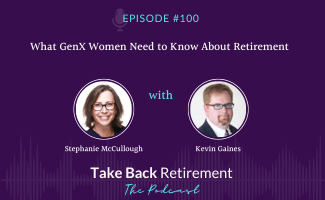
Episode 100
What GenX Women Need to Know About Retirement
“We’re nothing if not resourceful. That’s our generation’s superpower.” -Kevin
In celebration of the 100th episode of Take Back Retirement, our hosts Stephanie and Kevin Gaines reflect on the defining characteristics of their very own generation–Gen X–and key lessons that women in this age bracket can put into practice today in preparing for retirement.
From the seismic shift from pensions to 401(k) plans, to navigating the rollercoaster of financial events like the 1987 Black Monday and the dot-com bubble at the turn of the century, today’s conversation explores the pivotal moments that molded an entire generation’s approach to financial planning.
Our hosts shed light on the realities of midlife day-to-days in the 2020s, from dealing with the fallout of being the “Sandwich Generation” to considerations around financially supporting family members amid shaky times.
At the same time, Stephanie and Kevin celebrate the unique brand of resourcefulness that defines GenX, emphasizing their quest to find “balance, flexibility, and self-determination.”
Resources:
- Leave a Voice Memo for Take Back Retirement
- Personal Financial Inventory Downloadable Resource
- Take Back Retirement Ep 15: What Women Need to Know About Social Security
- Take Back Retirement Ep 82: Getting the Most from Social Security: Smart Strategies for Women with Heather Schreiber
- Take Back Retirement Ep 21: Simplifying Medicare: What’s Important For You To Know with Susan Sloan
- Take Back Retirement Ep 14: What Women Need to Know About Caregiving and Elder Law with Cathy Sikorski
Please listen and share with your friends who are in the same situation!
Key Topics
- The Defining Characteristics of GenXers (5:00)
- Why GenXers are More Cautious with Money (10:19)
- The “Sandwich Generation” (12:34)
- “How Do We Deal With All This Crap?” (18:06)
- Accepting That You Can’t Control Everything (22:23)
- Financially Supporting Family (32:10)
- Key Takeaways (32:36)
Stephanie McCullough (00:00):
We want to hear from you. Listeners of Take Back Retirement, this is our 100th episode, we’re so excited that you have stuck with us and that we have stuck with this project and now finally, we figured out how we can hear your delightful voices on our show. Please go to speakpipe.com/takebackretirement and leave us a voice message and we will work your words into an upcoming show.
[Music Playing]
Stephanie McCullough (00:34):
Hey, dear listeners, we need to let you know that Kevin and Stephanie offer investment advice through Private Advisor Group, which is a federally registered investment advisor. The opinions voiced in this podcast are for general information only and are not intended to provide specific advice or recommendations to any individual. To determine which strategies or investments may be suitable for you. Consult the appropriate qualified professional prior to making a decision. Now, let’s get on with the show.
Stephanie McCullough (01:09):
This is Take Back Retirement, the show that’s redefining retirement for women. Retirement is an old-fashioned cultural concept. We want to reclaim the word so you can make it your own. I’m Stephanie McCullough, financial planner and founder of Sofia Financial, where our mission is to reduce women’s money stress and empower them to make wise holistic decisions so they can get back to living their best lives.
Kevin Gaines is my longtime colleague with deep knowledge in the technical stuff: investments, taxes, retirement plan rules. He’s a little bit giggy and quantitative, I’m a little bit touchy-feely and qualitative. Together, through conversations and interviews, we aim to give you the information and motivation you need to move forward with confidence. We’re so glad you’re here.
Stephanie McCullough (01:58):
Coming to you semi-live from the beautiful Westlakes Office Park in suburban Philadelphia this is Take Back Retirement with Stephanie McCullough and Kevin Gaines of Sofia Financial and American Financial Management Group. Say hello, Kevin.
Kevin Gaines (02:09):
Hello, Kevin.
Stephanie McCullough (02:09):
Kevin, you and I have several things in common, but one of the ones that we like to talk about and maybe commiserate about somewhat frequently is the fact that we are both proud members of Generation X.
Kevin Gaines (02:24):
Yes, yes. 10th generation of the U.S.
Stephanie McCullough (02:28):
Oh, interesting. I didn’t know that.
Kevin Gaines (02:30):
That’s where the X comes from.
Stephanie McCullough (02:31):
Seriously?
Kevin Gaines (02:32):
Yeah. It had nothing to do with, well, anything else, which is why I always found the whole concept of Gen Y, Gen Z ridiculous. It’s like, yeah, but the X doesn’t mean the letter X, X means 10.
Stephanie McCullough (02:45):
The Roman numeral.
Kevin Gaines (02:46):
It’s the Roman numeral.
Stephanie McCullough (02:47):
Which we had to learn back in school.
Kevin Gaines (02:49):
Yes. Along with cursive and long division and-
Stephanie McCullough (02:52):
Things nobody learns anymore.
Kevin Gaines (02:54):
Things that nobody learns anymore.
Stephanie McCullough (02:57):
So, Gen Xers in the U.S. were born between 1965 and 1980. I was born in ’67, so I’m kind of one of the older Xers out there, you’re a couple years younger than me.
Kevin Gaines (03:08):
Yeah. 1970. I’m not too far behind [Stephanie McCullough overcross: Yeah] but yeah.
Stephanie McCullough (03:12):
So, on the older end of Gen X. But it’s so fascinating. We were doing some research trying to come up with a definitive number of how many Gen Xers there were versus the other generations. And it’s like not even 10 million fewer of us is the consensus I was coming out with. There might be maybe 74 million-ish boomers and millennials, and we are somewhere around 65 million, maybe Gen Xers. I mean, that’s still a lot of us. There’s a lot of us out there.
Kevin Gaines (03:38):
It’s just, yeah, we’re just not appreciated. I’ll say it. We’re not appreciated.
Stephanie McCullough (03:42):
We are the forgotten generation.
Kevin Gaines (03:44):
The boomers, everybody everything’s set up for the boomers and then now everybody’s worried about the millennials because well, there are really big generation as well and what are we, whatever. People don’t even remember why we’re named Gen X.
Stephanie McCullough (03:59):
Yeah. I never knew that. I don’t think I ever knew that, the 10.
Kevin Gaines (04:04):
Yeah! I mean, think about it. When we were kids, we had to get in the house by ourselves [Stephanie McCullough overcross: Yeah]. Latchkey kids.
Stephanie McCullough (04:10):
Right. I also heard it’s called digital immigrants because unlike today’s youth, or even the millennials, like these technologies didn’t exist when we were younger. I remember when we first got a fax machine in the office that was so exciting that we could have instantaneous mail.
Kevin Gaines (04:30):
Think about, I mean, I still remember in high school, we all wanted to join the local fire department. Volunteer fire department, be part of that. I mean, we’re kids, so we’re not actually finding the fires or anything, but they still let the junior members get pagers.
Stephanie McCullough (04:47):
Oh, you could get a pager.
Kevin Gaines (04:48):
We would get a pager. Because I mean, “Hey, there’s a fire.” Great. We can’t do much, but hey, we get to know there’s a fire, but a pager [Stephanie McCullough overcross: Yeah] that’s high tech.
Stephanie McCullough (04:59):
That was cutting-edge.
Kevin Gaines (05:00):
Yeah.
Stephanie McCullough (05:00):
Absolutely [Kevin Gaines overcross: So yeah]. What are some of the characteristics of our generation because of some of these things we grew up with? I mean, I feel like we’re kind of skeptical, a little bit cynical, a little bit independent, shall we say.
Kevin Gaines (05:18):
I absolutely agree with that. And the more you read, the more you see that’s actually one of the defining characteristics of us is our independence. And maybe it does go back to what we referenced earlier being latchkey kids. It’s like we had to fix our own afterschool snacks [Stephanie McCullough overcross: Oh yeah].
Kevin Gaines (05:37):
I mean, we learned how to use the oven before we probably should have right [Stephanie McCullough overcross: Yeah], although, and the microwave, again, new technology. So, we started off being more on our own, learning to accept, “Hey, we got to figure a lot of this stuff out for ourselves [Stephanie McCullough overcross: Yeah yeah].” And then add on to that, think about where we are. We’re the first generation that never really knew pensions.
Stephanie McCullough (06:10):
Hmm. Yeah, exactly.
Kevin Gaines (06:11):
401(k)s is pretty much, I mean, we entered the workforce, that was our option. So again, relying on ourselves, we have to figure out how much to save, we have to figure out how to manage that and now as we’re approaching retirement, we don’t have the benefit of that pension of just getting that quote-unqoute “safe” monthly check.
Stephanie McCullough (06:33):
Yeah! I saw us called the 401(k)-experiment generation by a Goldman Sachs Asset Management study, right. Like it was this grand experiment to, “Oh, let’s try to let people save their own money for retirement,” and then companies kind of jumped on it like, “Oh, that means we don’t have to do pensions anymore.” And you know this obviously happened over a number of years and pension scaled down while 401(k) scaled up but I certainly never had a pension.
Kevin Gaines (07:00):
Yeah! I’ll tell you what, I predict in 20 years, we’re going to get even more pissed off because we’re going to make a bunch of mistakes with our 401(k)s as far as how to manage the cash flows.
Stephanie McCullough (07:11):
10 years. I mean, I’m two years away from 59 and a half, so this could be a lot sooner.
Kevin Gaines (07:16):
Yeah! But it takes a while for things to work through the system. And then in 20 years they’re going to say, “Hey, we’ve come out with this whole new way to do 401(k)s to protect you from bad decisions, but let you get all the rewards or whatever and we’re going to be sitting there as we have for the last how many decades, going, “It would’ve been nice if we would’ve had this.”
Stephanie McCullough (07:37):
Yeah. Well, even a lot of the innovations we’ve seen since I’ve started doing this work, which people might have heard me say that I’m a career changer. So, when I first walked up and down the halls of a hospital, helping people sign up for their retirement plan, the default investment option was a money market account.
Stephanie McCullough (07:57):
So, if someone just signed up and never picked some mutual funds, they were in a money market, which is, has not kept up with the investment market. Now they have default options being your target date fund, which I believe we talked about on a previous episode, and we will link to in the show notes, they have automatic enrollment. I mean, that was a huge innovation.
Stephanie McCullough (08:20):
Like in the old days, it was automatically non-enrollment and you had to go find the people in HR and find the forms and fill them out and turn them in. Certainly, couldn’t do it online to sign up for this plan.
Stephanie McCullough (08:32):
So, now they have auto enrollment, they have a default option which actually gets you invested, and they even have automatic increases in your contribution levels. So, they’ve already learned a bit from us.
Kevin Gaines (08:44):
Yes! And you know what, and so gets back to my previous comment, once we start using the money, you know they’re going to say, “Hey, we should have done this. So, going forward, we’re going to do that.” Back to my previous statement, “Hey, what about us? [Stephanie McCullough overcross: Yeah]”
Stephanie McCullough (09:00):
Well, I think one of the other shortcomings in the system is that when you change jobs, you have the option to take the money out even though you get the tax and penalty. But I mean, I certainly knew plenty of friends and certainly clients who oh, the time they were changing jobs was also the time they were buying a house or moving to another city or having kids and that extra money could have come in really handy and it’s out of their retirement.
Kevin Gaines (09:20):
Flashback to another previous episode when we talked about the money mistakes you and I made. I did that. I took my 401(k) money and ran [Stephanie McCullough overcross: Yup]. I didn’t roll it, keep it growing, tax-deferred. Nope. Went out, blew it, paid the 10% penalty, paid the income tax and I don’t even know what happened with that money. Live and learn [Stephanie McCullough overcross: Yeah]. Which is the whole purpose of this podcast.
Stephanie McCullough (09:45):
Learning, hopefully off of some other people and not your own mistakes makes some short cutting of that. But I’ve also heard that as a generation we tend to be a little bit more cautious and conservative with our money. Do you think that’s due to some of the economic conditions that we lived through?
Kevin Gaines (10:05):
Maybe. I’ve heard that as well. I mean, if we walk back, so think back 1987. I’m 17-years-old, you’re a few years older.
Stephanie McCullough (10:18):
I’m 20.
Kevin Gaines (10:19):
But everybody’s just starting to get thinking or being aware of money and savings hopefully, or at least the earlier half of Gen X and we see this massive stock market crash. That kind of serves as a little bit of a wake-up call, it’s like, “Wow.”
Stephanie McCullough (10:36):
And even if we didn’t have investments ourselves at that point, it was back when everybody watched the nightly news. That’s where you got your information, you watched the news, you probably read a newspaper and your parents might have been freaking out about it.
Kevin Gaines (10:49):
Yeah! And then we have the 90s, we have this internet boom in the latter half of the 90s. We’re all rich [Stephanie McCullough overcross: quote-unqoute] and then we realize just as easy as this stuff goes up, it can go down and for our younger viewer, younger listeners, it could go down a hell of a lot.
Stephanie McCullough (11:11):
Yeah. Just google dot-com bubble bursting. Vaporware.
Kevin Gaines (11:18):
I mean, as much as everybody talks about 2008, the stock market performance wasn’t as bad [Stephanie McCullough overcross: really] as scary as that can be.
Stephanie McCullough (11:26):
As ’99, 2000?
Kevin Gaines (11:27):
As ’99, 2000. Well, at least on the NASDAQ index [Stephanie McCullough overcross: right] which is where we all put our money because that was the future and then we learned the future is not a straight line up.
Stephanie McCullough (11:41):
Yup! And there has been research showing that the formative, or let’s say the early experiences you have as an investor, the first times you’re out there investing in the markets, those early experiences are formative in terms of your worldview and your level of willingness to take risk and your kind of trust that the system is going to work out for you.
Kevin Gaines (12:04):
Yeah! You learn from your experiences.
Stephanie McCullough (12:07):
So you know, I’ve seen statistics too that we are pretty pessimistic in our economic outlook, both of our own situation about the growing income gap and wealth gap, and also about the possibility of improving our circumstances.
Stephanie McCullough (12:20):
So, there was one study that said that Gen X women especially stand out in their negative assessment of generational progress. Fully 74% of Gen X women said that their generation will be worse off than their parents.
Stephanie McCullough (12:34):
On the positive side, though, our life experience has led us on the hold to be pretty darn self-reliant, right. We’re quite adaptable because we’ve had to be, some of the characteristics are problem solvers, multitaskers, and because we were left on our own a lot, right, we had to figure it out. And I think we do figure it out and we kind of do so perhaps more quietly than our older and younger brethren.
Kevin Gaines (12:58):
And I will also say this, thinking of our formative years, the 80s and the 90s, there were pretty good decades to be in the U.S. Yes, there was this massive [Stephanie McCullough overcross: we had peace] — we had peace, we saw, we “won’ the Cold War.
Stephanie McCullough (13:18):
Oh, yeah, I remember those.
Kevin Gaines (13:18):
–You know, We saw these relaxed tensions that as opposed to the baby boomers who we see footage of them diving under their school desks to protect them from a nuclear bomb, which okay, whatever and going forward to millennials and the Gen Zs, there’s a lot of — well just watch the news and to see what they’re having to deal with. Fortunately, we didn’t have those scary of headlines. Yeah, bad stuff happened but [Stephanie McCullough overcross: right]it definitely seemed like better decades.
Stephanie McCullough (13:55):
And now we find ourselves firmly in midlife, whatever that might mean to you. Back in the old days when I was 54, I was saying I was exactly at midlife because my plan is to live to 108. So, now I’m past the middle but there are a lot of pressing realities and obligations when you get to this point in life, right.
Stephanie McCullough (14:16):
There are worries about family possibly, there are worries about health. A friend of mine recently said that when all their friends get together, they call it the organ recital because everyone’s complaining about some bodily organ or other and listing off their ailments. I thought that was pretty funny.
Stephanie McCullough (14:34):
So, health worries and also potentially we’re in situations where we need to be caregivers or at least watching out for older parents, older family members, others. We’re now the full-on adults, nobody can dispute. We are adults at this point, so other obligations come along with that.
Kevin Gaines (14:54):
And it’s not just the older generation. I mean, I got friends, there, unfortunately, they have custody of their grandchild because their grandkids parents are addicts and this is not the only family dealing with this, right. So, now as they are anticipating retirement, yes, they have to care for their parents, which yes, but we expect that. We kind of know that’s going to happen.
Kevin Gaines (15:24):
But now we’re having to deal with situations where it’s either the younger generation or that second generation that we’re now having to care for and that radically changes our retirement vision.
Stephanie McCullough (16:41):
Yeah. When you kind of maybe thought you were going to have some more freedom to do what you want to do when you want to do it finally and then all of a sudden maybe you’re taking on additional caregiving responsibilities. Like you said, either for parents or people of that generation, or for kids or folks of that or younger generations, right, it’s a lot. If you are the most stable one around you could be called upon to step in.
Kevin Gaines (16:09):
Yeah! And we’re happy to do it because it’s family. Happy might not be the right word in every situation but we’re [Stephanie McCullough overcross: willing] willing to step in and do it because again, that’s our generation. We do what’s got to get done [Stephanie McCullough overcross: Yeah, yeah]. We’re not going to sit here and have any false sense of entitlement.
Kevin Gaines (16:30):
I’m not referencing none of the other generations directly but we don’t. We’re family of– We actually are one of the other traits of our generations. I think, anyways, that we’re fairly unassuming [Stephanie McCullough overcross: Yup] and because we have broad shoulders, so to speak, to take all this on, it does force us to make adjustments that we weren’t necessarily thinking we were going to have to.
Stephanie McCullough (16:55):
Yep, yep. Which of course all ties into financial worries. You knew we were going to get there eventually, right. I mean, like we always say, it’s all tied into our money and our money affects all of it. So, going from perhaps planning for your older years, or you and your partner or spouse’s older years to now all of a sudden having to perhaps chip in for mom’s care or take on another household member that really does change the calculus.
Kevin Gaines (17:26):
Oh yeah. So, my question to you, Stephanie, is how do we deal with all this crap?
Stephanie McCullough (17:37):
Well, as always, my first comment is to be a little kinder to ourselves.I think, I don’t know, maybe it’s a first kid thing or maybe it’s a Gen X thing, like tend to be pretty hard on ourselves about this stuff. We perhaps have unrealistic expectations of ourselves around money because older generations maybe had pensions or had some other mechanisms that made things a little easier. We’ve been a little bit more on our own and of course, no one taught us this stuff.
Stephanie McCullough (18:06):
Usually, our parents didn’t teach us, school doesn’t teach us, and here we are, right. So, when people come to me and say, “I can’t believe I’ve reached this age and I still don’t know this stuff. Like shouldn’t I know this?”
Stephanie McCullough (18:19):
How exactly? How? It’s not nature, right, you’re not going to just come fresh onto the planet knowing how the financial system works. The financial system is relatively new in our human development. So, let’s not be too hard on ourselves, step number one.
Kevin Gaines (18:38):
Don’t dwell on the should haves, I mean, should haves don’t contribute to the conversation.
Stephanie McCullough (18:43):
Don’t should all over yourself, right. The guilt and the shame is too common and not productive. So, beyond that, I think the most useful exercise is, especially now when we’re here in midlife, right, taking a little time, a little space to step back and get some perspective.
Stephanie McCullough (19:06):
Because so often we arrive at this midlife area. We’ve been just going, going, going, we’ve been checking the boxes every day. We’ve been doing what needs to be done, maybe juggling all the balls, whatever metaphor you want to use and we haven’t necessarily had time to focus on what we want. What is it that you would ideally like to see in your future?
Kevin Gaines (19:30):
I think that’s a very underappreciated, yet important step to take. Because as we’re sitting here getting stressed or worrying or just making general assumptions, if we don’t know what we want our future to be and we have said this in several or previous episodes but it’s that important. If we don’t know what our future, what we want it to look like, how do we know what we’re going to do to get there [Stephanie McCullough overcross: Yeah]? How do we know when we get there? We don’t.
Stephanie McCullough (20:03):
And we’re not trying to be callous and unrealistic here. Obviously, we know you can’t just throw off all your obligations and go skipping off to the south of France and ignore everything for the rest of your life. And at the same time, if you can take a little time to think about the things that bring you joy, how would you like to feel each day?
Stephanie McCullough (20:24):
How do you want to live? Who do you want to spend your time with? What are the things that bring you meaning and purpose? Once you have that idea, it’s not like you’re flipping a switch to get there. But then you can start to think about how you take small steps to bring some of that into your daily life today and also try to set things up so that you’re on a path to have more of it in the future.
Kevin Gaines (20:50):
Right! And when we’re talking about what brings you joy, I would say make sure don’t focus on the specifics, going to Paris brings me joy. That’s a little specific. Is it the travel? Okay. If you understand it’s the travel that brings you joy, then it doesn’t necessarily need to be Paris if schedule, finances, whatever doesn’t allow that but just taking a random day trip, that might be enough to buy you a little time if nothing else.
Stephanie McCullough (21:21):
Right. Is it walking around a museum and looking at beautiful things?
Kevin Gaines (21:25):
Right. The values and the concepts, not the specifics [Stephanie McCullough overcross: Yeah yeah] and that will allow you to adapt when the situation isn’t what you thought it was going to be.
Stephanie McCullough (21:36):
Yep. Yep. And if your list, when you’re starting to think about this is specifics, that’s okay. You can start there and then start to dig a little deeper, right. Oh yeah, what is it about this? What is it about that time I was able to help my friend when she was writing that proposal. I don’t know what it is, but what was it about that that really helps me feel alive?
Stephanie McCullough (21:58):
So, the other point I want to make is that there will continue to be many things that are out of our control that we do not get to pick, right. Our health going forward, we can have some influence on that and I think we should all be thinking about how can I set myself up to live as healthy as possible for as long as possible? But still, there’s things we can’t control there.
Stephanie McCullough (22:23):
How long we’re going to be around on the planet. We can’t predict that, we can’t really control it. Our caregiving needs also whether or when we might be on our own. If you’re partnered now, chances are you’re not going to pass away on the same day.
Stephanie McCullough (22:41):
So, there might be a time when you are solo. There is public policy changes, the economy is going to do what it’s going to do, the investment markets are going to do what it’s going to do. Geopolitics are going to keep chugging along and none of us really can change that kind of stuff. So, the healthiest approach, in my opinion, is to focus on the things that we can control.
Kevin Gaines (23:06):
So, how do we do that? How do we focus on what we can control? Well, an inventory I think would be a good way to do that. And not just you know, we’ve already talked about understanding what your values or the concepts of what you want from retirement but just understanding what you have to work with.
Kevin Gaines (23:30):
It’s real easy to go onto the social security website. “Hey, how much can I expect to get once I start collecting the check? And what will I get at different ages?” Social security. That’s a pretty good start. Hey, you’re guaranteed to get X amount of dollars every month for the rest of your life [Stephanie McCullough overcross: Yeah]. Alright. That’s a basis to start planning on. Then you can just go down the list of saying, “Well, what else do I have? What else do I need to do?” Understanding, oh, Medicare is there for me.
Kevin Gaines (24:01):
I mean, I don’t want to dwell on too many of these of the different benefit programs but understand these form the basis of our retirement lifestyle and knowing that we have these and not understanding the numbers, that actually may give a lot of us, maybe not necessarily comfort, but a little bit more certainty that we can relax knowing we have.
Stephanie McCullough (24:27):
And we’ll link to the specific episodes we’ve had on social security and Medicare in the show notes. Sometimes people get stressed out about thinking about looking at the numbers and that doesn’t feel like something that would calm them.
Stephanie McCullough (24:38):
But I want to assure you that if you can set aside the self-judgment, if you can take some deep breaths and get through it. If you can find help, either in the form of a money buddy or a professional to go through the numbers.
Stephanie McCullough (24:53):
We have seen countless people just kind of feel better seeing it all on one page, understanding what they’ve got, when it’s going to come into play, when they’re allowed to use it, all the different parts, how much they’re putting in currently. Then they can think about, “Oh, should I make some changes? Or what might this look like?” It is, I promise you, if you can get through the stomach-churning, nauseating anxiety and dread, it is a helpful exercise.
Kevin Gaines (25:23):
I think one of the biggest fears everybody has is the fear of the unknown [Stephanie McCullough overcross: hm hm yeah]. Even if you don’t like what you see, at least you know what it is and you don’t have this imaginary boogeyman lurking ready to pounce.
Kevin Gaines (25:41):
You know what the boogeyman is, oh, it’s not enough or it’s in the wrong places or whatever conclusion you draw from. This inventory, this sitting down just understanding where you are, but at least it’s now known and can be contained.
Stephanie McCullough (25:59):
Yeah. I think that’s a really good point. The other thing that Morgan Housel says, he is the author of The Psychology of Money, which is a fabulous book. He talks about getting clear on what game you’re playing because there are plenty of people out there in the wider world “spouting advice” quote-unquote recommendations about money, but they may or may not be relevant to your situation, right.
Stephanie McCullough (26:25):
What game is that person playing? What are they trying to optimize for in their life, in their financial situation? What are they trying to do with their money? If it’s something completely different from what you are trying to get to, you can disregard what they’re saying and not worry about it.
Kevin Gaines (26:40):
Right. And when he was talking about that, he was actually referencing what we call fin twit, which is short for financial Twitter but it’s all of these financial braggers, pontificators more on the investment side, claiming to be able to make these great moves with the investments, and this is good, this is bad, or whatever.
Kevin Gaines (27:01):
He’s assuming these guys, these people are being honest and it is mostly guys or being honest, but his point was, their situation could be entirely different than what your situation is. So, even if what they’re saying is good advice for them may not be good for you, right.
Kevin Gaines (27:19):
I would expand on that. It’s not just these idiots on social media. It’s your neighbors, it’s your family, it’s your friends [Stephanie McCullough overcross: exactly], they all have different situations than you. It might not be radically different, or maybe it is, but what they’re saying, “Oh yes, I Oh yes, you’ve got to have long-term care or no, I would never have long-term care,” as an example. Well, that might be the right answer for their situation, yours is different.
Stephanie McCullough (27:49):
And we also say too that these famous talking heads who give financial advice and write books and maybe have radio programs and public television specials, they seem to have a one size fits all list of advice. Never do this, always do that.
Stephanie McCullough (28:07):
That to me is a sign to listen more carefully when they say never or always, I’m like, “Hmm, hmm,” because the answer is always– because in financial planning, the answer is always, it depends. It depends. And if someone’s not recognizing that, it depends, then again, I don’t know that their advice is going to be universally helpful.
Kevin Gaines (28:28):
Yes. Always, never or probably the most dangerous words in what we’re doing here.
Kevin Gaines (28:35):
I was talking to another friend a few weeks ago, and for whatever reason we were talking about social security and she was saying, “Oh, well I’m not going to really have any social security because I’ve been self-employed.” Okay, that self-employment tax you’re paying is you’re paying your social security tax, you’re paying into it. “Oh, Well, it’s not going to be that much.”
Kevin Gaines (29:00):
Well, she happened to have been married. I said, “How long were you married? Was it more than 10 years?” She goes, “Oh God, it was the 20 longest years of my life.” Alright. I said, “You claim off his social sec–You’re entitled to claim off of his social security benefit as well.” She said, “No, I think that was in the divorce agreement that I’m not allowed to.”
Stephanie McCullough (29:19):
Doesn’t work that way.
Kevin Gaines (29:21):
No, it doesn’t work that way. It’s a government benefit that doesn’t impact him at all. He has no control or say or anything on that, that’s yours. Oh! So, all of a sudden, you could literally see these shoulders relax. So, it’s being aware that can help in a lot of ways.
Stephanie McCullough (29:41):
Yeah, yeah. The other thing, and maybe we need to have a whole separate episode on this topic, but I think at some point down the line, it’s worth looking at the realities of how much financial support you can offer to your parents, to your kids, to other people who might be relying on you without endangering your own future stability. It can be difficult to draw those boundaries, but in the end, you’re not really helping anyone if you are bankrupting yourself to support someone else.
Kevin Gaines (30:18):
That sounds really brutal, Stephanie. But wait, what happens if you’re on an airplane and all of a sudden you lose cabin pressure and you’re traveling with a child?
Stephanie McCullough (30:29):
Well, you try to put their oxygen masks on, and while you’re trying to do that, you both pass out.
Kevin Gaines (30:34):
So, what do they tell us to do on every flight when it comes to those oxygen masks? Put yours on first.
Stephanie McCullough (30:41):
You’re no help to anyone if you can’t breathe.
Kevin Gaines (30:44):
Right. So, why is that different than finances? It isn’t [Stephanie McCullough overcross: It isn’t]. If you’re not going to be able to provide for yourself, then you’re not going to end up being able to help anybody else, so-
Stephanie McCullough (30:56):
Yeah! And that can be really difficult to think through on your own. So again, finding someone you trust and feel comfortable with to talk through these things with, it can be a big, a big help and relief. And just as a reminder, there are financial advisors who will work on a project basis on an hourly basis, you don’t have to have millions and millions of dollars to invest with them to get that kind of support.
Stephanie McCullough (31:21):
I think what I take away is kind of the big picture objectives for most of my Gen X friends and acquaintances is balance, flexibility, self-determination. We want to continue to be our independent, self-reliant selves, and to be able to decide how we live, where we live, with whom we live as long as we’re around, would you agree?
Kevin Gaines (31:48):
Absolutely. We’re nothing if not resourceful [Stephanie McCullough overcross: Yeah]. It’s our generation’s power. Take a subtle like you know… other generations, their special power. May have been selfishness, it might be mooching, not playing in any particular stereotypes of younger or older generations but just saying.
Stephanie McCullough (32:10):
And you say, Kevin, that we’re resourceful and step one of being resourceful is knowing what resources you have. So, we will share in the show notes a link to an inventory sheet that we put together for helping you get your arms around what you’ve got, where it is, what it means, what it can do for you and that’s when you can start to think, “Alright, do I need to make some adjustments to get myself where I want to be for my future?”
Kevin Gaines (32:36):
One final thought, Stephanie, before we sign off, again, this is our 100th episode and I want to thank everybody and I thank you, Stephanie, for being my partner on this journey, you know. We started during COVID, we’ve had a lot of fun, we’ve stressed on what are we going to do for this episode or what are we going to do for that episode? But it has been an incredible learning journey.
Kevin Gaines (32:56):
And in some ways that’s what this episode was, is the culmination of everything we’ve been listening to as far as our guest, everything we’ve been talking about. I mean, as you listen to this episode, you hear lots of references, the previous episodes as well as even us saying, “Hey, we’ve said this before, or we’ve said this again.” This is to steal a phrase from college, this is almost like a capstone episode of taking the different things that we’ve learned and discussed and seeing how they kind of fit together.
Stephanie McCullough (33:34):
Yup! Thank you, Kevin, for going on this crazy journey with me. I appreciate it. And listeners, please remember, go to speakpipe.com/takebackretirement. There’ll be instructions. It’s super easy to leave us a voice memo and we want to hear your voice on our future episode. Thanks so much for being with us, we’ll talk to you next time. It’s goodbye from me.
[Music Playing]
Kevin Gaines (33:54):
And it’s goodbye from her.
Stephanie McCullough (33:59):
Be sure to subscribe to the show and please share it with your friends. Show notes and more information available at takebackretirement.com. Huge thanks for the original music by the one and only Raymond Loewy through New Math in New York. See you next time.
Voiceover (34:13):
Investment advice offered through Private Advisor Group, LLC, a registered Investment Advisor. Private Advisor Group, American Financial Management Group, and Sofia Financial are separate entities. The opinions voiced in this material are for general information only and are not intended to provide specific advice or recommendations for any individual security. To determine which investments may be appropriate for you, consult your financial advisor prior to investing. This information is not intended to be substitute for individualized tax advice. Please consult your tax advisor regarding your specific situation.