Take Back Retirement

Episode 84
The Retirement Expense You Can’t Afford to Ignore: Planning for Healthcare Costs
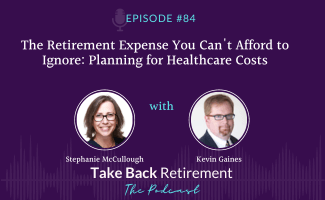
“If you’re looking at the costs of medical expenses over time, they’ve actually historically grown faster than regular inflation. Healthcare is expensive, and it goes up faster than the rest of your spending; don’t overlook it.”
Listen in as our hosts, Stephanie McCullough of Sofia Financial, and Kevin Gaines of American Financial Management Group tackle the critical yet often underestimated topic of healthcare costs in retirement. They uncover the harsh reality that healthcare expenses can become a significant financial burden if not properly accounted for in your retirement plan. Shedding light on the unpredictable nature of health and the associated costs, they stress the importance of being prepared for more than just your mortgage or grocery bills. They also debunk the common misconceptions around Medicare and long-term care.
Stephanie and Kevin explore the complexities of managing retirement funds with future taxes in mind. They highlight the strategies to mitigate the tax hit when withdrawing from IRAs and 401(k)s, and how these can impact your Medicare premiums through the Income-Related Monthly Adjustment Amount (IRMAA). Learn about the benefits of Roth conversions and how Health Savings Accounts (HSAs) and Roth accounts can be powerful tools in reducing your tax burden. They also discuss the ‘widow penalty’ in tax brackets and the need for strategic planning, especially when it comes to Social Security and the real rate of medical expense inflation. This episode is packed with insights to help you secure your financial health.
Resources:
- Request to lower an Income-Related Monthly Adjustment Amount (IRMAA)
- Take Back Retirement Episode 21: Simplifying Medicare: What’s Important For You To Know with Susan Sloan
- Take Back Retirement Episode 62: What Women Need to Know About Longevity
- Take Back Retirement Episode 27: Health Savings Accounts (HSA’s): What Women Need to Know
Please listen and share with your friends who are in the same situation!
Key Topics
- Healthcare Expenses in Retirement Planning (02:25)
- Medicare Costs and Supplemental Insurance (04:36)
- Income-Related Monthly Adjustment Amount (IRMAA) (06:58)
- Medical Expenses Planning for Retirement and Tax Implications (13:09)
- Spouses of Different Ages Who Want to Retire Simultaneously (17:46)
- Inherited IRAs, Tax Brackets, and the Widow Penalty (18:38)
- Inflation Rates and Medical Expenses (21:56)
- Wrap-Up (24:18)
Stephanie McCullough (00:00):
Let’s say you are planning for “retirement” and you’re trying to answer that eternal question, “Do I have enough? Am I going to have enough? Am I on track to have enough?” Most people’s inclination — because if you talk to a financial planner like me and Kevin there, we’re going to say, “Well, it depends, how much does life cost you?”
Stephanie McCullough (00:22):
So, when people go to answer how much life costs them, it’s like, “Oh, well, I’ve got my mortgage payment or my rent. I’ve got my cell phone bill. I’ve got my car payment. I’ve had my groceries every month. I’ve got this bill, that bill, the other bill,” there’s a big blind spot and that type of planning. And that’s what we’re going to try to fill in today.
[Music Playing]
Stephanie McCullough (00:50):
Hey, dear listeners, we need to let you know that Kevin and Stephanie offer investment advice through Private Advisor Group, which is a federally registered investment advisor. The opinions voiced in this podcast are for general information only and are not intended to provide specific advice or recommendations to any individual. To determine which strategies or investments may be suitable for you. Consult the appropriate qualified professional prior to making a decision. Now, let’s get on with the show.
Stephanie McCullough (01:25):
This is Take Back Retirement; the show that’s redefining retirement for women. Retirement is an old-fashioned cultural concept. We want to reclaim the word so you can make it your own. I’m Stephanie McCullough, financial planner and founder of Sofia Financial, where our mission is to reduce women’s money stress and empower them to make wise holistic decisions so they can get back to living their best lives.
Stephanie McCullough (01:49):
Kevin Gaines is my long-time colleague with deep knowledge in the technical stuff: investments, taxes, retirement plan rules. He’s a little bit giggy and quantitative, I’m a little bit touchy-feely and qualitative. Together, through conversations and interviews, we aim to give you the information and motivation you need to move forward with confidence. We’re so glad you’re here.
Stephanie McCullough (02:14):
Coming to you semi-live from the beautiful Westlakes Office Park in suburban Philadelphia, this is Stephanie McCullough and Kevin Gaines of Sofia Financial and American Financial Management Group. Say hello, Kevin.
Kevin Gaines (02:24):
Hello, Kevin.
Stephanie McCullough (02:25):
Kevin, what is this blind spot of which we speak?
Kevin Gaines (02:29):
I don’t know of any blind spots. I know of a big sucking black hole which might be to what you’re referring, ah this wonderful nebulous thing called healthcare expense. And part of the problem with healthcare expense is none of us know what we’re going to spend.
Stephanie McCullough (02:49):
This is true because you know, what does life have in store? And the eternal how long we going to be around to need it?
Kevin Gaines (02:57):
That’s the promise, is there’s all these unknowns. You may say today, “I’m basically healthy. I’m probably just going to just keep going along and then at some point I’m just going to drop.”
Kevin Gaines (03:08):
That’s my actual philosophy.
Stephanie McCullough (03:11):
That’s your plan.
Kevin Gaines (03:13):
That’s my plan.
Stephanie McCullough (03:13):
You’re a hundred percent healthy. And then drop it in the next minute.
Kevin Gaines (03:15):
And then it’s all of a sudden, the proverbial bus or something just takes me out.
Stephanie McCullough (03:19):
Truck.
Kevin Gaines (03:20):
In which case my healthcare expenses may not be too bad. But that’s not the path most of us get to go down. You know, most there’s a decline and as you decline, you have expenses and more and more expenses.
Stephanie McCullough (03:37):
Even if that is the path you go on, you’re not going to want to go without health insurance. Because what if as you’re going about your daily life, you trip and break your ankle, you’re going to want that health insurance.
So, even though right, we don’t know how much it’s going to cost us, but there are some estimates out there.
Stephanie McCullough (03:56):
For example, Fidelity does an annual report that they call the Retiree Healthcare Cost Estimate. So, this gives us some interesting numbers. For example, their estimate for a single person aged 65 for lifetime healthcare expenses from that point forward is – brace yourself – $157,500 after taxes. That’s kind of a lot of money and if you are in a couple, you got to double it.
Kevin Gaines (04:37):
Yes! So, this stuff is not cheap.
Stephanie McCullough (04:39):
Right
Kevin Gaines (04:40):
And that’s what we’re trying to get at is, I mean, and for the most part, that’s assuming average, it’s not hard to get above average in this day and age.
Stephanie McCullough (04:49):
Very true. Remember too, that what we’re talking about here is medical expenses. When we’re talking about Medicare and supplemental insurance and out of pocket things like you know, I like to go to my chiropractor that’s not really always covered, those kinds of things.
Stephanie McCullough (05:05):
But don’t forget that long-term care is a different category. Right, we’re not getting into that really in this episode. But if you need assistance in getting yourself out of bed, bathed and dressed, that’s not medical assistance. That’s not for the most part not covered by Medicare.
Stephanie McCullough (05:27):
For some exceptions. They cover a few days here and there after you get out of the hospital. But that’s not even in this calculation. We’re talking just traditional healthcare, going to the doctor, getting your medicines going to your physical therapist, that kind of stuff.
Stephanie McCullough (05:42):
As we know from episode 21 with Sue Sloan, Medicare is the primary health insurance for folks over age 65 in the United States. But Kevin, there’s a big misconception about Medicare. A lot of people think Medicare is free, it is not.
Kevin Gaines (06:02):
It is not free. And just to add insult to injury, it doesn’t cover nearly as much as people think or hope it will.
Stephanie McCullough (06:13):
Yeah!
Kevin Gaines (06;14):
So, without going into too much detail you know there’s, think of it as essentially three parts to Medicare. You got part A, which is your hospital, part B is your doctor, part D is your drug. Part A, actually you do get for free.
Stephanie McCullough (06:30):
So, you get something for free, yay.
Kevin Gaines (06:33):
99% of us, we get it for free. There’s a couple little glitches where you may have to pay a couple bucks. But part B and part D, there’s a premium involved.
Stephanie McCullough (06:46):
Yes, yes. You do have to pay the government for your Medicare coverage. The interesting thing is it’s kind of a sliding scale.
Kevin Gaines (06:58):
It is, Ahh! If you, you know so for 2024 when we’re recording this, the base cost for part B is roughly $175 a month.
Stephanie McCullough (07:13):
Okay, per person.
Kevin Gaines (07:15):
Per person. But then they have something called IRMAA, which is a premium if you earn over X and X for 2024 starts 206 for joint, 103 if you’re single. And so, you have to pay-
Stephanie McCullough (07:32):
$206,000.
Kevin Gaines (07:34):
Correct. So, there’s five tiers and the top tier puts you up at almost $600 a month.
Stephanie McCullough (07:43):
Just for Part B?
Kevin Gaines (07:45):
Just for part B, we’re not talking any of the other associated costs. So, that’s what you are dealing with. Now, yes, to pay $600 a month, you have to earn over $500,000 a year if you’re single. So, if you’re earning that money, $600 a month may not be a big deal.
Stephanie McCullough (08:05):
But just to you know … we’re trying to point out that you know yes, there is a cost to Medicare. So, it’s not just the Medicare cost right, I mean that’s like you pointed out Kevin, it doesn’t cover everything, so many people like to buy a supplemental policy, which we also talked about in episode 21 but give us the quick short rundown.
Kevin Gaines (08:33):
So, essentially there’s two types of supplementals. One’s called Medicare supplemental or Medigap. And you know, there’s a series of predetermined coverage that covers things that A, B and D aren’t covering. And then there’s Medicare Advantage, which we see advertised on TV all the time and that’s oversimplifying.
Kevin Gaines (08:55):
That’s basically the health insurance you have. Now they kind of roll parts A and B into it. So, a lot of times you may actually only have one premium to worry about for example. But that’ll cover a lot of the things that Medicare doesn’t. I mean, it’s dental is not covered.
Stephanie McCullough (09:12):
Yeah, vision, right
Kevin Gaines (09:14):
Vision is not covered. Yeah! There’s a lot of things that Medicare doesn’t cover that you’re probably going to want to have at least a little protection from. Because as a lifelong wearer of glasses, these things aren’t cheap.
Stephanie McCullough (09:29):
This is true. This is true. And when I finally broke down and bought my first prescription sunglasses, I nearly choked on the cost. But I do like to read on the beach, so it was a good investment. They just cost money.
Kevin Gaines (09:41):
So, the thing about IRMAA is it applies for one year only. So, what they do, so the IRS looks to see what you filed for two years ago, and they say, “Well, that’s your income.” So, this is going to be what your Medicare premium’s going to be.
Kevin Gaines (10:01):
So, if you have a one-year spike in income, you could get stuck with IRMAA for one year and then you go back down to the base rate. Or if you’re taking large distributions from your retirement accounts, then you could be having IRMAA every year. Now in some cases you are actually allowed to appeal and say, “Yeah, that was two years ago and-
Stephanie McCullough (10:25):
My situation’s very different. Why? We had one client who was making good money so that when she was filing for her Medicare for the first year, they said, “Well, two years ago you were making, I don’t remember the number $300,000, therefore you have to pay this extra charge for your Medicare,” which is what we’re talking about IRMAA.
Stephanie McCullough (10:47):
But she was able to fill out a particular form which we can link to in the show notes because I don’t remember the number of it. IRS forms always have a number and said, “Hey, I’m not making that anymore, I retired.” Right? So, my new normal is not close to that. So, she was able to appeal and get that reduced.
Stephanie McCullough (11:02):
So, if it’s a big change in lifestyle like that, you can get it changed. But these one-offs right, let’s say, Kevin, what if I win the lottery and I win a million dollars in 2024, 2026, I’m going to have higher Medicare premiums. But just for that one year is what you’re saying.
Kevin Gaines (11:21):
Right! Yeah! So, I mean, like this is a gross oversimplification. If you had control of the situation, they’re probably not going to waive it. If you didn’t have control, they’re more inclined to waive it. So, you get laid off, you had no control, IRS is going to be more open to waving it than say you did a massive Roth conversion.
Stephanie McCullough (11:45):
Yeah!
Kevin Gaines (11:45):
Or you were driving an Uber and you happened to pick up Taylor Swift and Kelce on their first date and he’s trying to impress her, and he leaves you a million-dollar tip. Hey, could have happened. You know! Again, that’s something you kind of had control over because that was income you were earning. So, maybe, maybe not, but yeah, so don’t rely on the IRS waiving that IRMAA for you.
Stephanie McCullough (12:14):
Yeah! And as with most things right, if you have a higher income and therefore have to pay more, presumably you have a higher income. So, hopefully that you can stomach it. What we’re trying to drive home in this episode is though, don’t overlook this in your planning.
Stephanie McCullough (12:33):
If all of your retirement assets are in something that has yet to be taxed like an IRA or a 401(k) plan, then you know, your taxable income each year could be on the higher side because everything you’re pulling out goes through the tax fence or whatever the metaphor is that you want to use, it’s going to be taxed. So, you could be in a higher bracket than you might think, meaning your income’s actually higher than your spendable money because of taxes.
Kevin Gaines (13:10):
Right! And, you know to pile on that, yes, we were just talking about IRMAA and you know taking this money out can increase your cost or your income for IRMAA, but it also could just put you in different tax brackets as you’re taking money out—
Stephanie McCullough (13:27):
Yeah
Kevin Gaines (13:27)
To pay for these medical expenses.
Stephanie McCullough (13:31):
Yes
Kevin Gaines (13:32):
So, there’s a couple different ways, congratulations, you saved all this money for retirement. But, you know taking that next step to say, “Which account should I be saving in?” This is one of these situations where being strategic —
Stephanie McCullough (13:51):
Yeah
Kevin Gaines (13:52):
And help you control some of your costs.
Stephanie McCullough (13:57):
And when you say be strategic, you’re talking about looking at the future taxation of your different pots of money?
Kevin Gaines (14:04):
Correct. You know, understanding, and we’ve talked about this in numerous episodes, you know understanding that you know there are tax brackets and you know taking, having large incomes is going to put you in a higher tax bracket where you’re paying more dollars on these distributions.
Kevin Gaines (14:24):
But if you have some of your savings in accounts that are taxed differently, you can keep the overall tax rate lower and still achieve the needed income to cover these expenses. And you know to be specific you know, in my mind I’m thinking Roth accounts, and HSAs health savings accounts which we spent some time talking about in episode 27, which was HSA. And Roth accounts, well, I just never miss an opportunity to bring them up in any episode.
Stephanie McCullough (15:02):
Well, dear listener, I want to tell you like these are the conversations that Kevin and I have with our clients frequently when we’re talking about the pros and cons of doing a conversion from a pretax IRA or 401(k) to a Roth, because it’s kind of painful in the year you do it, you’re going to pay tax on more income and it’s income you’re not hold on “earning” that year?
Stephanie McCullough (15:24):
But you got to jump over the tax fence, you got to pay that tax. It can be painful in the year you do it, but the benefits are down the road when you’ve got that money that you don’t have to pay tax on in “retirement”, in older ages because your income rate, your income level affects these things like your Medicare premiums and your tax brackets on the money you do take out of your 401(k).
Kevin Gaines (15:51):
Yes, exactly. And you know, the earlier you start thinking about this stuff, the more time you have to do it. For example, “Hey, I’m age 63.” Oh, you’re listening to this, you’re age 63 listening to this episode going, “Oh my gosh, I need to do this immediately. I’m going to convert my million-dollar IRA into Roth.”
Stephanie McCullough (16:11):
Ouch
Kevin Gaines (16:13):
Think back to what we just said about IRMAA, 63, that they’re going to look at you at 65 when you file for Medicare. They’re going to see you earned a million dollars. Hey, guess what? You are stuck at the top IRMAA. Start thinking about this you know mid-late 50s.
Kevin Gaines (16:30):
Do a little bit, each year, you’re going to work your way up to a bigger Roth account and possibly the tax by each year is going to be smaller, both in overall tax dollars and lower tax rates and you’re not doing it when they’re going to look at you for your Medicare surcharge.
Stephanie McCullough (16:50):
And to be clear, we’re not saying don’t do it at age 63, right. Because maybe you’re only stuck with that IRMAA surcharge, that higher premium for one year and then you go back down to a lower level. So, as always, the recommendation depends on your situation. We’re not making recommendations; we are trying to arm you with as much information so you can make informed decisions on all these different pieces.
Kevin Gaines (17:13):
Yes, that’s a great point Stephanie, that this is education.
Stephanie McCullough (17:17):
Yes!
Kevin Gaines (17:18):
Because I guarantee you there was somebody out there listening to this that doing that million-dollar Roth conversion at age 63 makes a lot of sense. I can’t come up with that scenario, but I’m sure there’s one random person out there, just like I’m sure there-
Stephanie McCullough (17:32):
Okay, let’s be honest, they might not be listening to this podcast. They’re out there in the world, we hope they’re listening, they might not.
Kevin Gaines (17:42):
And if you are, call me.
Stephanie McCullough (17:46):
Alright. Here’s another scenario though. And this happens with some regularity, that, and we did have an episode on this as well. Let’s say that spouse number one is 65, 67 retiring, spouse number two, 62 wants to retire at the same time, take advantage of the lifestyle travel, do all the things.
Stephanie McCullough (18:08):
Spouse number two at 62 is not eligible yet for Medicare. So, and that you can’t hop onto your spouse’s Medicare, that’s not how it works, it’s for each individual person. So, then you have to go buy private health insurance on your own or on the exchanges. So, that’s another expense, which we’re not saying it’s the wrong thing to do. Again, be aware, plan for it.
Kevin Gaines (18:32):
Right! There are no right or wrong answers, there’s just factors to consider.
Stephanie McCullough (18:38):
Kevin, one more thing to tie in again to a previous episode, this one’s episode 78 about inherited IRAs. Because if you inherit an IRA after 2020, you have to empty it within 10 years, which is code for pay tax on that money.
Stephanie McCullough (18:55):
So, that’s a situation where your taxable income might be bumped up kind of artificially, not really from your job earnings. Ahm so, that could hit you with IRMAA as well, right. We’ve got clients kind of where they’re balancing the inherited IRA distributions with looking down the road at their hmm potential IRMAA brackets.
Kevin Gaines (19:17):
Yes. And that’s if you inherit from your parents or somebody, but if you inherit from your spouse, you can say, “Oh, it’s no big deal because I get to take it over my life expectancy.” But remember, your tax bracket just basically got cut in half.
Stephanie McCullough (19:30):
Because of the widow penalty.
Kevin Gaines (19:33):
Because of the widow penalty.
Stephanie McCullough (19:35):
Explain that.
Kevin Gaines (19:36):
So, when you earn 200,000 as a joint couple, you may pay 24%, but that 200,000 as an individual is 32%.
Stephanie McCullough (19:47):
Ouch!
Kevin Gaines (19:48):
And going back to IRMAA, 200,000 as on a joint account you actually don’t hit IRMAA. But if you hit 200,000 as an individual, you’re actually in the second-highest bracket. So, for 24, that’s almost a $400 monthly increase.
Stephanie McCullough (20:11):
In your Medicare premium
Kevin Gaines (20:12):
Yeah!
Stephanie McCullough (20:13):
Not total, the increase.
Kevin Gaines (20:16):
And depending on you know — and that’s labeled to be a consistent number, not just a one-year spike, but well you know, how can you possibly earn the same amount if your spouse died? Doesn’t your income get cut in half? Not really.
Stephanie McCullough (20:34):
Not always.
Kevin Gaines (20:35):
You’ll lose a little in social security, you know up to one third of what you were earning as a couple.
Stephanie McCullough (20:43):
Yeah. You use the smaller of the two benefits.
Kevin Gaines (20:47):
Right. Then retirement account. So, if you’re getting a pension, maybe there’s a decrease in the pension depending on which option you selected there. But with retirement accounts, you inherit that from your spouse. You know, if you each have a million-dollar IRA that you have to take 10% out of, you inherit your spouse’s, you now have a $2 million IRA that you have to take 10% out of no change in income.
Stephanie McCullough (21:21):
Right!
Kevin Gaines (21:22):
So, don’t automatically assume that when you become single, there’s going to be this huge drop in income depending on how much and where you’ve saved the dollars, you may not see that much of a drop.
Stephanie McCullough (21:37):
Yeah! Always depends on the particulars of the situation, especially with these intricacies around retirement accounts and the taxation and, and you know these brackets and the rules and how they hit you. Kevin, we have one other piece of really good news for people.
Kevin Gaines (21:54):
Oh! Because I haven’t heard much good news here, so-
Stephanie McCullough (21:57):
Okay! I’m being sarcastic. Hmm, you know. Inflation has come back to the forefront of people’s awareness in recent years. Because we had the big spike in inflation, but even you know, before that was out there, the inflation rate, how costs go up year to year varies by what you’re buying.
Stephanie McCullough (22:20):
And some of the things that are actually higher than average are higher education, college and medical expenses. So, if you’re looking at the costs of medical expenses over time, they’ve actually historically grown faster than regular inflation.
Kevin Gaines (22:38):
But Stephanie, we get COLA adjustments on our social security, doesn’t that cover this?
Stephanie McCullough (22:44):
Cost-of-living adjustments on your social security? Ahh, nope. Because your cost-of-living adjustments on social security are based on regular overall inflation. And if that’s, what would you say a long-term average is Kevin? Two and half percent-ish, three percent-ish.
Kevin Gaines (23:04):
What the hell? Three and a half.
Stephanie McCullough (23:06):
Okay! To, to you know overestimate say three and a half percent, but the financial planning software I use for healthcare costs, they use an inflation rate of 6.3%, almost double. So, yeah, healthcare is expensive, and it goes up faster than the rest of your spending; don’t overlook it.
Kevin Gaines (23:33):
And just to throw a little health policy out there to everybody, keep in mind America in general is getting older, which means there’s more demand for healthcare.
Stephanie McCullough (23:47):
True
Kevin Gaines (23:48):
And as a proud graduate of ECON 101, I learned the more demand there is for a product, the more the supplier’s rate can raise the cost of it.
Stephanie McCullough (24:01):
The less the supply, right. The shortage of nurses and healthcare workers also drives the price up.
Kevin Gaines (24:08):
Six and a half maybe. Is there potential for it to be higher? Let’s just say we can come up with a scenario or two where that would happen.
Stephanie McCullough (24:19):
So, dear listeners, we are not trying to freak you out. We are not trying to send you into a panic spiral. But as always, we’re just trying to bring things to your awareness so that you can make good planning decisions so that you can be informed as you look forward and think about where your dollars might be going and where you might want to put them in preparation.
Kevin Gaines (24:47):
Right! So, I mean, Stephanie, really what we’ve said here today is don’t overlook healthcare costs.
Stephanie McCullough (24:54):
Yup!
Kevin Gaines (25:55):
Be realistic about healthcare costs. And be strategic about where your savings to increase the power of that savings.
Stephanie McCullough (25:06):
Because it is a real piece of the puzzle for all of us. You know, even if you subscribe to Kevin’s plan of be healthy, be healthy, be healthy, be gone, you’re still going to have healthcare expenses, Medicare expenses hmm and as we said you know, lots of us don’t have that privilege. So, we do have to think about other expenses down the road. Kevin, you’re still going to need glasses every couple of years in your healthy old age.
Kevin Gaines (25:32):
Yeah, I know it. Gosh darn it.
Stephanie McCullough (25:37):
Even if you do the lasik surgery or something.
Kevin Gaines (25:40):
Ooh, LASIK, yeah. Because you know, that doesn’t cost anything.
Stephanie McCullough (25:48):
Exactly. Dear listeners, we hope this is helpful to you. Please share it with a friend, please leave us a review on your podcast app. Thanks so much for being with us, we’ll talk to you next time. It’s goodbye from me.
[Music Playing]
Kevin Gaines (26:00):
And it’s goodbye from her.
Stephanie McCullough (26:05):
Be sure to subscribe to the show and please share it with your friends, show notes and more information available at takebackretirement.com. Huge thanks for the original music by the one and only Raymond Loewy through New Math in New York. See you next time.
Voiceover (26:20):
Investment advice offered through Private Advisor Group, LLC, a registered Investment Advisor. Private Advisor Group, American Financial Management Group, and Sofia Financial are separate entities. The opinions voiced in this material are for general information only and are not intended to provide specific advice or recommendations for any individual security. To determine which investments may be appropriate for you, consult your financial advisor prior to investing. This information is not intended to be substitute for individualized tax advice. Please consult your tax advisor regarding your specific situation.