Take Back Retirement

Episode 79
Small Steps, Big Impact: How Prioritizing Self-Care Transforms Your Finances with Emi Kirschner
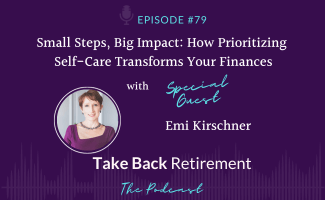
Guest Name: Emi Kirschner
Visit Website: emikirschner.com
“You have a choice about everything, and not choosing is still a choice. Prioritize yourself and ask for what you need.” – Emi Kirschner
What if you were told that self-care isn’t just an indulgence, but a key player in achieving personal and professional success? Our hosts Stephanie McCullough and Kevin Gaines chat with Emi Kirschner, a seasoned investor, serial entrepreneur, and coach to women business owners.
They pull back the curtain on the issue of avoidance, especially when it comes to financial planning and essential self-care, and share insights about why we often avoid these important tasks and how changing our mindset can lead to a transformation in our personal and business finances. Emi shares some pearls of wisdom about the power of self-care and its direct impact on productivity and clarity.
Stephanie, Kevin, and Emi then tackle one of the most challenging topics – the taboo around financial conversations. They share personal experiences and insights on breaking societal norms and approaching these conversations with curiosity rather than apprehension. Tune in for an episode that challenges norms, encourages curiosity and most of all, prioritizes self-care!
Resources:
Please listen and share with your friends who are in the same situation!
Key Topics
- Intro to Self-Care and Finances (02:42)
- Breaking Down Financial Tasks into Manageable Steps (05:10)
- Overcoming Overwork and Finding Balance (09:56)
- Work-Life Balance and Productivity (15:01)
- Prioritizing Self-Care and Inner Knowledge for Success (19:19)
- Financial Planning, Avoiding Procrastination, and Breaking Taboos (24:16)
- Overcoming Limiting Beliefs and Taking Control of Finances (30:09)
- Self-Care, Mindfulness, and Financial Wellness (36:05)
- Wrap-Up (36:43)
[Music Playing]
Stephanie McCullough (00:06):
This is Take Back Retirement, the show that’s redefining retirement for women. Retirement is an old-fashioned cultural concept. We want to reclaim the word so you can make it your own. I’m Stephanie McCullough, financial planner and founder of Sofia Financial, where our mission is to reduce women’s money stress and empower them to make wise holistic decisions so they can get back to living their best lives.
Stephanie McCullough (00:30):
Kevin Gaines is my longtime colleague with deep knowledge in the technical stuff: investments, taxes, retirement plan rules. He’s a little bit nerdy and quantitative, I’m a little bit touchy-feely and qualitative. Together, through conversations and interviews, we aim to give you the information and motivation you need to move forward with confidence. We’re so glad you’re here.
Stephanie McCullough (00:54):
Coming to you semi-live from the beautiful Westlakes office park in suburban Philadelphia. This is Stephanie McCullough and Kevin Gaines of Sofia Financial and American Financial Management Group. Say hello, Kevin.
Kevin Gaines (01:05):
Hello Kevin.
Stephanie McCullough (01:07):
I am thrilled for you to hear this conversation that we have with my friend Emi Kirschner. Emi is an investor, a serial entrepreneur, and a coach of women business owners. She also hosts the Women Who Build Empires Podcast, which has been going on significantly longer than our podcast, so she knows what she’s doing.
Stephanie McCullough (01:26):
Her mission is to empower women entrepreneurs in reaching beyond seven figures by helping them build more profitable businesses that create the change they want to see in the world.
Stephanie McCullough (01:36):
She combines her deeply intuitive abilities with her analytical sense, which is a great combination, plus her 12 plus years of entrepreneurial experience. She guides clients to become the best versions of themselves, growing connected teams and building authentic sales.
Stephanie McCullough (01:52):
When she isn’t working, you can find Emi sipping coffee and wearing flip flops where she lives in Charlotte, North Carolina, or seeking sunshine and visiting beaches up and down the east coast. Let’s dive into our great conversation with Emi.
Stephanie McCullough (02:09):
Emi Kirschner, welcome to Take Back Retirement.
Emi Kirschner (02:12):
Thank you. I am so super excited to be here.
Stephanie McCullough (02:16):
Well, I love talking to you because we’ve known each other for a long time. You are such a pro at what you do, and you’ve been a podcaster for a long time.
Emi Kirschner (02:23):
Yeah, for almost five years.
Stephanie McCullough (02:25):
That’s amazing.
Emi Kirschner (02:26):
It is amazing. It is. I think at least my experience is everybody that I get to talk to is so cool and I love hearing the stories and just meeting amazing people.
Stephanie McCullough (02:39):
Well, you are one of our amazing people and what we wanted to focus on today is this phenomenon that’s kind of part of the human condition, at least I think, which is we tend to avoid the stuff that we know we kind of should do. And maybe the word “should” is part of it, but things like looking after our finances or even just the self-care aspect of doing the things that are good for us.
Emi Kirschner (03:06):
Yeah.
Stephanie McCullough (03:07):
Do you see this and why do you think it might be?
Emi Kirschner (03:09):
All the time. I actually just had this conversation with a client more on the self-care and sleeping end of it. But it shows up in her money, her money strategies too, where she’s thinking that she’s being more productive by working later and working more and not sleeping.
Emi Kirschner (03:28):
And I explained that was not how our bodies work. And she was a little resistant. She’s like, fine. I got the, “Fine, I’ll do it if you’re going to make me.” I’m not making you do anything, highly recommend. This is my experience. And she texted me four days later and was like, “Oh my God.” She’s like, “I have a whole new level of clarity. I can think differently,” because she slept for more than six hours, so-
Stephanie McCullough (03:57):
In just four days.
Emi Kirschner (03:59):
Yeah, yeah. And she had this lingering cold for weeks and weeks and weeks, and she’s like, I’m completely healed. I feel great. I can do my work in less time. So, some of those little self-care things are really important. And it’s how I like to set up my clients’ days is taking care of yourself, taking care of your family, whatever other important thing.
Emi Kirschner (04:23):
And then business works into those things. And I’m not saying that that doesn’t mean that there aren’t times that business or work is the predominant thing that you’re doing, and there’s a shift there. But if your general way of being is to take care of you first, you’re going to have better results in everything else that you’re doing.
Emi Kirschner (04:46):
And from a money standpoint, and I think any of the things that we think that we should, and I’m air quoting here for all the listeners, it’s scary. And I think there’s a lot of self-judgment. What if I don’t know, what if I get it wrong? How am I going to be perceived by other people? Maybe I should have figured this out a lot sooner. What if I don’t like what I see?
Emi Kirschner (05:12):
And that’s a lot, that’s a lot of pressure to put on yourself. And I can guarantee that nobody in your sphere is judging you the way you are judging yourself. And nor are they thinking about you as much as you are thinking about whatever it is.
Emi Kirschner (05:30):
And the way I like to look at things that make me uncomfortable, and I’ve done this in my money journey as well, is to start digging in. And every time that that discomfort comes up or guilt or shame or whatever you’re experiencing, is to remind myself that I get to do this and take this on newly.
Emi Kirschner (05:53):
And right now, I’m only taking in information. There’s no good, there’s no bad, there’s nothing to be feeling badly about. It’s just information so you can make better decisions and different decisions as you move forward.
Kevin Gaines (06:10):
Do you find that as a really great way to get people to change their mindset is to just say, “Hey, step one, it’s just collecting the data, so we don’t have to do anything with it.” So, you don’t have that pressure. Is that where the success comes from?
Emi Kirschner (06:28):
Yes, absolutely. So, when I’m having that conversation, because my clients in business ignore their business finances as much as they ignore their personal finances. So, it’s one of the things, as a coach that I love to delve into and make sure that they’re a little uncomfortable and they’re starting to take it on so that it’s like relief almost.
Emi Kirschner (06:52):
I don’t have to do anything; I just have to look and see what’s there. And sometimes they’re like, oh my goodness. Things are so much better than I thought and that’s really awesome. And now I feel like I can take another step. So, there’s no pressure. We’re breaking this big, gigantic, looming thing into a tiny little baby step.
Emi Kirschner (07:14):
And then we just baby step and baby step and baby step. And I have a client who, I mean, had completely avoided her business finances. I said spreadsheet. She pretty much passed out and KPIs. And she was like, what?
Kevin Gaines (07:28):
Real fast. KPIs, what are they?
Emi Kirschner (07:32):
So, they are key performance indicators and businesses use them. Although you could make up KPIs for your personal life, anything from habits to money and everything in between, and don’t go overboard. But they’re metrics that are used to measure success in a business.
Emi Kirschner (07:57):
So, I took the pressure off, I made it so that it was a neutral experience. There was absolutely nothing she could mess up. And within a couple of months, she was creating new KPIs in the spreadsheet that she had made all by herself and coming to our calls with, “Hey, I did this thing and I’m looking at it this way. And I think that if I make these little tweaks with some of my staff that we can increase our revenue by X, Y, and Z.”
Stephanie McCullough (08:23):
And that was a total 180 from who she had been before.
Emi Kirschner (08:27):
Then … please don’t make me look, everything’s been fine for the last 10 years, so why should I do it differently? And it’s really cool for me to see somebody going from really scared and nervous and afraid to being empowered and making really cool choices. And that ripples out into other areas of life, just like sleeping.
Stephanie McCullough (08:53):
I think so, I know that journaling is good for me, and I feel good when I do it, and I still tend to avoid it. And I think part of it is this voice in my head like, well you’ve only done it twice in the past three months. Like, oh my gosh, you’re a terrible person. And picking up the journal brings that voice up.
Emi Kirschner (09:13):
Yeah, yeah. Or I think you get into like half of the routine and you’re like, “Well, I’m doing well enough, so I don’t need to do this anymore.” I’ve certainly done that. And then I fall back into whatever less beneficial habit and I’m unhappy about whatever and I’m like, it doesn’t even occur to me to go back to do the thing that was working and restart. And I think that’s human nature.
Stephanie McCullough (09:44):
When things are going well, why do I need to do this self-care stuff?
Emi Kirschner (09:48):
Exactly. And they say it takes like three weeks to create a new habit. I think it takes six months to a year to really have it become part of your identity. And when I’ve broken that down for my clients too, particularly in self-care and in finances where we’re just taking those little baby steps and sometimes, they’re right on and sometimes we have a little setback knowing that we’re just going to get back on the horse and continue to move forward until it becomes part of the identity where you don’t think about it.
Emi Kirschner (10:23):
And I know a lot of people use the example of if you were in a bar and somebody offered you a cigarette and you’re not a smoker, you wouldn’t even think about it. So, that’s like your identity is not a smoker. As being somebody who invests or saves their money. You may not identify as that until you do it for X amount of time where you just, I’m an investor, I’m a saver. I’m somebody who prioritizes working out.
Kevin Gaines (10:50):
Now, one of the problems I know people have when it comes to self-care, taking time to do the holistic stuff they should be doing is like, especially small business owners, but even people who are responsible for managing their family is the attitude of, yes, but I’ve got all these other things to do and I’m the only one who can do this. Or I’m the only one who will do this. How do you get over that mindset? Because frankly I have that.
Emi Kirschner (11:23):
Well, it is a mindset and it’s a mindset that keeps you stuck and in a cycle of overwhelm, confusion, exhaustion, burnout. And I think there’s a couple of layers there. I think big picture, that’s the way our society in the U.S. operates right now.
Emi Kirschner (11:41):
And it’s what’s been created. And the only way to stop it is to stop doing it. Because we don’t have to operate that way. It’s just that’s-
Stephanie McCullough (11:53):
But we think we do.
Emi Kirschner (11:54):
Right. Because that’s the way we’ve been taught and raised and culturally what’s been accepted, it’s like you’ve got to work harder. And it’s really interesting for me because some of the most successful people that I know and work with work 20 to 30 hours a week. And their businesses are growing, they’re making a ton of money and they’re happy and fulfilled. So, I know it can be done.
Emi Kirschner (12:22):
So, it’s looking at what are your priorities and what do you delegate? Which is really easy to say. And as somebody who, my family, both my parents at this point, my kids a lot less, but on occasion. And my sister and my brother all rely on me and it’s easy to get sucked into the sure, just give it to me because I’ll get it done thing. Or they seem to be struggling with it. So, I’m like, “Oh, well I know how to do that.”
Emi Kirschner (12:53):
Sometimes giving it back to the person or delegating it is really helping them grow in a way that you’re not thinking about. So, I have to be very intentional with what I take on. And that’s, for me, been really, really helpful. And I have seen that particularly with my kids too when they were younger. It’s really easy to do all the stuff because they don’t know how to do it and they’re going to fumble through it.
Emi Kirschner (13:19):
And I really tried to create a space to step back and let them fail forward in a place where I could guide them and catch them so that they were prepared when they decided to fly the coop, if you will, and adult on their own at a much younger age than most kids are today and doing so successfully.
Emi Kirschner (13:41):
So, it’s not easy, but I think it really is, what do you want to choose? The paradigm of overwork and burnout or finding some rhythm that works for you and then being okay with experimenting. Like be curious. So, I teach a lot of time management, calendaring, planning, and then how to make everything fit in your day and time blocking and putting those things that are personal to you, like working out, like meditation, like lunch, going for a walk, any of those really simple things in your calendar.
Emi Kirschner (14:21):
So, you’re making commitments, being in integrity with yourself. And people will send me their calendars, it looks great. And then they’re like, well, that whole week went awry because so and so did this. And then this happened, and the dog threw up and they forgot lunch and my partner needed this.
Emi Kirschner (14:43):
And the one thing that they don’t include — well there’s two pieces. One is having just some open space time to move things around because just because you time block doesn’t mean it’s set in stone. Keeping that kind of detective hat that on so that you’re curious about, well, what worked, what didn’t work? Where is my energy level? How can I do this a little bit better? What space do I need to or do I want to include? And am I cramming three weeks of stuff into one day, which most of us are.
Stephanie McCullough (15:17):
Yes. My list is like 75 things long.
Emi Kirschner (15:21):
Yeah. It’s three, three things. If you get three things done in any day, you are good. That’s it. And I like Andrew Huberman and I think it’s the Huberman Podcast. He talks a lot about health and wellness. One of his episodes a while back was about productivity and brain function. And we really only have two 90-minute blocks of deep focus time in any given day.
Emi Kirschner (15:50):
Some people can add a third, but you’ve got to be on your game that day. And that’s how he sets up his day with a 90-minute block in the morning, 90-minute block in the afternoon to do really deep meaningful thought work. And then everything else in between is his routine, his self-care, admin stuff, maybe some meetings, et cetera.
Emi Kirschner (16:16):
So, think about what works for you from an energy standpoint. Are you a morning person? Are you a night person? When do you do your best work? Because for me at least the, you’ve got to get up at five o’clock in the morning or four o’clock in the morning to have the best day and be successful is not true. Everybody has a different circadian rhythm.
Stephanie McCullough (16:39):
This is true. Kevin gets up super early and is at his desk at like six. And I roll in around 8:30 or 9 and leave at six or seven.
Emi Kirschner (16:48):
My girlfriend gets up at 4:30 and she loves it. She’s so excited. And I am rolling out of bed at 6:30 to 7. And don’t talk to me for a while.
Stephanie McCullough (16:59):
Right, yeah. So, I want to go back to a word you used a minute ago. You said choose that we could choose not to kind of live in this culture of burnout or kind of buy into that we all must work harder. And that’s our … well, now I’m going to add my own words. That’s the definition of being a good person. But I don’t know that a lot of us see it as a choice. We absorb it, we accept it, it’s just the way it is. But you’re saying that’s not true.
Emi Kirschner (17:29):
I’m going to challenge everybody who’s listening to let it sit with you that you have a choice about everything and you’re not choosing as a choice.
Emi Kirschner (17:39):
Yeah. Your work environment, your personal environment may have a lot of structure to it. And there’s always a place to make some shift where you can prioritize yourself and get what you need. It’s a function of identifying it and then asking for it.
Stephanie McCullough (17:57):
Asking for it from others or from yourself.
Emi Kirschner (18:00):
Both. Am I okay with making this change? Or do I want to stay in unhappiness or exhaustion or whatever else you want to add in there? Because that exhaustion piece is serving you some way even though you don’t like it.
Stephanie McCullough (18:18):
This is true. Yeah.
Emi Kirschner (18:20):
Yeah. And maybe it’s not time to let go of that piece right now because it is too scary or it’s too big. But you may be able to choose something else that serves you and fills you up in a better way. But I feel really confident that I could talk to a hundred different people and help them in some small way, have better habits, feel good to them within the constraints that they have and the obligations and the responsibilities and give them more time.
Kevin Gaines (18:51):
But that’s interesting. Because I mean, I think we all know whether we identify it in ourselves or not, but we all claim, we know somebody else who always seems to, as we may throughout — they thrive in the chaos. If everything isn’t going nuts around them, they feel lost or if you’re not exhausted from going 20 different directions, you don’t feel like you were productive, you feel like you failed. It’s like, “I was slacking that day.”
Emi Kirschner (19:19):
Right. Because you’ve bought into a belief that you have to be exhausted, exhausted, burned out, and chaos equals success. Which isn’t necessarily true because there’s plenty of people who are not exhausted, burned out and working in chaos that have incredible success.
Emi Kirschner (19:37):
And then I would even ask, well how are you defining success? A lot of us think money equals success. Even if we say that it doesn’t, that that’s not it. A lot of us, if you really drill down are going to say, well, money equals X, Y, and Z for me, which then equals success.
Emi Kirschner (19:57):
And if you pull back and start looking at what’s really a priority for you, relationships come up. Health and wellness come up. But we’re not taught to … I mean, you think about even in school like gym or PE or whatever they’re calling it now, it’s one tiny little leftover thing and we’re supposed to be sitting at desks all day.
Emi Kirschner (20:18):
Which isn’t how the human body works naturally. We’re supposed to be up and moving around and mobile. So yeah. There’s a place for a little shift for everybody.
Stephanie McCullough (20:30):
Well, and the exhaustion, burnout, and chaos, if we’re defining that as success, it’s not very sustainable. Because it’s certainly not good for our health.
Emi Kirschner (20:39):
No, no. And you hear it everywhere. Everybody talks about so and so is overwhelmed in this chaotic world. So, then you’re hearing it reinforced into your brain unconsciously, but then it’s easier to lean in to, well that’s what I have to do because we all want to be part of the group whether we think about it or not. And we all want to be accepted.
Emi Kirschner (21:08):
So, yeah. I really challenge everybody, figure out one little thing where you can take care of yourself and have more energy – and it doesn’t have to be what everybody else is doing.
Stephanie McCullough (21:22):
Yes. Say a little bit more about that. Because the marketers want us to believe that self-care is new skin lotion that costs $300 and a massage and things that cost money.
Emi Kirschner (21:34):
Yeah, yeah. So, just sitting quietly, if you can’t sit quietly with no phone, no TV, no music for 20 minutes, half an hour, and that feels really uncomfortable for you, I would practice doing that even if it’s once a week. Because you’re so used to that stimulation coming in and that’s part of what’s keeping you in the chaos.
Emi Kirschner (21:58):
So, one of the things my son started doing as part of his success routine is he sits for an hour with nothing. I don’t think he’s doing it every day right now, but he was for a while. And he does do it a couple times a week. And then we both will do whole weekend digital detoxes.
Stephanie McCullough (22:17):
Nice.
Emi Kirschner (22:17):
And it’s really hard at first because you’re like, what do I check? What do I check? What’s on Instagram? Who do I talk to?
Emi Kirschner (22:27):
And then when you can sink into past the discomfort and you are past this place too of where your thoughts are kind of all over the place and scattered and oh my God, this feels really uncomfortable. The next phase of that for me at least is creativity and peace and quietness of your mind. And that’s where I can solve a lot of my challenges. Like, “Oh, now I see.”
Stephanie McCullough (22:55):
Yeah. Whereas we’re taught the solutions are go, go, go research, research, talk to more people, try more things, as opposed to getting quiet and tapping into your own self-knowledge. Do you think that’s what’s happening?
Emi Kirschner (23:10):
Yes, absolutely. Like for me and other people I’ve talked to who have similar practices, we have all the answers within ourselves. And when you’re listening to that, you’re going to be so much more aligned in everything else that you’re doing.
Emi Kirschner (23:28):
We’ve been taught to look outwards and while there’s lots of great information out there, when you start tapping into who you are as a person and what’s going to serve you and your mission in life and who you want to be and who you want to be remembered as, all of those answers are inside, and they don’t come out instantaneously.
Emi Kirschner (23:51):
So, I’m not saying go sit there for half an hour and the meaning of life is going to come to you. If you do it as a practice, even once a month, things will shift for you.
Stephanie McCullough (24:01):
Well, and those are all the questions we ask people before we help decide what they should do with their money. Because the money’s just a tool for all of those things. And if it’s not aligned, then that causes stress and probably gets you in the wrong place.
Emi Kirschner (24:16):
Right, yeah. And for me, that’s super fun to think about because once I’m like, well, I want this and I want that and this is really important, then I can plan my money around that.
Stephanie McCullough (24:27):
Yes.
Emi Kirschner (24:27):
So, and I like that. It doesn’t matter whether or not it actually happens for me, it’s more the being creative and I will share, I’m a nerd about having like all my estate planning done and I have an elaborate party planned and fireworks and budget.
Emi Kirschner (24:50):
And I know that conversation makes a lot of people uncomfortable. And for me, I’m like, “Well, I’m going to be dead, so it doesn’t matter what happens,” like my kids or whoever will take care of whatever that needs to be taken care of.
Emi Kirschner (25:06):
But I get to play with right now how I think I want it to look and what I don’t want to have happen. So, there’ll be no yellow flowers and we’ll be having a blast, so-
Stephanie McCullough (25:18):
It is easy to avoid. We’re often on the podcast, figuratively shaking our fingers at people, even just to do update their will and talk to their family and their parents about where is their stuff and what are their intentions, what do they want? But that’s one of those things that’s easy to avoid.
Emi Kirschner (25:34):
I will say one of the best things my parents taught me was to have those conversations proactively. And they started, I think when I was even in my 20s, having those conversations of, “Hey, we just want to let you know there’s nothing to worry about. We’re making these plans, and we want you to be a part of them.”
Emi Kirschner (25:53):
Which was great because then I start to have education about that. And that’s part of what I’m giving to my kids in a different way because I’ll text them randomly. I’m like, “By the way, add this to my death party.” And so, it’s a joke and they’re like, “Yes, Emi, whatever,” with an eye roll. But there’s education in there. And it also normalizes the conversation. That’s part of, I think one of the biggest challenges with money and self-care is we don’t talk about it.
Stephanie McCullough (26:28):
Right. Totally.
Emi Kirschner (26:30):
We’re uncomfortable about whatever we’re uncomfortable about and we think people are going to judge us. And I think that’s one of the reasons why people don’t invest in advisors like you is because they think you’re going to judge them. Which is so not true. And at this point, I mean, you’ve seen it all.
Stephanie McCullough (26:49):
This is true.
Emi Kirschner (26:51):
It’s just education and then making choices. What do I want? And even if your portfolio or your savings isn’t that big, you can still think about what you want. And play with it because that focus also then creates it.
Kevin Gaines (27:08):
One of the weirder conversations I have with clients is they say, “I know I’m not supposed to talk about this.” So, it’s not that they have an issue with it necessarily, but they have this perception that society says, oh, you’re not supposed to talk about this.
Kevin Gaines (27:26):
And there’s a step. It’s like, who cares? You want to talk about it, let’s talk about it. Yes, we’re saying you should talk about this with your kids or with the rest of your family or whatever. And they’re like, they don’t necessarily have a hang-up on it, but they feel like they’re supposed to. In your conversations, how do you get around society? I guess is how I’ll phrase that.
Emi Kirschner (27:54):
Yeah. So, I just start normalizing the conversation like, “Hey, well I’m happy to talk about it with you too. And I really don’t care what everybody else is saying. So, if you want to have a conversation with me, great. And if you don’t, okay. And if you do later, I’m here.”
Emi Kirschner (28:08):
For me, I like to talk about these things because I find it interesting. Everybody’s perspective is a little bit different. Everybody’s way of doing it is a little bit different. I get ideas and knowledge from other people.
Emi Kirschner (28:26):
So, I think when you start making it okay for people to talk about it then, and again may not be in that moment, but then it becomes more normal. So, like the client I was telling you before we recorded, when I said she was not really paying attention to her business finances and was very uncomfortable with spreadsheets and KPIs, we broke it down into that baby step.
Emi Kirschner (28:52):
And then over time, because I kept the conversation open and it wasn’t a one-time thing, she became empowered and then started creating her own stuff. And now is completely rocking and still learning. There’s still a lot of learning for her to do.
Emi Kirschner (29:09):
But I think it’s for those of us who are in a space to help people have difficult conversations, financial or otherwise, particularly in places where the general idea is that you don’t talk about money is to hold that space open and say, “Hey, we’re here to talk about it and be open about there’s no judgment.” And make it okay. And people will come eventually and maybe they have the conversation with somebody else and you don’t even know about it. And that’s okay too.
Stephanie McCullough (29:43):
That’s okay.
Emi Kirschner (29:44):
But for me, if we don’t talk about it then it’ll never be okay.
Stephanie McCullough (29:48):
And that’s what I hear so many women come to me, they feel this shame like, “I should have it figured out. I’m a terrible person because I’m the only one who’s such a mess.” And I think to your point about baby steps, they think like, oh, I have to figure it all out tomorrow as opposed to just, I have to dip my toe in and start.
Emi Kirschner (30:09):
And taking those actions gives you the momentum to keep going and the motivation even. Some people wait for the motivation. I think taking the action gives you the motivation.
Emi Kirschner (30:21):
Yes, yes. And there’s also another limiting belief that I think a lot of women have of, I’m not good with numbers and I’m bad at math. And I mean, for me, it took me a really long time. And Stephanie, I think you know Amy Anderson.
Stephanie McCullough (30:36):
I do.
Emi Kirschner (30:36):
She — have a really good sit down with me one time, because I was told in fifth grade by my math teacher that I was terrible at math and that I would never be good at math. So, that’s what I-
Stephanie McCullough (30:49):
Yeah.
Emi Kirschner (30:50):
That’s how I then fulfilled that. And in college I took business statistics and I started to understand that I actually could do math and I liked it. And it wasn’t until Amy, and I were coming back from a retreat that we had both been at for, with the business coach we were working on. And I was like, “I’m not good at my numbers.” And she was like, “Emi, yes you are. You just sat around a table with 10 other women and were doing their numbers in your head.” And I was like, “Oh, okay.”
Stephanie McCullough (31:24):
But you need that perspective, someone else outside to break through those old beliefs that you had.
Emi Kirschner (31:29):
Yeah. And that really hit me and landed me. And that was probably seven or eight years ago. So, and several years in business. So, it really landed with me, and it changed how I did everything.
Kevin Gaines (31:48):
So, Emi, you’re talking about changing your mindset and realizing, for example, oh I actually am good with numbers, et cetera. Now earlier in the conversation we were talking about as we were starting a new task, starting to start new habits, some of this the first step is really just taking in the info.
Kevin Gaines (32:05):
And when you hear that phrase taking in info, at least I think well numbers or data or something concrete. But could that also be taking in, well like I said, the acceptance of oh, I actually am good with numbers. That’s part of that first step of changing your mindset. Would you think that that kind of connects?
Emi Kirschner (32:28):
It does. And I think that’s more of an acknowledgement. So, the info would be, for me is more tangible. So, it’s like looking at your accounts and really practicing the neutrality of the information and not assigning an emotion to it. And then the next step for me is even then getting into the, oh, I am okay with numbers. I can do this. And you want to find something that you’re unconscious feels okay with when you’re having that conversation with yourself too.
Emi Kirschner (33:06):
So, if you’re looking at your finances in totality for the first time in a really long time and what you see is not what you like going with, I’m a rockstar at money isn’t going to fly with your unconscious and then you’ll continue to make choices that aren’t going to benefit you. And if you look at your accounts and you don’t see what you would like to see, then I think it’s really becoming in the place of curiosity again, well how can I make this a little better? What would help me be a little better at money or anything else?
Emi Kirschner (33:47):
And then comes the acknowledgement of, oh hey, I can do this and it doesn’t hurt. So, it’s the next thing. It’s like, oh, it’s going to be so hard. It’s like, let me run for the first time and I’m just going to sign up for a marathon and really let my body break down. Maybe I’ll just start with a mile.
Stephanie McCullough (34:06):
And then I think congratulating yourself, “Hey, I did the mile, or I looked at the numbers and I didn’t die. The world didn’t end.”
Emi Kirschner (34:14):
The world has not … whatever. And I looked at it and it’s okay. And I had that happen with a client, like she had avoided everything for years. And I’m like, all I’m asking you to do is open up your checking account and look at it. And yay, once you do that. And again, same thing, she came back and she’s like, “I did a budget.”
Stephanie McCullough (34:40):
Which is like steps beyond. Yeah, yeah.
Emi Kirschner (34:44):
So, it can be a lot of fun. I think money is so much fun.
Stephanie McCullough (34:50):
Not many people we talk to have that attitude. What makes it fun for you?
Emi Kirschner (34:55):
I mean, I am a lifelong learner, so that’s some of it. There’s always something to learn. There’s a lot for me of empowering moments when I’m doing the things that I set goals on that I’m meeting. I love being able, when I have X, Y, and Z, I get to do blah, blah, blah. Or one of the things I’ve been playing with now is every time I spend money or choose not to spend money, because there are moments when I’m like, “Hmm, I really want that just because I want it and do I get it or not?” And I’m like, “I didn’t buy it. That’s awesome. Yay me.” There’s so many ways to just play with how you feel about it and the choices that you’re making that then reinforce really what you want.
Stephanie McCullough (35:40):
Yes, yes. And you have to first get clear on what you want.
Emi Kirschner (35:45):
Yeah. And people don’t think about that. You kind of get set in, it’s like, this is the way it’s supposed to be. And it’s just like you don’t have to be exhausted and burned out every day and do more and more and more. That’s a choice. You can choose to play with and create whatever you want with your money.
Stephanie McCullough (36:06):
Yeah. You’re in control. Love that.
Kevin Gaines (36:12):
Emi, this has been a great conversation. Appreciates your time. Where can people find you? What can we learn more about what you do?
Emi Kirschner (36:19):
Absolutely. Well, first of all, thank you. I’ve enjoyed this conversation so, so much. And everybody can find me on my website, which is emikirschner.com.
Stephanie McCullough (36:29):
Excellent. We’ll certainly link that in the show notes. And thanks for being with us.
Emi Kirschner (36:36):
Thank you for having me. I so appreciate it.
Stephanie McCullough (36:37):
Absolutely.
Kevin Gaines (36:38):
Thank you.
[Music Playing]
Stephanie McCullough (36:42):
Even though Emi really focuses on working with women business owners, so much of her wisdom is applicable to all of us. I really enjoyed the concept of being curious, but then experimenting, playing with things to see what’s going to work for each of us personally. If I know that I really should be sitting down with my journal more often because it does help me, instead of beating myself up for not doing it, setting myself little experiments, playing around with what’s going to work and noticing feels like a much lighter way to take that on as opposed to beating myself up about like, oh, you got to do the journaling because then it feels like a chore and then I avoid it.
Kevin Gaines (37:28):
Well, and that was actually one of the most important things I thought she said was talking about experimenting. Because it’s hard to do because you have fear of failure or comfort in what is already working. And how often are we willing to say, well, what if we just try something different and we’re not talking big things either here, just change something up and see how it works for you. And if it doesn’t work, fine, it doesn’t work. Go back to what it was.
Stephanie McCullough (38:01):
Right. Or try something different.
Kevin Gaines (38:03):
But yeah, I mean if you don’t try something different, then how are things going to step up for you?
Stephanie McCullough (38:10):
Right. And I feel like all of us have some area in our lives where we’re trying to improve something. But I think the bigger kind of structural issue that she addressed was kind of the cultural messages that we get and that we live in. And her point that we can choose, we have a choice whether we want to keep living in that belief that exhaustion and burnout and chaos is okay. Not only okay, but actually what we’re going for. We can choose to opt out of that whole belief and make different lifestyle choices that put us in a different place. I think often it’s not even obvious that it is a choice.
Kevin Gaines (38:57):
The other big thing I took away, Stephanie, was when she was talking about you’re developing these new habits, the first step is taking in the info. Don’t do anything. It’s just survey the situation, what is out there, what am I really dealing with? And then from there you can make decisions or deal with fighting the shame or embracing the change or whatever. But the first step is just figure out what you’re dealing with.
Stephanie McCullough (39:26):
Yeah. And I love her perspective that money can be fun. She thinks money is fun. There’s a different thing from what we normally hear. It doesn’t have to be this heavy, serious thing. How can you set yourself little experiments, little rewards, little attagirls. Like, “Hey, I didn’t spend money on that thing that I was thinking I was going to go. Way to go. That’s amazing.” Little things that can really over time change our behaviors.
Kevin Gaines (39:55):
Absolutely.
Stephanie McCullough (39:55):
And I think I’m going to have to try just sitting in quiet with a digital detox. Because if I sit quietly, I’m going to pick up my phone or I’m going to pick up something to do or a book. Because I feel like I’m being idle, and idleness is not good. Did anyone ever say that to me in my life? I don’t know. But somewhere it’s a belief in my brain. So, that would be an interesting experiment.
Kevin Gaines (40:20):
Well, I should have asked this question of her, and I failed. What happens if you fall asleep?
Stephanie McCullough (40:28):
That’s fine. That means you needed to sleep.
Kevin Gaines (40:29):
She’s talking about this. And then all of a sudden, I’m thinking if I sit still for 20 minutes without reading, I’m liable to be snoring.
Stephanie McCullough (40:36):
That means you needed a nap. And that’s okay.
Stephanie McCullough (40:40):
Alright. Well, we hope you enjoyed this conversation. We’ll talk to you next time. It’s goodbye from me.
Kevin Gaines (40:48):
And it’s goodbye from her.
[Music Playing]
Stephanie McCullough (40:52):
Be sure to subscribe to the show and please share it with your friends, show notes and more information available at takebackretirement.com. Huge thanks for the original music by the one and only Raymond Loewy through New Math in New York. See you next time.
Voiceover (41:07):
Investment advice offered through Private Advisor Group, LLC, a registered Investment Advisor. Private Advisor Group, American Financial Management Group, and Sofia Financial are separate entities. The opinions voiced in this material are for general information only and are not intended to provide specific advice or recommendations for any individual security. To determine which investments may be appropriate for you, consult your financial advisor prior to investing. This information is not intended to be substitute for individualized tax advice. Please consult your tax advisor regarding your specific situation.