Take Back Retirement

Episode 93
She Did It! Real Retirement Stories with Sharon Johnson
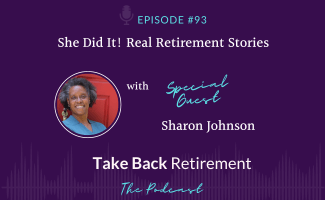
Guest Name: Sharon Johnson
Visit Website: 80stvladies.com
“It wasn’t nearly as traumatic for me as I was expecting it to be. I was a little concerned about how I would transition from having to get up and having that routine to creating a new one.” – Sharon
Welcome to another edition of Real Retirement Stories – a series of Take Back Retirement. Our hosts Stephanie McCullough and Kevin Gaines chat with Sharon Johnson. After an illustrious 22-year career as an executive assistant at ABC Television, Sharon didn’t slow down—instead, she switched gears and found a new calling co-hosting the 80s TV Ladies Podcast. Join in to hear her incredible journey from the bustling world of television execs to the equally dynamic realm of podcasting, where she revisits iconic 80s TV shows with a modern feminist perspective. Sharon’s story is a testament to the transformative power of embracing change and finding joy in unexpected places.
Sharon originally envisioned her retirement as a time for travel and catching up on missed TV series, but life had other plans. Through her podcast, she rekindled her love for classic 80s shows like “A Different World,” gaining fresh insights into the progressive roles women played both in front and behind the camera. Sharon also shares her serendipitous entry into the television industry in the mid-90s, working for an independent production company, and how those experiences shaped her understanding of TV production and storytelling.
Whether you’re intrigued by the behind-the-scenes workings of TV production or the fresh perspectives that come with retirement, Sharon’s story is a celebration of staying active, engaged, and ever-curious. Don’t miss this inspiring episode filled with nostalgia, wisdom, and the boundless opportunities that come with retirement.
Resources:
Please listen and share with your friends who are in the same situation!
Key Topics
- Sharon’s Original Plan for Retirement (04:07)
- 80s TV Shows and their Portrayal of Women (06:29)
- TV Industry Changes and Experiences of Women Behind the Camera (11:35)
- Retirement Concerns and Health Insurance Planning (17:27)
- Retirement and Transition from Office to Remote Work During COVID-19 (22:01)
- Analyzing Programs such as Grey’s Anatomy and Remington Steele (25:56)
- Retirement Planning, Identity, and Transition (37:37)
- Stephanie and Kevin’s Wrap-Up (43:13)
Sharon Johnson (00:00):
You know when you’re ready. And if you are hesitant, it doesn’t matter. Hesitate, just wait until you say, “Okay, I’m going to do it at this time.” And if you don’t have that knot in your stomach or you don’t have that well, or whatever it is, it tells you that you’re more uncertain about it than certain about it, than if it’s within your power. Don’t do it.
Sharon Johnson (00:24):
You know. Some people get thrust into it before they’re ready. And I was fortunate that that wasn’t the case for me. So, if that’s also the case for someone else, I just say, you need to wait until you are ready. And if you have the luxury of doing that, it doesn’t hurt anything if you wait a little bit.
Stephanie McCullough (00:46):
Hey, dear listeners, we need to let you know that Kevin and Stephanie offer investment advice through Private Advisor Group, which is a federally registered investment advisor. The opinions voiced in this podcast are for general information only and are not intended to provide specific advice or recommendations to any individual. To determine which strategies or investments may be suitable for you. Consult the appropriate qualified professional prior to making a decision. Now, let’s get on with the show.
Stephanie McCullough (01:21):
This is Take Back Retirement, the show that’s redefining retirement for women. Retirement is an old-fashioned cultural concept. We want to reclaim the word so you can make it your own. I’m Stephanie McCullough, financial planner and founder of Sofia Financial, where our mission is to reduce women’s money stress and empower them to make wise holistic decisions so they can get back to living their best lives.
Kevin Gaines is my longtime colleague with deep knowledge in the technical stuff: investments, taxes, retirement plan rules. He’s a little bit giggy and quantitative, I’m a little bit touchy-feely and qualitative. Together, through conversations and interviews, we aim to give you the information and motivation you need to move forward with confidence. We’re so glad you’re here.
Stephanie McCullough (02:09):
Coming to you semi-live from the beautiful Westlakes Office Park in suburban Philadelphia, this is Stephanie McCullough and Kevin Gaines of Sofia Financial and American Financial Management Group. Say hello, Kevin.
Kevin Gaines (02:19):
Hello, Kevin.
Stephanie McCullough (02:20):
Today we have another of our occasional series we call Real Retirement Stories. Sharon Johnson retired in 2022. Her last paying job was, as an executive assistant at ABC television where she worked for 22 years. She’s now co-host of the 80s TV Ladies Podcast, which launched right around the same time she said goodbye to her job-job for the last time.
Stephanie McCullough (02:45):
The podcast explores 80s television shows from a modern feminist perspective and celebrates the women both in front of and behind the camera who made them. I just love this show.
Stephanie McCullough (02:57):
Since retiring, she has traveled quite a bit and just dived into being a podcast host. So, we hope you enjoy our conversation with Sharon.
Stephanie McCullough (03:12):
Sharon Johnson, welcome to Take Back Retirement.
Sharon Johnson (03:15):
Thank you so much for having me.
Stephanie McCullough (03:35):
So, when people ask you what you’re doing these days, what do you tell them?
Sharon Johnson (03:23):
Mostly I talk about the podcast, 80s TV Ladies, of which I am one of the co-hosts. It actually is something that my friend Susan reached out to me about, about a year before I retired, asked me if I wanted to be on a podcast talking about TV, and I said, without hesitation, yes.
Sharon Johnson (03:44):
It was not my long-term goal for retirement, but it’s been everything I expected. Not that I really had any expectations, but it’s been, it’s been awesome. It’s been fun. It continues to be enlightening, and I have learned so much, ahm and you know, through our guests and everything. So, it’s been fantastic.
Stephanie McCullough (04:08):
So, what was your original vision for when you thought you would pull back from working?
Sharon Johnson (04:15):
My original plan, frankly, was to do some traveling. Ahm and frankly, to watch a lot of TV because there’s so many things I haven’t watched, because I didn’t have time, didn’t have the energy, whatever. And I was very much looking forward to spending a lot of time doing that.
Sharon Johnson (04:36):
Well, I still kind of am, but I’m actually going back and and rewatching some shows I watched when they originally aired in the 80s for the podcast, but other shows that I hadn’t, they’re, I say about maybe about 25% of the shows I didn’t watch or was not a regular viewer of when they originally aired, A Different World being one of them, which is the show that we’re currently talking about.
Sharon Johnson (05:02):
Even when I was a kid, I was not particularly interested in shows about people my age or teenagers or families. I wanted to see what the grownups were doing. I guess [Stephanie McCullough overcross: Yeah]. So, A Different World kind of fell into that category. So, I, I didn’t watch it and it’s been amazing actually to go back and watch it now.
Sharon Johnson (05:27):
I knew of it of course, and I think I watched most of the first season, but I quickly just was like, yeah, this isn’t for me at the time, but it’s just, it’s really an amazing show and I’m not at all surprised that it still resonates today.
Kevin Gaines (05:41):
Now, do you take different things away from these shows today than you did back when you were watching them before? Or if you never watched them before, do you think you view them differently?
Sharon Johnson (05:52):
Back when I was watching the shows when they originally aired, I really had no ah background in or interest in how these shows got made, who made the shows or any of the other, any of those other pieces of it. And that’s actually one of the things that we’re really focusing on as far as the podcast is concerned.
Sharon Johnson (06:13):
So, from that standpoint, it’s a different viewing experience for me. I mean, for the shows that I watched, I don’t think there are any shows that we’ve covered so far that I can say that I was not a fan of other than what I mentioned before, that were, it had nothing to do with the content or whether or not I was good. It was just a subject matter that I wasn’t interested in really. So, I was really just a viewer back in the 80s.
Sharon Johnson (06:36):
I just sat down, watched it, really didn’t think too much about it. Ahm, now that we’re going back and looking at them, I am, I’ve been just really surprised at how much for the time, a lot of the content, a lot of the ways that women and women characters were depicted, ahm was as forward thinking as it was.
Sharon Johnson (07:02):
And maybe it was just for me at that age, it just seemed normal that this is how it should be without really thinking about or really having as much of an understanding as I could have about hmm the strides that women really started to take in the 80s in terms of their personal lives and professional lives.
Sharon Johnson (07:18):
And I have been struck by just how these shows that are almost 40-years-old in some cases, really were quite topical and really did such a great job of depicting women even at that time, in some ways better than now, in a lot of cases.
Stephanie McCullough (07:43):
Really?
Sharon Johnson (07:44):
And, I, Yeah, and I also was not aware, because again, I wasn’t paying any attention to anything except what was on the screen. I wasn’t paying attention to anything about the women that were working you know behind the camera on these shows, whether they be writers or directors or crew or anything else.
Sharon Johnson (08:01):
And it’s been, it’s been really eye-opening for me, especially getting the chance to talk to some of these women about what their experiences were, and especially the ones that are still working. Ahm, we have a couple of women from A Different World who are still working, ah that are guests on our show. Anddd–
Stephanie McCullough (08:22):
That’s so cool.
Sharon Johnson (08:23):
Yeah. It’s, it’s been from that standpoint alone, it’s been encouraging, and it’s been revelatory for me. Susan was much more in tune because she was interested in working in production and working in television and film. And I wasn’t, at the time, I was just, I, I was a viewer and I loved TV and stuff, but it never seemed to be something that I thought that I could do, let alone wanted to do.
Stephanie McCullough (08:50):
And you ended up working in something TV adjacent, right? Your career?
Sharon Johnson (08:54):
I did. And a couple of occasions, the first being hmm, I worked for a small independent production company in the mid-90s for a couple of years, they made television movies. Ahm, the company had been around for a long time, but it, it was some — I don’t remember the exact date, but somewhere around that time shortly, within a few years before I started working there, what were called the fin-syn rules ahm changed.
Sharon Johnson (09:25):
Because up until then, networks could not own the programs that they showed on air. And so, they had to have independent production companies make them for them. And then that company retained the rights, that company retained the hmm ownership of those programs.
Sharon Johnson (09:47):
But that had begun to change, when that, when that rule was abolished, then networks began to get into that business. And so, at this point, I don’t think there are very many, if any, ahm independent production companies of that kind that were there then.
Sharon Johnson (10:07):
In any event, the company I worked for had been one of those production companies for a number of years. The partners had kind of split, two of them, a married couple had decided to go and retire, basically. And, ahm, Sheldon, my boss that wanted to keep working for a few more years.
Sharon Johnson (10:23):
And so, during the two years I was there, I think we made three TV movies. So, that was really my first real steep exposure into what it takes to ah make television as it happened here. But there were a lot of similarities to what happens in film as well. And hm if I’m honest, I realized in doing that, that that wasn’t for me. I’m not a production person.
Sharon Johnson (10:48):
Yeah, th-that, I mean, as much as, I mean, I still loved watching television, but I really wasn’t, I don’t think really interested in what I guess I would call the sales side of it. Because they’re selling their product to somebody. To get somebody to buy, you know they’ve got a project and they want a network or television to buy this project or a studio to buy this project.
Sharon Johnson (11:11):
And I just thought, “Yeah, I don’t, I don’t think this side of the business is for me.” Ahm, and then a few years later when I found out that ABC television was moving most of their operations here to California, after having been purchased by Disney a few years before, I thought, well, maybe ah the network side might be better suited for me in some way, shape, or form. So, that’s how I ended up at ABC/Disney.
Stephanie McCullough (11:40):
And how long were you there?
Sharon Johnson (11:41):
I was there for 22 years, that’s where I was working when I retired.
Kevin Gaines (11:45):
So, what were you doing with ABC?
Sharon Johnson (11:47):
I was an executive assistant working for, three different over the years, three different senior executives at the company. Ahm, my first boss was the president of the network. That was fascinating on so many levels. My next boss was a woman who was the president of ah worldwide television distribution. So, her team sold Disney-owned content to television stations, cable stations around the world, literally.
Stephanie McCullough (12:20):
Interesting. Okay.
Sharon Johnson (12:22):
And then the last executive I worked for was in marketing for ABC, the folks that their goal is to you know to promote all of the shows, but most of the ah energy was creating ah video content. Most of it went to television, but they were in the process of pushing it to out towards the internet. Ahm, and that was very interesting as well to see all that as well as you know other sorts of promotional activities, so-
Stephanie McCullough (12:55):
I mean, it was a time of big change in, in how we all watch and consume content.
Sharon Johnson (13:01
Oh! Absolutely. I, I was saying to somebody the other day, I’m so glad that I was there when I was, because I got to see the tail end of the process or, or the, what we think of as network television. And then as it has evolved, devolved, I guess I would say into what it is today as things began to get pushed more and more towards streaming. Ahm, but you know for instance, in the second year I was there, I got to go to New York for the Upfronts.
Stephanie McCullough (13:35):
Oh, fun.
Sharon Johnson (13:38):
Which back then was still this huge event. Fun fact, the year that I went to the Upfronts,Ahm, Susan Lambert Hatem is my co-host on our podcast. And her husband is a television writer. And it just so happens that that was the year that a show that he created got picked up by ABC.
Sharon Johnson (14:00):
And the first time I met him was the night of the Upfronts at this dinner that ahm ABC was holding for you know all of the people that were on all the shows. And that’s where I met Rich the first time. He was needless to say, a very happy guy that night, because the show had been picked up by network.
Stephanie McCullough (14:21):
I mean, I feel like kids these days, they’ll never really understand like, you had to be there at the beginning of the season and then the season ended at a certain point, right. There was a television season, and if you miss the show, you miss the show and your friends had to tell you what happened, like. Even just getting a VCR was a big deal. Because you’re like, “Ooh, I got to tape my show and then I can watch it if I’m not going to be home.”
Sharon Johnson (14:42):
Yeah, exactly. And that’s the whole idea of the water cooler moments and stuff. Because you come into work the next day and everybody would be talking about what happened on such and such a show last night.
Sharon Johnson (14:55):
Ah! And because they you know, they did reruns back then as well, but they didn’t always rerun all of the episodes of a particular show. So, if you missed it, maybe you catch it during the summer, but you might have to wait until it hit syndication before you actually get to see it.
Stephanie McCullough (15:14):
Yep. So, then you watch it on the little UHF channel. Right?
Sharon Johnson (15:18):
Exactly. It was a whole new world to say the least. An old world rather you know.
Kevin Gaines (15:23):
My wife and I talk about this all the time, less about the actual series, but the holiday programming. I mean, especially around Christmas. I mean, if you missed Frosty on that Tuesday night, you are going to have to wait 365 to see it again. But it actually held a little, maybe because of the age or something, but it held a little bit of magic that it was like, “This is it. This is it.”
Sharon Johnson (15:46):
There were a lot of things like that, you know. I don’t remember which network, but one network would show Gone with the Wind every year [Stephanie McCullough overcross: Yup]. Or some network would show The Ten Commandments at Easter time, or somebody else would once a year show the Sound of Music [Stephanie McCullough overcross: Yup]
Sharon Johnson (16:02):
Let alone all the Christmas programming, like the Charlie Brown Christmas or ahm Frosty the Snowman, The Grinch. [Stephanie McCullough overcross: Yeah] All of those things, and so you know you would have to set your calendar and make sure you’re in front of the TV at the appropriate hour, so you could catch it every year.
Kevin Gaines (16:18):
Yeah. I mean, I might be sounding like some old fuddy duddy, but you know there was something nice about only being able to see these shows, or like I said, go back to the phrase I used. It was something magical about only being able to see it once a year.
Sharon Johnson (16:30):
I agree.
Kevin Gaines (16:31):
Getting to see Miracle on 34th Street whenever I want, it loses something.
Sharon Johnson (16:37):
I agree. And I think part of it is the community of it all because everybody’s watching the same thing at the same time. Ahm, everybody is you know listen, as much as I like the idea that you can watch anything you want to at any time you know, there’s ups and downs of anything. Ahm, that in some ways is a detriment that you can watch just about anything at any time because there’s so much and what do you pick?
Sharon Johnson (17:07):
And sometimes I don’t have the mental acuity to watch something new to take it in. So, I’m rewatching episodes of something I’ve already seen.
Stephanie McCullough (17:17):
Oh! Yes. Comfort watching.
Sharon Johnson (17:18):
Exactly. Exactly.
Stephanie McCullough (17:21):
You can kind of listen with half an ear and you know nothing too surprising is going to happen.
Sharon Johnson (17:26):
Exactly.
Stephanie McCullough (17:28):
So, we talked about community. One of the things I think about in, in leaving a primary career is not just the financial things you’re leaving behind, but the other stuff, right. The, the maybe the learning opportunities, the challenge, the community of your coworkers. Were there certain things that you were hesitant to leave behind when you retired? Or worried about?
Sharon Johnson (17:53):
Ahm, you know before COVID forced me to come home and work from home for the last two years, I was a little concerned about that. I am very much a creature of habit. And the idea that one day all of a sudden, I suddenly don’t have this structure in place [Stephanie McCullough overcross: Yeah] ahm, it did worry me a little bit, not enough that would make me keep working. But I did think about that.
Sharon Johnson (18:20):
Ahm! But then having worked at home for the last two years, I think it really helped me make that bridge from going into the office every day to not having work, having to work anymore. Ahm, I was, I was you know, I have some friends because of the nature of their jobs, probably more than anything else, sometimes feel like they have to be on call 24/7.
Sharon Johnson (18:45):
My job was not that. I turned on my computer at the appointed hour. I turned it off when my day was over. And even though it would be sitting right out here in my living room/office area, didn’t bother me a bit. I didn’t think about it again until I had to do it all over again the next day.
Sharon Johnson (19:03):
So, for me, I really think that helped me transition from working and getting up every day and going through that routine into trying to find my new routine.
Stephanie McCullough (19:18):
Yeah. I mean, a lot of people, the COVID had people reexamine. Were there other things that it prompted you to think about?
Sharon Johnson (19:29):
You know. Not really. Ahm, I had been thinking about retiring for years, and the reason, the main reason I didn’t do it sooner was because of health insurance. I had breast cancer 20 years ago, even though everything was fine, you know, had a lumpectomy and chemo and radiation and happily they caught it really early, et cetera.
Sharon Johnson (19:56):
But nevertheless, it is not outside the realm of possibility that it could come back. And the, the fact is that you know, our health insurance situation is such that I need, I felt that I needed to make sure that I had myself covered until I went on Medicare. And that more than anything is what drove my decision as to when I would go ahead and retire.
Sharon Johnson (20:24):
My financial advisor basically said, when I was 60, he said, “You’re just, you’re working now because you want to not because you have to.” And I said, “Well, that’s great, but I’m not comfortable yet. I’m not there yet where I feel like I’m ready to roll those dice for the next few years, and in the hopes that something doesn’t happen that I’m not prepared for.”
Stephanie McCullough (20:44):
And it was the health insurance part that made you uncomfortable.
Sharon Johnson (20:47):
Yes, absolutely.
Kevin Gaines (20:50):
So, did you actually wait until 65 to retire? Or did you retire a little bit earlier and then just kind of bridge the health insurance with COBRA or something?
Sharon Johnson (21:01):
The latter. I waited until I was within the 18 months of COBRA. And, ah so, I could continue my company health insurance up until I just went right into Medicare. So, once I figured out all of that and the timing and the dates and all of that …
Sharon Johnson (21:20):
Ahm, I, Actually, my retirement, I retired, it’ll be two years next month. I originally planned to retire — it kept sliding. And for the life of me, I can’t remember why, but once I figured out the date of the 18 months, et cetera, I thought, well then, I’ll just do it 18 months.
Sharon Johnson (21:40):
And then it was like, “No, I’m going to wait a little bit longer because,” and there were a couple of those because that came up, I don’t remember what they were, but it ended up getting pushed into July, ah early July so, ahm. But yeah, the, the timing for COBRA is what drove me to actually finally choose my date.
Stephanie McCullough (22:03):
So, how was the actual transition? Like, you were. Well before COVID, you were going to an office. Was there you know, recognition, celebration, you were at a big corporation for a bunch of years. What does it look like to retire from a big company these days?
Sharon Johnson (22:19):
Well, Ah the, the folks, we still weren’t back at the office on a regular basis, at least most of the people in my team. Ahm, I only went in myself a handful of times. Partially because of a reorganization that happened that had nothing to do with COVID. Or it had to do with other structural things within the company.
Sharon Johnson (22:42):
Ahm, and also, because over the last year, they kept pushing back the date when they wanted people back in the office on a more regular basis [Stephanie McCullough overcross: Right]. There were some people on my team that were already in the office. In fact, there was one person who hm went back into the office at his request, hm I want to say in June or July of 2020.
Sharon Johnson (23:07):
Now, he was the only person there. But you know nevertheless, that was his choice completely.Ahm, I was happy being at home, so I stayed at home as long as I could. Ahm, So, I never actually went back full time and again, and, but through Zoom and other, I knew some of the new people that were part of the team that I was part of as well.
Sharon Johnson (23:30):
And I would’ve been perfectly fine without any kind of acknowledgement, celebration, whatever you might want to call it. But my boss insisted on doing something and it turned out to be very nice. For instance, hm our new team consisted of people that were from a totally different location than our old team because they were combining business units basically.
Sharon Johnson (23:56):
So, the folks that were from a different location, ahm, but were now part of the same team, they came to our location. I was working at hm a small lot, production lot in the Los Villas area here in southern California, where both General Hospital and hm Grey’s Anatomy shoot, it is also the oldest working lot that’s been continuously working since, I want to say for 115 years [Stephanie McCullough overcross: Woww].
Sharon Johnson (24:27):
It’s changed hands over time, but there’s a lot of history on this lot, so-
Stephanie McCullough (24:33):
That’s neat.
Sharon Johnson (24:33):
Yeah, it was really great for the folks from the new team that were able to come. I was able to take them on a tour around the lot. Hm, Unfortunately, because of COVID and stuff, we couldn’t get onto any of the … I was going to say we couldn’t get on into the stages, but we actually did because Grey’s Anatomy was done for the season. So, we were able to walk around the hospital set a little bit. There was nobody there.
Kevin Gaines (24:57):
How big is that hospital set?
Sharon Johnson (24:59):
It’s pretty big. It actually is pretty big, hmm because they’ve been there so long, they have expanded it a lot. So, they have a lot more space probably than they did when they originally started it. And they took over a green space, that’s now, that they’ve been using as the exterior for hmm— I don’t know if you guys watch the show, Meredith Grey’s house.
Sharon Johnson (25:21):
They also have been using, you know other exteriors around the lot for some of the exterior shots on the show. In fact, there are a couple times I’m like, “That’s my window up there.” Stuff like that.
Kevin Gaines (25:35):
Yeah, I just need to find a few more ways to bring up Grey’s Anatomy so I can encourage my wife to listen to this episode because she loves the show.
Sharon Johnson (25:44):
Well, I’ll tell you two quick stories. So, this was, this would’ve been back when hm I want to say maybe the second or third season of the show hm, of Grey’s Anatomy. And I was working on a lot. And I had taken to having my lunch outside, at these tables outside what turned out to be the bungalow where the Grey’s writers were.
Sharon Johnson (26:06):
And there’s a sound stage just across on the other side. And I’m just sitting there minding my own business one day, and I look up and there’s Shonda Rhimes talking to the actor who played Denny from that season. He was the one that — and so now his character had already been killed off on the show. So, I’m like, “What’s he doing here?” You know, I didn’t know because I made it a point not to try.
Sharon Johnson (26:29):
I could have found out what was going on or what they were, but I made it a point not to, because I wanted to find out when I watched it. Ahm, As I found out later, that was the season when, when Izzie was having hm, hm hallucinations because of the brain cancer and stuff. So, that was a little bit of a surprise.
Sharon Johnson (26:47):
And then there was another day I was sitting there; I don’t know what I was doing. I had my little laptop there and I was playing music. I happened to be playing the soundtrack from Enchanted and Patrick Dempsey walks by and I have no idea what, what sparked it, but he made some sort of comment and I said, “I’m just having lunch, but I’m listening to the soundtrack from Enchanted.” And he was like, “Well, that’s really great.” And went on his merry way.
Sharon Johnson (27:09):
So, those are my two stories, because that’s the thing, I’m inside all day in my office and they’re in their sound stages and in their whatever. And you rarely see anybody, but every now and then, you know, somebody would wander by. So—
Stephanie McCullough (27:28):
So, you had a little celebration, you had people?
Sharon Johnson (27:30):
Yeah, it was really nice. Ahm, hm. It was really nice. And I think it was also nice for the rest of the team to see some people. There were a couple people that I talked to that I had never met before, but it turned out they had been hired during the pandemic and they’d not met other people in person before.
Sharon Johnson (27:50):
They’d been working remotely the whole time. So, I was happy to provide an excuse for everybody to get up out of their house and come in and you know see people that they hadn’t seen for a while. So, that was really nice. That was really nice.
Stephanie McCullough (28:02):
That’s cool. I mean, I feel like sometimes those big transitions in life, it’s nice to have something marking them. Otherwise, you just wake up one day and like, right, I don’t have to log on today.
Kevin Gaines (28:11):
Right.
Sharon Johnson (28:13):
Yeah. For me, I think it would’ve been a lot different if I had still been coming into the office every day [Stephanie McCullough overcross: Yeah]. But, you know, I’ve been used to sitting here by myself for such a long time, but nevertheless, it was really great to see them you know, to see some people.
Sharon Johnson (28:25):
Honestly, I don’t know exactly what I did at that point. Ahm, you know, It had been almost a year ago that Susan had asked me if I wanted to do this podcast with her. Hold on. I think shortly after my last day at work, we did our first Facebook Live for the podcast.
Sharon Johnson (28:48):
I’m not sure the exact date that was, but it was shortly after that because we launched a week or two afterwards. Our first podcast episode, I want to say was July 22nd through thereabout [Stephanie McCullough overcross: Oh, cool]. And my retirement date was July 7th.
Sharon Johnson (29:03):
Ahm, I’m sure what I was probably doing a lot of at that point was hm because obviously, we’d already started recording and whatever show we were, was coming up, I was probably rewatching a lot of episodes.
Stephanie McCullough (29:18):
Yeah.
Sharon Johnson (29:20):
Because I could, and because we had the time for the first couple of shows we did, which were Scarecrow, Mrs. King and Remington Steele, I watched every episode. Now we’d start recording for six months and I would usually just have them on while I was here working all day. I didn’t, you know, I didn’t really have to watch them too closely except for certain episodes.
Sharon Johnson (29:42):
So, it was really just to really re-familiarize myself and get back in the head space for that. Ahm. So, I probably was still in that mode of, of trying to get through hm those episodes, feeling like I had to watch all of them.
Sharon Johnson (29:58):
And one of the reasons at the time that I was doing that too is that our initial intent with the podcast was we were not going to do an episode-by-episode recap, but what we were going to do is like season by season.
Sharon Johnson (30:16):
What were some of the themes, were some of the things that were happening, especially with the female characters. Where were they? And, and. So, you kind of had to have a sense of all that and we’ve evolved into more of an overview, at least when it’s just Susan and me.
Sharon Johnson (30:30):
And we’ve been fortunate enough to have guests to talk about the show and as far as their experiences were. So, hm things have definitely changed which is good, and which is fine. I think it is really kind of evolved into something we didn’t expect, but something we’re really, really happy with and I think really proud of.
Kevin Gaines (30:50):
So, since you’ve watched the episodes more recently than I have, Remington Steele, did you notice a change after they enforced the contract? So, so Pierce couldn’t become Bond versus before?
Sharon Johnson (31:05):
Ahm. Not really. Now that, that only applied to the last season, if you will, which actually turned out to be five, like two-hour TV movies. There was a day– I didn’t feel there was a change in terms of his performance or certainly didn’t feel like he was phoning it in by any stretch of the imagination.
Sharon Johnson (31:33):
Ahm! But to me, there was a change in the writing. I don’t know that I found those last few episodes to be as good as perhaps the rest of the show. You know! Just as a little background, so when we started the podcast, we started with Scarecrow, Mrs. King, that was one of Susan’s favorites of that time.
Sharon Johnson (31:57):
And then I picked Remington Steele because it was mine. My favorite. Love that show. And I knew about the whole, you know Bond thing. Because I’m also, and my brother is even more so a James Bond fan and seeing all the movies and stuff. Um, but I didn’t remember what came after.
Sharon Johnson (32:18):
And so, it was doing the podcast that I realized, NBC insisted that they couldn’t let this man out of his contract. And then they didn’t even do a full season of episodes of the show.
Sharon Johnson (34:28):
They didn’t have any place to put it. But the last, I guess they just did it because they thought, “Well, we’d like to have this guy continue on our air because somebody wants him to be James Bond, so we’re going to have somebody would be James Bond on our air and isn’t that great.” But they didn’t really do much hmm so, yeah, that part of it was kind of disappointing really.
Kevin Gaines (32:51):
So, it may have just been an excuse to try to mark up a few of the ad minutes.
Sharon Johnson (32:55):
Probably, yeah. I mean that’s my opinion. I obviously haven’t talked to anybody who was in the room, but that’s my opinion.
Sharon Johnson (33:04):
Ahm, having said that, as I mentioned, my brother’s a big James Bond fan, and he was not on board initially for Pierce Brosnan at that time to become James Bond. He just thought he was too unseasoned, if you will. He was not ready.
Sharon Johnson (33:20):
Ahm, and looking back, I think, I kind of agree with him. I feel bad for Pierce, but I think he was better suited to step into the Bond role when they, when they did come back around a few years later. And I really enjoyed the movies that he did hm as Bond. So, you know, I don’t know, I guess things kind of work out the way they’re supposed to in the end sometimes.
Stephanie McCullough (33:41):
Sometimes, right.
Sharon Johnson (33:42):
But I still think that the NBC did him dirty. I do. They should not have done that. Especially since they really didn’t have a … they just did. They didn’t have a plan. They just were like you know, “Oh! Somebody wants make this guy James Bond. Well, let’s keep him on our air because we can.” And that really was the impetus behind the whole thing, in my opinion.
Kevin Gaines (34:05):
Yeah. For the record, Stephanie and I are both fans of 007 as well.
Stephanie McCullough (34:09):
Yes, yes. For sure. So, one of the things I think you told me is that you are currently after “retirement” working more than you expected to on this podcast.
Sharon Johnson (34:20):
Yes.
Stephanie McCullough (34:20):
Is that a good thing?
Sharon Johnson (34:22):
It’s a very good thing. I mean, it really is a good thing. Ahm you know, I’m, I’m sure I would’ve been perfectly fine and am still perfectly fine parking myself in front of the TV hm you know for long periods of time.
Sharon Johnson (34:36):
But it’s very good that I have this to do, especially because I’m enjoying it so much. I love it so much. It’s, it’s, it’s really kind of ticking a lot of boxes that I didn’t even know existed for me.
Stephanie McCullough (34:53):
Yeah. Like what?
Sharon Johnson (34:56):
Well, I love history. I love TV, so I’m learning a lot about the history of TV that I may not have taken the time to really delve into, if not for this podcast. Ahm, and especially you know, considering the role that, that so many women played in so many of the shows that I loved, I knew of some of them.
Sharon Johnson (35:18):
I knew of Linda Bloodworth-Thomason, I knew of Diane English, but beyond that ah you know, because I didn’t look too deeply into things at the time, and it wasn’t as easy then as it is now[Stephanie McCullough overcross: Right] to get that information, I just didn’t. And so, learning about, the whole learning experience of it is just really fantastic.
Sharon Johnson (35:40):
Every day I’m learning something new and I’m like, “Oh my gosh, I had no idea.”Ahm, So, that part of it’s been really great.
Stephanie McCullough (35:47):
And then you and I met at a conference for podcasters, right. So, you’re getting out and about.
Sharon Johnson (35:52):
Yes, exactly. That’s been really fascinating too hm. I’ve been an avid podcast listener for a long time, although apparently, unlike most people or most podcast listeners, my podcast listening is around entertainment primarily.
Sharon Johnson (36:11):
I don’t listen to much outside of that because for me it’s just another form of entertainment, I guess, podcasting or podcasts [Stephanie McCullough overcross: Yeah]. Ahm, I listen to them in the morning when I take my walk, which is what I used to do when I was working. That would be my exercise. I would get up in the morning and walk for half an hour, 45 minutes and listen to my podcast, and I listen to them in the car.
Sharon Johnson (36:33):
And so, it’s been fascinating to learn more about the world of podcasting. And to my surprise, because again, I’m so interested finding that the majority of people that listen to podcasts are listening to things. I didn’t know the true crime was such a big thing in podcasting. I had no idea. I had no idea.
Stephanie McCullough (36:56):
There’s so many niches and categories and then yeah, I think we all kind of gravitate to the stuff we like which is kind of a fun thing.
Sharon Johnson (37:03):
Yeah. Yeah. At least for me. Ahm, and yeah, it’s been great. So, it gives me time, it gives me an excuse to watch TV that I hadn’t watched before. And in many cases, it helps me learn some things that I didn’t know, and I still have time to do you know some TV watching and do some traveling [Stephanie McCullough overcross: Yeah] as well.
Stephanie McCullough (37:25):
So, one thing that a lot of people think about, right. And we as financial planners are encouraging our clients to think about is the fact that we could live a very long time, right. And I think you’ve got some longevity in your family. Is that right?
Sharon Johnson (37:38):
Yes. My mother turned 92 in April. She lives by herself. She drives. She takes care of the house. She insists on gardening [Stephanie McCullough overcross: Okay]. When I was there visiting in April, I think I came back from my walk and either she was still, or had just finished being outside, digging up weeds. And I’m like, “Mom, what are you doing?” “Well, I got to get,” I’m like, “Okay.” So hm, so yeah, she’s doing great.
Stephanie McCullough (38:14):
That’s great.
Sharon Johnson (38:15):
She’s obviously, you know slowing down a little bit. She is 92 after all. That’s a long time. But you know, I, I marvel at her every day, and I do try to talk to her just about every day. Again, one of the advantages of the modern world, we usually try to FaceTime a few for half an hour, so every day.
Stephanie McCullough (38:33):
That’s nice.
Kevin Gaines (38:35):
So, thinking back five years before you retired to where you are today, what’s the biggest surprise now that you are retired? Or at least you know walked away from the main job? The primary job.
Sharon Johnson (38:52):
I guess the biggest surprise is I wasn’t expecting this podcast to come along, but in terms of other things related to, to retiring, I mean, I don’t, I don’t miss going into the office. Ahm. Unfortunately for me, where I was located, not the folks I mentioned before th-there– where I had my little retirement gathering.
Sharon Johnson (39:17):
But I was in another location, and I just didn’t spark to the people I was working with, working around, let’s put it that way for the first time in my working life [Stephanie McCullough overcross: Wow]. So, I consider myself very lucky. I have been very fortunate in terms of, of not just the people that I worked with, but the people I worked for, for the vast majority of my working life.
Sharon Johnson (39:44):
So, and it wasn’t horrible. It just was ah one of the reasons why I was not at all unhappy that I didn’t have to go in the office every day because I didn’t have to deal with these people.
Sharon Johnson (39:56):
So, five years before I retired, I guess I just thought I just won’t have to be here anymore. Ahm. Although I knew that there were things I would miss or that I would have to adjust to, the routine of it all, the cetera, that you know having to work from home helped me transition through.
Sharon Johnson (40:17):
So, it wasn’t nearly as traumatic for me as I was expecting it to be. I was a little concerned, you know about how would I transition from having to get up and having that routine to creating a new one.
Stephanie McCullough (40:32):
Yeah. I mean, that’s a big issue, right, especially if our identity is tied up in what we do and our daily structure and our you know habits and for a long time.
Sharon Johnson (40:45):
Yeah, and you know. And I am single. I’ve never been married. I don’t have any kids, so I’m the only one I’ve ever had to worry about. And that helps, if you will. I was the only one that would suffer or thrive depending on what I did after I retired, to a large extent. Ahm. So, yeah, I, I feel really fortunate in a lot of ways that the transition for me has gone as well as it has.
Stephanie McCullough (41:15):
Any advice for people who were, where you were kind of with their date, they keep pushing it back because hmmm they’re a little anxious about walking out the door for the last time.
Sharon Johnson (41:25):
You know, actually. I’ve said this to a couple other people because I’ve had a couple other friends who’ve kind of gone through this after I did. You know when you’re ready. And if you are hesitant, it doesn’t matter. Hesitate, just wait until you, you say, “Okay, I’m going to do it at this time.”
Sharon Johnson (41:46):
And if you don’t have that knot in your stomach or you don’t have that well, or whatever it is, it tells you that you’re uncertain you know, you’re more uncertain about it than certain about it, than if it’s within your power. Don’t do it.
Sharon Johnson (42:02):
You know. Some people get thrust into it before they’re ready. And I was fortunate that that wasn’t the case for me. So, if that’s also the case for someone else, I just say, you need to wait until you are ready. Ahm ,and if you have the luxury of doing that, it doesn’t hurt anything if you wait a little bit. You know, hm yeah. I think that’s what I would say.
Stephanie McCullough (42:25):
Love it. So, Sharon, we’ve talked about your fabulous podcast, 80s TV Ladies, how do people find it if they want to follow and listen.
Sharon Johnson (42:33):
We can be found on all of your podcast apps like Apple Podcasts and Spotify and Goodpods, et cetera. You can also go to our website, 80stvladies.com and you can listen to our episodes there, or on our YouTube channel, which is also called 80stvladies.com.
Sharon Johnson (42:53):
We also post on Facebook and Instagram. And we’re just now getting into TikTok hm, for more information and to find our community, if you will.
Stephanie McCullough (43:03):
Excellent. I love it. Great. Thanks so much for sharing your story.
Kevin Gaines (43:07):
Thank you.
Sharon Johnson (43:08):
Thank you so much for having me. This has been a real treat.
Kevin Gaines (43:14):
Well, that was fun. I actually wish we would’ve turned that into a five-part series. Of course, I would’ve morphed it into you know, a spinoff of her show, just talking about all the different TV shows.
Stephanie McCullough (43:27):
Right. Such a fascinating niche.
Stephanie McCullough (43:30):
I mean, this is a fascinating time we live in, in that anyone, you and me included, could go start a podcast or just find a way to talk about things that interest them.
Stephanie McCullough (43:42):
Now, I don’t know that they’re “monetizing it.” I’m not sure they’re making money from the podcast. That wasn’t their goal. But, you know it is fulfilling a lot of interesting roles for her in quote unqoute”retirement.”
Stephanie McCullough (43:55):
So, she’s learning, she’s active, she’s got structure, they’ve got you know timeframes flexible around travel or what other things they want to do. And it’s you know kind of, as she said, checking a bunch of boxes that maybe she didn’t even realize that she wanted to have checked.
Stephanie McCullough (44:13):
So, I think the message I take away you konw is exploring, finding something that’s super interesting, something that you’re passionate about, that you can spend time on especially with a friend, if possible, has a lot of value.
Kevin Gaines (44:28):
Well yeah yeah, and to that point, I think it was interesting when she said, listen, five years before she retired, she was thinking of retirement, but never even crossed her mind that she would be doing a podcast.
Kevin Gaines (44:39 ):
So you know, that’s when we’re talking with people, it’s what do you think you’re going to want to do? It’s more of a conceptual or hypothetical [Stephanie McCullough overcross: Right] as opposed to anything concrete, because things change.
Stephanie McCullough (44:55):
Things change
Kevin Gaines (44:56):
That just come out of nowhere. There’s other opportunities and all of us the next thing you know, it’s like, Yes! “Screw it. I’m going to blow the budget and I’m going to hop on you know whatever they’re calling the name of the different private spaceships. You don’t know what’s going to be available, let alone what’s going to strike your fancy.
Stephanie McCullough (45:13):
Yep. So, planning gives you the flexibility to take advantage of these things when they come up, right. Having some assets, having some pots of money that you haven’t spent through, obviously.
Stephanie McCullough (45:26):
Ahm, and I feel like you know sometimes clients will reach out to me like, “Wait, how much did we say I was going to spend this year?” I’m like, “We’re guessing. We didn’t know exactly. We didn’t know how much was going to go here, there, or anywhere else.” But having guessed and having put some things in place means that you’ve got more flexibility to pivot when life happens. Whether you know, unpleasant or pleasant surprises.
Kevin Gaines (45:52):
Well you know, the title of a previous episode, We’re Guessing and That’s Okay.
Stephanie McCullough (45:55):
Yep, yep. For sure. And then it was interesting too to hear Sharon say that having to work from home, maybe assuaged some of her worry about you know losing the structure of actually going to the office. So, it could be that lockdown accelerated her timeline a bit.
Stephanie McCullough (46:14):
You know.And I can see how the unknown of what it’s going to look like really could play a role in having some of that anxiety and that hesitancy to pull the trigger and actually leave, right. Even long after her financial advisor assured her, she was going to be okay.
Kevin Gaines (46:34):
Well, yeah. I mean, that’s the thing is you never know where the inspirations or the opportunities are going to come from or the learnings. She learned during COVID or at least got a taste of [Stephanie McCullough overcross: Yeah] this is kind of how retirement could go, at least as far as you know the social interactions. Alright. Hey, I’m, I’m good with this.
Stephanie McCullough (46:58):
Yeah. Yeah. And that’s why you know when people think, “I think I want to buy a winter house in Arizona or New Mexico and I want to spend four months a year there,” and we encourage people, okay, go rent a place for a couple months. And try it out. The trying it out before you dive in completely is nice if you have the opportunity to do that.
Kevin Gaines (47:21):
Hypothetically speaking, you know, once you retire, maybe live in a different city for a couple years at a time and then go to a different one. Not that we’ve ever talked to anybody who’s doing that or anything. Right, Stephanie?
Stephanie McCullough (47:34):
We’ll link to that show in the show notes because I don’t remember the episode number, but yes, there’s all kinds of different models out there, right. Which is why we like to talk to women who have retired and are willing to share their story just to expose you dear listener to you know different possibilities.
Kevin Gaines (47:50):
What I also liked about what Sharon’s story, or the story Sharon was telling us was her idea for retirement was at least partially to be a glorified couch potato. She wanted to spend her time watching TV and everything.
Kevin Gaines (48:08):
So many times you know, when people talk about you can do all this stuff in retirement and there’s this and there’s that. I mean, and a lot of our real retirement stories have been that as well, that you know women doing all of these neat and exciting things and everything, there’s nothing wrong with relaxing and just having a nice, low impact if you will, low pact retirement, if that’s what you want to do. At no point have we ever said that’s the wrong way to do retirement.
Stephanie McCullough (48:41):
Whatever things you haven’t really had time to do that you love to do; this should be the time for it.
[Music Playing]
Kevin Gaines (48:49):
Absolutely.
Stephanie McCullough (48:51):
Well, we hope you enjoyed Sharon’s story. Thanks so much for being with us. We’ll talk to you next time. It’s goodbye from me.
Kevin Gaines (48:58):
And it’s goodbye from her.
Stephanie McCullough (49:02):
Be sure to subscribe to the show and please share it with your friends, show notes and more information available at takebackretirement.com. Huge thanks for the original music by the one and only Raymond Loewy through New Math in New York. See you next time.
Voiceover (49:16):
Investment advice offered through Private Advisor Group, LLC, a registered Investment Advisor. Private Advisor Group, American Financial Management Group, and Sofia Financial are separate entities. The opinions voiced in this material are for general information only and are not intended to provide specific advice or recommendations for any individual security. To determine which investments may be appropriate for you, consult your financial advisor prior to investing. This information is not intended to be substitute for individualized tax advice. Please consult your tax advisor regarding your specific situation.