Take Back Retirement

Episode 108
Retire on Your Own Terms – Or Don’t! (rerun)
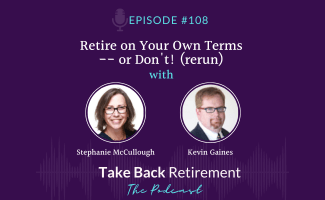
There is no one right way to retire. Even if you don’t do everything you had hoped to do, you can still build a plan so that you can do more of the things you want and less of the stuff you don’t. In this episode, we’re Taking Back Retirement by redefining the old image and definition of this phase of life. Our hosts Stephanie McCullough and Kevin Gaines break it down in this rerun episode dating back to episode 2 from 2020.
Please listen and share with your friends who are in the same situation!
Key Topics
- Redefining Retirement to What YOU Want to do (02:12)
- When Things Don’t Go According to Plan (07:34)
- How Technology is Changing Retirement (10:19)
- Being Realistic (12:24)
- Other Ways You Can Make Money While Retired (14:05)
- Preparing for Your #2ndHalfPlan (15:31)
Stephanie McCullough (00:00):
Hey, dear listener, we were looking around at some of our highest downloaded
episodes recently and noticed that episode number two, yes, the second one we
ever did, way back in 2020, is among the highest. It is called Retire on Your
Own Terms or Don’t. And I think it gets at the heart of a lot of what we’re
trying to say here. Even though the word retirement is in the title of our
podcast, it’s not about your traditional idea of retirement. We know many of you
have not yet heard this, and even if you have, we think it may be worth giving
another listen to kind of refocus. So please enjoy and let us know if you think
it still applies.
Stephanie McCullough (00:48):
Hey, dear listeners, we need to let you know that Kevin and Stephanie offer investment advice through Private Advisor Group, which is a federally registered investment advisor. The opinions voiced in this podcast are for general information only and are not intended to provide specific advice or recommendations to any individual. To determine which strategies or investments may be suitable for you. Consult the appropriate qualified professional prior to making a decision. Now, let’s get on with the show.
Stephanie McCullough (01:23):
This is Take Back Retirement, the show that’s redefining retirement for women. Retirement is an old-fashioned cultural concept. We want to reclaim the word so you can make it your own. I’m Stephanie McCullough, financial planner and founder of Sofia Financial, where our mission is to reduce women’s money stress and empower them to make wise holistic decisions so they can get back to living their best lives.
Kevin Gaines is my longtime colleague with deep knowledge in the technical stuff: investments, taxes, retirement plan rules. He’s a little bit giggy and quantitative, I’m a little bit touchy-feely and qualitative. Together, through conversations and interviews, we aim to give you the information and motivation you need to move forward with confidence. We’re so glad you’re here.
Stephanie McCullough (02:14):
Hello, it’s Stephanie
Kevin Gaines (04:15):
and it’s Kevin.
Stephanie McCullough (02:17):
Hey, we’re here today talking about this ever-changing concept of retirement. We named the podcast Take Back Retirement because we want to have a conversation about this question of whether the concept of retirement is outdated in the world we live in today.
Kevin Gaines (02:36):
And frankly, spoiler alert, it is, you know, the old image that we all have of, what our parents or grandparents went through, you know they did the 35, 40 years. They get the gold watch. And I mean, I could still picture my grandfather just sitting out on the front stoop just watching life, watching the neighbors sitting in the rocking chair. That’s not what most of us picture nowadays for ourselves.
Stephanie McCullough (03:07):
Yeah. And even my grandparents retired to Florida, moved to a community with golf and tennis and close to the beach. And that’s great. And maybe some of us do wish we could still do that. And yet, that is not, like you said, it’s not the reality for a lot of us. I’ve talked to a lot of people who say, gosh, I don’t think I’ll ever be able to retire. And then we have this generational change,
Kevin Gaines(03:32):
Right. You know, what baby boomers and Gen Xers, you know, we don’t have the idea of playing golf every day for the rest of our lives doesn’t appeal to us, if you’re telling us the rest of our life is going to be 20-30 years. I mean, and that was the other thing, going back to the old image, playing golf every day or sitting on the front porch was one thing you could do because a lot of people, when they retired, they had, what, five, 10 years? We’re now talking about life expectancy into the late eighties even early nineties for a lot of us if you actually reach retirement age, so, more time that you want to fill up. That’s something that needs to be accounted for.
Stephanie McCullough (04:12):
Yeah, completely right. I mean, I feel like the people, the women I talked to, if they love their jobs, they can’t imagine not working in some capacity. Maybe no longer the 40 50 60 hours a week they’re doing now, but they don’t necessarily want to stop cold Turkey. And then the people who don’t necessarily love their careers are itching to do something else and follow some passion or, or make an impact in another way. That’s kind of, you know, what I see a lot.
Kevin Gaines(04:41):
Yeah. A lot of people I talk to, it’s the engagement. They want to be engaged. They want to be part of society. They don’t want to retire from an active life. Now that active life might be a lot more fun and stuff that you want to do, but you’re active, you’re involved.
Stephanie McCullough (05:03):
Right. And we looked up, in fact, in preparation for this episode, the definition of retirement from dictionary.com and the first definition is the act of retiring, withdrawing, or leaving. And I don’t think that appeals to a lot of us withdrawing from life, leaving our communities and, and the things that we love. That’s not what we’re going for.
Kevin Gaines (05:27):
No, it’s, I mean, and it helps that, work, especially in America, has changed over these last few decades. Again, think back to the image of parents and grandparents. A lot more of them were manual labor, whether they’re working in the factories or construction or whatever. More of us now are service. We’re sitting behind a desk. It’s easier on our bodies to work for a longer period of time if we want to. The advantage of planning is getting to that point where we can say, Hey, I’m doing this because I want to, not because I have to.
Stephanie McCullough (06:09):
Exactly. Right. I feel like what you and I are talking about retirement is maybe changing the definition and going to a situation where, you know, maybe we want to call it being free from the need to work for money [Kevin Gaines overcross: right] so that you’re decoupling the stuff you’re doing day to day from that need for sustainability of your life.
Kevin Gaines (06:35):
Exactly. I mean, and not to be, you know, to be the proverbial wet blanket here, but you know, we’re talking about a lot of optimistic reasons why we retire and what we’re going to get to do. But you know, there are some issues out there that are forcing people to either work longer or retire earlier than they want to and that has some negative impacts on the retirement dream.
Stephanie McCullough (07:00):
Yes, exactly. There are, besides the sheer longevity of it. Right. And I, I heard years ago the director of the Stanford center for longevity speak at a conference and she said, isn’t it fascinating from a cultural perspective that medical science has given us 20-25 extra years of life? Why did we choose to put them on the end? That one kind of blew my mind. I was like, Oh, adding the years on the end to retirement is a cultural decision. So that’s huge. But Kevin, you’re right, a lot of people are involuntarily retired, whether through a corporate decision or the need to care for loved ones. You know, there’s a lot of things that go on that don’t go according to plan.
Kevin Gaines (07:51):
We have these conversations all the time, you know these situations as well as I do. That we work with clients or people come to us and say, Oh my gosh, I had this idea and now X has happened. We need to figure out what to do next. There’s panic, there’s fear. And the biggest thing that we could do is just to encourage the deep breaths. But then the other side, you have a lot of experience with this, Stephanie, that people come to you saying women especially coming to you saying, we had this dream, we thought it was going to be, and now here I am at 65 years old and I’m now divorced, or something else is gone haywire. I just need to rethink the whole thing. I mean, how do you…where does that conversation go?
Stephanie McCullough (08:43):
Yeah, exactly right? In a divorce there’s a splitting of the assets and then very often you know, it takes more money to run two households than one. So even if it’s the same amount of income coming in and the same level of assets, right it doesn’t go as far. And then very often women end up getting support for a time, but not very long. Or women have to pay out. I talked to a woman the other day, her retirement plan is gone. She had to pay it out to her ex because she had more. So that totally blows up the plan. So I think, clinging onto this old image of retirement, it’s counterproductive because people who are in a situation where things have gone awry, it just makes them feel even worse. That, Oh my gosh, I’m never going to be able to sit on that porch.
Kevin Gaines (09:33):
I would say to sum this up, is that number 65 that even people younger than us kind of have in their mind. That’s not the retirement age anymore. Maybe it’s earlier, maybe it’s longer, but it’s not, it’s not a hard fast rule. It’s not, Oh my gosh, if I can’t retire at 65 something is wrong. No, that’s not necessarily the thing. It’s your choice. It’s what you want to do. And that kind of feeds back to why we say we’re taking back retirement. Right?
Stephanie McCullough (10:10):
Yeah. And we do like to focus on the positive aspects, right? Longevity is both a risk, but it’s also a positive thing. People are healthier and more active for a longer period of time. Right? We do have more time on this earth usually to make an impact, to be with our families, to watch your grandkids grow up, whatever it might be. And then I think there’s technology, which is kind of changed things, as well.
Kevin Gaines (10:35):
Absolutely. I mean, especially with technology, not only is it easier to keep working because of technology, but you’re now not tethered to the home. Think about it. You used to have to wait by the phone if you had a phone appointment with social security or whatever, but now you could be on a beach taking that call if you wanted to. Or if you wanted to stay in contact with your family. Again the home phone isn’t this anchor. It’s just something really simple like a mobile phone is now.
Stephanie McCullough (11:08):
It allows telecommuting, it allows people, you’re not tethered to the office either. If you want to work in some capacity. Maybe doing what you did before or doing a whole new thing, you’re not geographically constrained. Like you used to be—
Kevin Gaines (11:21):
You and I both know there’s a husband and wife advisor team that we know that their whole thing, they have a completely non-existent office. It’s everything is out in the cloud or secured so that they can be wherever they want to be and continue to work with their clients. So would you call them retired? No. Cause they’re continuing to work in everything, at least using the old definition. But they’re definitely living the life they want to live.
Stephanie McCullough (11:54):
Exactly. So that’s when we’re saying take back retirement, we really do mean to come up with your own definition. Individualize the plan to you specifically. There is no, right way to do this.
Kevin Gaines (12:09):
Yeah, exactly. It gets back to, you know, if you want to play with stereotypes, the generations of baby boomers and Gen Xers is, we are a lot more individual. We’re much more individuals than previous generations and possibly future generations, so we want to do things our own way and our own time. And that’s what we’re talking about here is be aware. There’s some downside, but there’s also embrace the upside and figure out how all these pieces are going to fit together for you.
Stephanie McCullough (12:44):
Yup. Yup. And maybe you’re in a situation where things didn’t work out as you had hoped as you had planned, right? We’re not trying to be all rosy and you know, rose-colored glasses here. We want to be very realistic. We encourage people really to look at their situation without judgment, right? Suspend that shame and blame for a little bit. Quiet the voices in your head. The numbers on the page aren’t judging you, but being realistic about where you are and the earlier you can start to think about it and to line up the pieces, the easier it will be to put something together as close as possible to what you are hoping for.
Kevin Gaines (13:26):
We’re talking about the dreams. That’s your North star. Your ideal retirement is the North star. We know that’s not what it’s going to be. You know that’s not what it’s going to be, but it gives you something to work towards to focus on and when some of the numbers do start bugging you out, you can just kind of lift your head and go, oh yeah, that’s why I’m sitting here doing this.
Stephanie McCullough (13:48):
Yup. Yup. I think one of the things I will get into this more in other episodes for sure, but thinking about that income. You know, Retirement income planning is what Kevin and I like to talk about. It is a complicated picture, but if we can, even if you have a secure career right now, starting to think about what are some other ways I could make money, right? Kevin and I are recording this from home right now because of the Coronavirus scare and we know there are people who are getting laid off. Which is terrible and tragic and those of us who may be in a secure job, it is worthwhile to think through what are the other ways I could make some money, whether it’s through a crisis or through partial retirement. What are some other income streams that you could turn to.
Kevin Gaines (14:44):
Think about what you want to do. Maybe there’s a hobby that you want to be more involved with and if that ends up generating some income for you, fantastic. That’d be you know, that ‘d be a lot of fun if you can do that, but at least understand what your options are. And that’s really what Taking Back Retirement is. It’s about understanding your options.
Stephanie McCullough (15:10):
Exactly. Having as many options as we can and even if we can’t get to a situation where everything is perfect and we can do everything we dreamed of, our goal is to help people build a plan that will allow them to do more of the things they do want to and less of the things they don’t, right it’s kind of a ratio.
Kevin Gaines (15:31):
Right. For example FMG, they use the hashtag #2ndhalfplan because we’re talking about the second half of your life.If you do the numbers it is maybe half you need to take into… I mean that’s a lot of time. There’s a lot of things to understand. A lot of things you can do and a lot of things that are going to happen. Don’t be worried, don’t be paralyzed by the fear. Embrace the opportunity. I feel like I should say amen after that comment. But you know, really, I mean the world. The world is proverbially your oyster at this point. So, take advantage of it.
Stephanie McCullough (16:10):
it is exciting with improvements in health and medical care, you know, people are staying healthier longer. One of the things we hope to do on this podcast is to bring you stories of people who have done it differently than the traditional and maybe bring you a little inspiration and a little thought provoking ideas to get yourself thinking about what possibilities you could have in store.
Kevin Gaines (16:33):
Right. And the beauty of these interviews are going to be, you may sit here and hear the whole thing. It’s like, well that doesn’t apply to me or it’s too late for me or that’s not what I want to do. But you’re going to hear the one nugget of something that inspired these people or something they did and go, Oh wait, that I can take away from. So we’re not talking about the entirety. We’re talking about the different pieces.
Stephanie McCullough (16:57):
Exactly. We are hoping that you find this podcast and discussion helpful. We’d love for you to join the conversation. Kevin mentioned the hashtag #2ndhalfplan, which is hashtag 2 N D second half plan. Please join the conversation. Tell us your experiences, tell us your ideas and inspiration or your worries. Tell us what you’d like to hear from us on the podcast, and we look forward to conversing with you.
Kevin Gaines (17:25):
Yup, and you can find us on most social media outlets, Twitter, Facebook, YouTube, LinkedIn. We want to talk. We want to hear your stories, so please don’t be shy.
Stephanie McCullough (17:36):
Alright, I hope you enjoy. This is Stephanie signing out and it’s goodbye from me.
Kevin Gaines (17:41):
And goodbye from her
Stephanie McCullough (17:45):
Be sure to subscribe to the show and please share it with your friends. Show notes and more information available at takebackretirement.com. Huge thanks for the original music by the one and only Raymond Loewy through New Math in New York. See you next time.
Voiceover (18:00):
Investment advice offered through Private Advisor Group, LLC, a registered Investment Advisor. Private Advisor Group, American Financial Management Group, and Sofia Financial are separate entities. The opinions voiced in this material are for general information only and are not intended to provide specific advice or recommendations for any individual security. To determine which investments may be appropriate for you, consult your financial advisor prior to investing. This information is not intended to be substitute for individualized tax advice. Please consult your tax advisor regarding your specific situation.