Take Back Retirement

Episode 18
How Do We Prepare for the Worst? with Mary Beth Simón
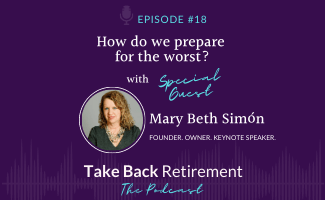
Guest Name: Mary Beth Simón
Visit Website: nichepartnershipconsulting.net/
“Most of us do not do enough to prepare for the unexpected.” How sure are you that you, your family, and your business are ready in times of emergency?
Our guest today is Mary Beth Simón. She founded Niche Partnership Consulting “to solve real-world problems faced by individuals and entrepreneurs” with particular emphasis on helping them create their contingency plan to keep business and life running smoothly in an emergency.
Listen in and learn why most people’s “contingency plans” are seldom robust enough when challenging times arrive and the most common things that they overlook when it comes to having their plan ready for deployment. Mary Beth also explains why contingency plans are not just for the elderly or sickly and why it is, in fact, never too early for anybody to start preparing theirs.
Reach out to Mary Beth to learn how to be prepared in times of emergency. Download her free contingency plan kit at www.nichepartnershipconsulting.net/kit.
Please listen and share with your friends who are in the same situation!
Key Topics
What does Mary Beth do, exactly? (1:52)
Optimizing our processes to be ready in times of emergency (4:45)
Why Mary Beth has her clients create a paper plan as opposed to a digital plan (07:00)
What most people don’t realize when it comes to having a contingency plan ready (8:02)
How a leader and their second-in-command can best prepare for the unexpected (10:32)
The process that Mary Beth uses when working with business owners (14:32)
“There aren’t that many people that you can pay to figure it out in an emergency.” (15:55)
Why do people avoid preparing for the inevitable? (18:07)
Why everybody needs a contingency plan (21:50)
How Mary Beth works with different kinds of clients on their plans (26:30)
Three things that anybody can do to be more prepared right now (31:26)
Mary Beth’s group program (34:23)
Why the time to have tough conversations is now (36:35)
“I don’t need it. My life is simple.” (37:36)
“It’s easier to plan when you’re not in the middle of a storm.” (38:56)
Stephanie McCullough: (00:00)
Welcome to Take Back Retirement, the show for women 50 and better facing a financial future on their own. I’m Stephanie McCullough and along with my fellow financial planner, Kevin Gaines, we’re going to tackle the myths and mysteries of “retirement,” so you can make wise decisions toward a sustainable financial future. Through conversations and interviews, you’ll get the information and motivation you need to move forward with confidence, and we’ll be sure to have some fun along the way. We’re so glad you’re here. Let’s dive in.
Stephanie McCullough:
Coming to you semi live from the beautiful West Lakes Office Park in Suburban Philadelphia, this is Stephanie McCullough and Kevin Gaines of Sofia Financial and American Financial Management Group. Say hello, Kevin.
Kevin Gaines:
Hello, Kevin.
Stephanie McCullough:
So today, our guest is Mary Beth Simón, she’s got a fascinating business called Niche Partnership Consulting. I met Mary Beth a few years ago. And I really thought that it would be appropriate to share what she does with our audience, because it really is on par with what we’ve been talking about.
Kevin Gaines:
Yeah, it complements what our goals with clients are. She just comes at a different angle, focusing on a different part of people’s lives professionally and personally. But you know, a lot of the same motivations are shared by us. So excited to talk with her.
Stephanie McCullough:
And like so many of the interesting business people that I’ve met over the years, what she does comes out of personal experience, and she’s going to share her story with us. So, let’s jump in.
Stephanie McCullough: (01:43)
Welcome Mary Beth Simón, to Take Back Retirement. We’re thrilled to have you here.
Mary Beth Simón:
Thank you, Stephanie and Kevin.
Stephanie McCullough:
So, why don’t we start with the real basics? What do you do?
Mary Beth Simón:
Sure. So, I coach individuals and entrepreneurs how to create their contingency plan and that empowers their second in command to keep business and life running smoothly in an emergency.
Stephanie McCullough:
So, that sounds like a great thing. What is it that’s so important, or maybe the story of how you came to do this work will tell us that.
Mary Beth Simón:
Sure. Yeah. So, I was working for Vanguard and I was preparing to retire. So, I knew that I wanted to retire in 2018, and in 2016 I was trying to figure out what I would do after retirement for my next career. So, I wanted to open a consulting practice and I wasn’t sure what my differentiating offer would be. And at the same time, one of my close friends who had retired two years before me, she was diagnosed with pancreatic cancer and initially the diagnosis was optimistic, they caught it early. It was operable, which was all great. And then within a matter of months, the diagnosis became more pessimistic. And of course, that was a very challenging situation. And at one point my friend asked me if she didn’t survive, if I would be willing to help her husband navigate the finances. So, my friend, she managed all of the investments. She handled all of the bill paying. They have two homes. She was a technology manager like me and her husband didn’t use a cell phone, didn’t use a computer.
Stephanie McCullough:
Oh, wow.
Mary Beth Simón:
Yeah. So, very different from a tech perspective. So I said, of course, that I would help. And I asked her if she would show me what was going on. And I think that was a step too far. So, she never did sit down and show me what was happening. And I think it was just too difficult in the middle of that diagnosis to do that. So, she passed away on the 4th of July and then I spent three months working closely with her husband to help figure out what the landscape of their finances looks like and to come up with a process to take them through while I was still working full time. And that’s when I realized that most of us do not do enough to prepare for the unexpected.
Stephanie McCullough:
Yeah. I have seen people try to go through it, whether with parents or spouses, and there’s just so much you don’t realize the other one is doing that needs to happen.
Mary Beth Simón: (04:44)
It’s exactly right. And I think for any of us who do manage the money in the home or for your business we kind of… It becomes second nature for us and we think, “Oh, they’re smart, they’ll pick it up.” And it’s really not a matter of intelligence. It’s really a process thing. We all have our own processes, even if it’s the way that we keep our passwords. Everybody has their own way of doing that.
Stephanie McCullough:
This is true.
Kevin Gaines:
Now to clarify, we’re not talking about an estate plan or anything like that. We’re talking, this is more like in case of emergency break glass, right?
Mary Beth Simón:
That’s right. So, it doesn’t have to be the scenario where my friend was passing away. It could be a scenario of I have a contingency plan in place because I want to make sure that if I’m hospitalized unexpectedly or if I’m out of the country and detained for a period of time that somebody here is going to be able to access all of my information and be able to keep things running smoothly.
Stephanie McCullough:
Do you feel like it’s gotten more challenging since so little of our lives is actually happening on paper anymore?
Mary Beth Simón:
It is challenging. And part of the challenge is that when you think of who is going to be your backup, how skilled is that person with digital versus analog type processes that’s another layer of complexity. So I see a lot of people who are great with having everything online, but maybe the person who is responsible to back them up and maybe their power of attorney may not be as adept at all of these digital processes. That’s a lot to think through.
Kevin Gaines:
So going on that, is it better to have a hard copy plan that literally you break the glass to grab or go into the desk and pull it out and go from there versus having something say in the cloud that just, “Oh yeah, just go to OneDrive or Google Docs or whatever and it’s sitting right there?”
Mary Beth Simón:
Yeah. So, that’s a great question Kevin. So, the plan that I create with my clients is a paper plan and they always could take that plan and upload it to a cloud. Now, I recommend using a very secure cloud. So, the only thing that I know of that I would recommend is Everplans and they’re out of New York City. And I know a lot of financial planners offer that to their clients as well. But what I have heard from financial planners anecdotally is that even though they provide that service to their clients for free, most of their clients don’t do it. And really the challenge is getting all the paperwork together. So, that’s where I work with people to create that hard copy plan. And then if they wish to put it in the cloud, then I think Everplans is a great solution.
Stephanie McCullough:
What are a couple of things that most people don’t realize, that they discover when they’re going through the work with you and go, “Oh my gosh, I didn’t think about that?”
Mary Beth Simón:
Well, one thing that people don’t realize, they don’t realize how many passwords they have, first of all. So I think on average, it’s estimated that most Americans have about 300 passwords, but I work with people who have upwards of 500 passwords.
Stephanie McCullough:
Oh my Gosh!
Mary Beth Simón:
So, depending on your business and your personal life, we have a lot. And then the other thing that people don’t think about is who do they trust enough to bring into this intimate circle and to tell someone where their passwords are what is their operating process and where all of their information is. So, that trust factor I think is challenging. And I think estate attorneys will say the same thing when it comes to naming a power of attorney. That’s where I hear some clients say, “I don’t trust anyone.”
Stephanie McCullough:
Ooh.
Mary Beth Simón:
Yeah. And so, it’s hard.
Stephanie McCullough:
Does it have to be all or nothing? Do you give one person access to your whole life or is there a way to kind of carve out and give different people access to different things like different levels?
Mary Beth Simón:
There is a way that you could do that. So for some people, for example, if they have a bookkeeper or an accountant who they are close with and they trust with all of that information, they may rely on them as their backup for that type of thing and then have someone else take over the rest of the plan, which in some situations, the divide and conquer mentality is a great way to go, depending on you have to think, “Is this person going to be able to conduct business while I’m in the hospital? Will they be emotionally upset or will they be able to do all of that at the same time?”
Stephanie McCullough: (09:57)
That’s a good point. I hadn’t thought about that piece of it because of course, right? This is only going to come into play during a crisis.
Mary Beth Simón:
Right. Some level of crisis, right? And everyone has their own life going on, so we don’t really know when it’ll happen and what that will mean for the other person that they need to drop.
Stephanie McCullough:
One of the estate attorneys that I know said recently, “One of the things people often forget is making a backup.” Yes, you need your second to command, but you need a backup to that person if for whatever reason that person is incapacitated or unavailable.
Mary Beth Simón:
I agree. Especially during COVID. So, my husband has always been my power of attorney and my second in command. And that’s when I realized, “Well, if one of us gets sick, we’ll probably both get sick. We both have businesses, we both have this financial life to manage.” And that’s when I realized that I needed to establish a secondary power of attorney and a backup to our contingency process.
Kevin Gaines:
Now, regarding the backup, do you find it works better talking about a married couple, having the same backup for both or having different backups? Pros, cons?
Mary Beth Simón:
Yeah. That’s something where we have to spend some time talking through who it makes sense to be the backup. So, first it needs to be somebody that we trust completely. Second, it needs to be somebody who accepts our mortality. So, if I can’t even talk to my husband about me dying, then I know that he’s not a good candidate to be my backup. The same goes with a lot of clients will say, “Well, it should be my oldest.” Same thing goes with your adult children, it all depends on the temperament and the personality of that individual. So, they need to accept your mortality. They need to be talented at doing difficult things. So, just like I was saying before, it’s an emotionally charged situation and there’s business to be taken care of and they need to be good at navigating paperwork and process. Think about phone calls to corporations about your retirement plan, your benefits, all of that kind of stuff.
Stephanie McCullough:
Fighting with a health insurance company?
Mary Beth Simón:
Exactly. It’s a very challenging thing to navigate. And that’s when one day I came home and I was complaining about what I was going through with my friend Sue with her situation. And my husband looked at me and said, “Who’s going to help me if you die first?” And I thought, “Ooh, I don’t know.” And so that’s when I started documenting all of this information and teaching other people how to do it because I’m like, “None of us are prepared for this.”
Stephanie McCullough:
Yeah. So, the connect the dots for us there. How did you go from going through this with your friend to creating your process in your business?
Mary Beth Simón:
Yeah. So, through the process with my friend after she passed away and I was helping her husband, I had people at Vanguard who were saying to me, “You should do this as a business. I would tell my husband to contact you if I died first.” That kind of thing. And I was like, “Okay, this is actually a thing.” So then, I decided to focus on it as part of my business and started with creating the plan for my family life and doing it for other people in our family, friends, and family, that kind of thing, and solidifying the process and then launched the business in May 2019. And once I opened the business, the primary people who came to me for a plan were small business owners, which I thought that that was interesting because they were the people who could see things unraveling quickly if they were pulled out of the mix. So, then the focus really became a working with small business owners and I still work with individuals as well, but primarily small business owners.
Stephanie McCullough:
Interesting.
Kevin Gaines:
So, when you do talk to these business owners, do you find the conversation encompasses both parts of their world, as opposed to just focusing on business? Because Stephanie and I can tell you as small business owners in many ways that it’s hard to separate the two entirely.
Mary Beth Simón:
It is. It’s very hard to separate. So, the process that I use is we begin by creating the contingency plan for your personal life. And then once we complete that, we go through the same process and we create a contingency plan for your business. Because in that way, we’re able to start to make the separation between the different operations, the accounts, all of that kind of stuff. And then the final piece is to create a business continuance playbook, where we focus on documenting the standard operating procedures for the business owner. So, business owners document the procedures for anything that they’re going to outsource or hire a consultant for, a contractor for, but they don’t document the procedures for the work that only they do. So, we go through a process of identifying all of the things that are only done by the business owner and then writing out those procedures, identifying decisions that the business owner makes and put that together in a playbook for the key personnel in the business.
Stephanie McCullough: (15:41)
I can see some people and I’ve heard this from clients sometimes when we talk about putting their documents, their legal documents into place they’re like, “Ah, I’ll be gone. I don’t care.” But it’s not only death that we’re talking. Right?
Mary Beth Simón
That’s right. That’s a common response, right? Or people say, “There’s plenty of money. There’ll be fine. They can pay somebody to figure it out.” There aren’t that many people who you can pay to figure it out in the middle of an emergency. So, what I like to say is, “Your estate attorney is not going to come to your house and look through your papers and go through your filing cabinet and look for your birth certificate so that you can be buried.”
Stephanie McCullough:
At $350 an hour.
Mary Beth Simón:
Right. So, somebody else is going to have to do that. And whether or not you have somebody in your life who will be willing to do that is to be determined. But the key is that this is in place so that if anything happens… Whenever something happens to people, often their friends and family, they want to help, but how often have you seen that it’s basically impossible for anyone to even help them because they need that other person. It doesn’t save any time because they need that key person to be there, either the spouse or the child, right? It’s not like they can just step in and help, but when you have a contingency plan, you can peel off pieces of it and give it to somebody and say, “Hey, would you hunt this down for me, make these phone calls?” That kind of thing.
Stephanie McCullough:
That’s a good point. Instead of just all making casseroles, we’ll say, “Here, do these three things and report back.”
Mary Beth Simón:
Yes. How much more helpful would that be?”
Stephanie McCullough:
Yeah. Enough baked ziti, already.
Mary Beth Simón:
Right?
Kevin Gaines:
Yeah, it’s all well and good to be wanting to help, but if nobody knows where to start…
Mary Beth Simón:
That’s exactly right. And I hear it all the time. There’s an illness, somebody is in the hospital and the family the spouse may and the kids are upset, are involved in visiting the hospital, but there’s no way for somebody else to easily help.
Stephanie McCullough:
Yeah. Hmm. That’s a really good point. Okay. So, this is important work, we’ve established that. Why Mary Beth do people avoid it?
Mary Beth Simón:
So, people avoid it because I think that they have an idea that if they speak it, it will make it happen. And I’m of the thinking that if we plan for it and address it, it will make it less likely to happen. of course something is going to happen to all of us at some point, but I feel like once we’re prepared, it lessens the stress that we carry and we tend to be able to live more freely.
Stephanie McCullough:
I think you’re right. In addition to not wanting to address our mortality or think about bad things that can happen, there’s a lot of talk out there like, “Oh, if you put it out into the universe, you’ll attract what you’re thinking about,” which probably has some validity in some areas, but we beat this drum all the time Kevin that, “Do the planning before the crisis hits, when you’re feeling calm and rational and have the time to think it through, especially with the professional to help you think it through as opposed to waiting until a crisis and then trying to pick up the pieces.”
Kevin Gaines:
Yeah. how many of us make great decisions in a panic situation? Quite frankly, I look at it this way. If you’re worried about jinxing yourself by doing this, do you jinx yourself by getting insurance for your car or for your house?
Mary Beth Simón:
Exactly. Or life insurance. Right?
Kevin Gaines:
Yeah.
Mary Beth Simón:
Most of us have life insurance, but yeah, it’s nearly impossible to create a plan in the middle of an emergency. And that’s what I try and tell people. In the middle of a storm is not the time that you’re going to be able to have the mental bandwidth and the focus to do this.
Stephanie McCullough:
Yeah. And they’ve done studies showing that, right? That, that frontal cortex, that part of your brain that does the higher level reasoning shuts down when you’re super emotional. So, it’s no fault of our own that we can’t handle it in a crisis when we’re grieving or super stressed out. It’s biology.
Mary Beth Simón:
Right.
Kevin Gaines: (20:03)
And quite frankly, you may not even have time to try to do it in a panic situation because not everybody gets 48-hour notice, “Hey, guess what? You’re going to be incapacitated in two days, so figure it out.”
Mary Beth Simón:
Right. That’s the thing it’s like, even if you had a concussion you might not be able to read for a while, you might not be able to focus and look at the computer. Can you just think of things that are like very temporary where you might need help and if you don’t have a plan in place, then it’s very difficult for somebody to step in.
Stephanie McCullough:
And back to this point about, it’s not just the end of life, right? It’s, “Oh my gosh, I’m going to have to be undergoing intensive medical treatment for the next six months. And I have to focus on that and I want my business to still be there at the end, or somebody has got to pay the bills at home and things have to keep chugging along without me doing all those crucial things that I do.”
Mary Beth Simón:
Yeah. And it’s so interesting. I find that when people have been successful and without any medical emergencies for a really long time, they become emboldened. The older they get, they’re like, “I’m going to be fine. Look I just made it all these years and everything’s gone well and I should be fine.”
Stephanie McCullough:
Back to the indomitable teenager attitude.
Kevin Gaines:
Yeah, “I never get sick.”
Stephanie McCullough:
Right.
Kevin Gaines:
Exactly, exactly.
Stephanie McCullough:
Can I ask a question?
Mary Beth Simón:
Yeah.
Stephanie McCullough:
A lot of people have fought me over the years on the idea. I believe that a stay at home mom doing lots of unpaid work, but not making an income needs life insurance. Would you say that she also needs a contingency plan?
Mary Beth Simón:
Absolutely. Because there are all types of indications that she is managing the finances and keeping the household running and she knows where everything is located. So, it’s very important that she has a plan that somebody else can pick up because she does all of this work that is not compensated and who would be able to fill her shoes if she was out of the picture for a short period of time or longer.
Stephanie McCullough:
Right. Paying the school tuition, making the dentist appointments, right? Getting people to their activities. even just knowing the carpool schedule.
Kevin Gaines:
Because we’re not talking about just knowing where the passwords are stored. It’s how everything fits together. What is the schedule?
Mary Beth Simón:
That’s right. It’s everything. Yeah. So, you just think of even like maintenance contracts, who are the contacts who you work with. So, for financial planners, a lot of people don’t ever write down who the financial planners are. So, it’s important for people in the family to understand who are their contacts that they should be working with.
Stephanie McCullough:
Yep. Absolutely. Oh my goodness. So, do you have any stories for us either nightmare stories you’ve heard or positive stories of people you’ve worked with?
Mary Beth Simón:
Yeah. So, I have to say that when I work with small business owners, after they create their contingency plan, something pretty remarkable happens. It seems to… Like I was saying before, it relieves a level of stress that they weren’t even aware that they were carrying. And then the business owner leapfrogs into a new level of their business or what they’ve always wanted to do. So, I have one business owner that after the plan was completed, he really started focusing on turning over the business to his adult children and moving into his retirement passion project, which was fantastic to see. And as always, it’s a little challenging going through those conversations with your adult children, about what to do when I’m no longer here or if something happens to me, all of that, but the reward was fantastic.
Mary Beth Simón:
And I see business owners just really move on to bigger and better things after they have their plan in place. And the same thing with individuals like young couples tend to work with me because they too can see they’re worried about their kids and they want to make sure that they have a plan in place. And then after they work with me, then they move forward and they get really solid financial planning advice, they get great insurance for their life insurance outside of work, that kind of stuff. So, that’s really exciting that transformation is what really jazzes me up when people say, “It was because I did this contingency plan that I started to think about this and that, or had these great conversations with my adult kids and that kind of thing.”
Mary Beth Simón:
And then for the sad stories, there’s somebody who a friend is talking to me about now. It’s a young family and the guy is in the hospital getting treatment and the diagnosis isn’t really optimistic. And they’re talking about creating a plan, but it’s not the time for him to be involved in it. And just like I was saying earlier so the wife is busy with the kids and with what’s going on with him. And it’s so challenging that there really isn’t like an age range for… I guess people think maybe a contingency plan is for older people and that’s not accurate.
Stephanie McCullough: (25:53)
Right. Because s*** happens to us at any age.
Mary Beth Simón:
It’s sad, but true.
Kevin Gaines:
It’s like where you irreverently call it bus risk. The bus can hit you at any point.
Mary Beth Simón:
Exactly.
Kevin Gaines:
Sometimes literally, sometimes figuratively, but something that’s coming out of the blue can happen to the 23-year-old, just as easily as an 87-year-old.
Mary Beth Simón:
Yeah. And I’m sure you guys see that as well with your clients that we do think that younger people don’t have to worry about planning as much, but they do.
Stephanie McCullough:
Yeah. Can you give us a little outline of the process you take clients through?
Mary Beth Simón:
Sure. So, when we first start walking together, so for business owners, it’s the personal contingency plan, the plan for their business and then the business continuance plan, but for we’ll just focus on the contingency planning process. So, I have a proprietary process that I put together. So, it is a binder with sections, folders, where all of your information can go into it. And it usually takes about four weeks to get through creating the plan. So, it takes about 12 hours. And I recommend about three hours a week because it can get old working with paperwork. So, the beginning process is really where our clients have to find all of their documents. Where is the deed to your house? Where are the titles to your vehicles? Where are your birth certificates, all of that, where your estate planning documents? And for anyone who does not have their estate planning documents in place, this is in the very beginning of the four week process, they’ll reach out to their attorney or I’ll make a referral for an attorney for them to work with to get them in place.
Mary Beth Simón:
So normally, by the end of the four-week period, they have their contingency plan and their estate planning documents all up to date so that they are ready to move forward. But the plan includes all of their important information, credit card statements, bank account statements, investment documents, everything. So, it can be pretty large. And then I encourage them to have a fireproof safe to store the plan in.
Stephanie McCullough:
And then people have to know that you have the safe, right?
Mary Beth Simón:
Yes. So then, the other part is the password management. So, there’s a paper book that I create for my clients, or they might use something like LastPass or an online password manager. And then the key is to make sure that their second in command is able to use the password system that they have in place. But yeah, once they have all of that in place, then the next step is to review it with their second in command. So, that takes about three hours to review your plan. So, depending on the personality of the individual you’re reviewing it with, you might want to do an hour and a half, go out to lunch, do another week of an hour and a half go out to lunch, and then you just want to give them time to absorb it all and to give you feedback where it’s not clear enough or they need more information, that kind of thing. So, it’s a two-way conversation.
Stephanie McCullough:
And you coach them through how to have that conversation?
Mary Beth Simón:
Exactly. So, depending on how they decide to work with me, I’ll even attend that meeting with the second-
Stephanie McCullough:
Oh, good.
Mary Beth Simón:
… in command and just observe and try and help keep the conversation on track, right? Because we have a tendency we can get easily distracted and diverted from doing this type of work.
Stephanie McCullough:
You think? I think I’d rather scrub my garage with a toothbrush than do that kind of work.
Mary Beth Simón:
Exactly!
Stephanie McCullough:
It’s like, what I do during tax time.
Kevin Gaines:
Do you find it helpful to be in the room especially if it’s like a conversation between spouses where there could be a little bit more emotion involved?
Mary Beth Simón:
Yes.
Kevin Gaines:
Or parent and child again, somewhere where the second in command has a stronger emotional…
Mary Beth Simón: (29:59)
Yeah. So, it depends if me being in the room is going to quiet the conversation that needs to happen, then that’s probably not a good thing. So, I usually defer to my client as to what will be the best scenario for them, depending on who their second in command is. But it can be really helpful to have me there to go through the process because one, then the second in command knows that I am a resource for them as well. And I can just reinforce the methodology and help the review stay on track.
Kevin Gaines:
Do you find your process is different and it might not be when you’re dealing with somebody who’s single versus somebody who’s married or has an established business partner or something long do you think?
Mary Beth Simón:
Yeah. So, the biggest difference for a single person is it’s important for them to trust someone enough, to be able to have them as the second in command. That’s usually the biggest difference. For most married people, there’s somebody in that network in their friends and family group that they definitely trust already.
Stephanie McCullough:
Interesting. So, if people are coming away from the conversation thinking, “Ooh, this makes me nervous. I haven’t done this work.” Maybe you could give them one or two homework items that they could work on that would put them in a better position than they’re in today.
Mary Beth Simón:
Yeah, absolutely. So, the first thing I would say would be around the estate planning documents. If you have them pull them out and read them. If they haven’t been updated for the last decade or even the last five years, then it might be important for you to schedule time with your attorney and do a review and make sure that everything is updated. Anytime that I have pulled out estate planning documents after a long period of time of not reading them, I always find there’s some mistake, there’s something that has changed. So, that’s something that we don’t do normally on an annual basis and we really need to do. So, that’s one I would say is get the will, living will and power of attorney in place at a minimum.
Mary Beth Simón:
And then the second thing for the homework assignment, I would say is get all of your passwords in an easy-to-use system, easy to use for you and easy to use for your second in command. And that might mean two different systems. So, I use an online password manager because that’s easy for me, but I also have them written in a book because that’s easy for my second in command. So, we always have to think about that second layer.
Stephanie McCullough:
That’s a good point. Because you do want to make it easy on whoever has to step in.
Mary Beth Simón:
Yes. And oh, one other thing, this is a bonus. Make sure that someone can unlock your phone. So, your second in command needs to have the code to your phone because how many passwords have two factor authentication now that they’re not going to get anywhere without access to your phone.
Stephanie McCullough:
Very good point.
Kevin Gaines:
Regarding the safe. So, you want this fireproof safe to keep everything. Do you have a preference for it to be portable or bolted into the ground? Because strangely enough, I’ve actually had these conversations before of whether the advantage of it being portable is if we got to get the hell out of here, we can grab it, but then it’s easier to steal. Do these conversations come up?
Mary Beth Simón:
Well, I haven’t had that conversation with anyone. So, I do like the idea of the portable, fireproof safe bags for people who live in fire prone areas. So, my youngest brother is in Colorado and I guess they have fireproof boxes where they keep all of their important things and his contingency plan is in there, but I like a safe that cannot be moved in the house. But maybe it’s a good idea to have something that is portable as well if you feel like you’re going to have a need to flee due to a natural event or something like that.
Stephanie McCullough:
Good point.
Kevin Gaines:
Good thought.
Stephanie McCullough:
So, Mary Beth, you mentioned that you have a group program. What does that look like and how did you come up with that way of working on this topic?
Mary Beth Simón:
Yeah, so I was looking at trying to offer personal contingency planning to people for a lower price than the one-on-one engagement. So, when people work with me, one-on-one, it ranges from $1,500 to $3,000, depending on the amount on the level of assistance that they need. So, for the group program, we have eight individuals who come together to create their plan for their personal life. It’s only for their personal life and that’s $997. And then I usually run some type of a special before the program kicks off. And we work together for four weeks. And we meet for 90 minutes a week as a group. So, it’s nice for people who like a group learning experience. And a lot of people in the program have said that they learned from the questions that the other people ask, even if it’s not a question that they have at the moment, it gets them thinking about the future for themselves.
Stephanie McCullough: (35:28)
And in my experience, a lot of especially women find these whole thing’s kind of intimidating and easier to just put off. I wonder if doing it together almost kind of brings a level of comfort?
Mary Beth Simón:
Yeah. there is a sense of community when done in the group program. So, I think that it does give them a feeling of, “Oh, this is normal and we should be able to talk about this with our friends, with our family.”
Stephanie McCullough:
That’s one of the big things Kevin and I have been hitting on in this podcast. So, listeners might get tired of hearing it, but we’re always saying, “Have the conversations with your loved ones now. Make sure you ask the questions, make sure where the stuff is, make sure they know what you want.” All those things that often people feel like they’re uncomfortable or they’re taboo, so they don’t get talked about.
Kevin Gaines:
Yeah. It’s better to know the question needs to be even if it only gets you as far as knowing the questions to ask at the time. At least getting to that point gets you somewhere to start. Again, going back to having a starting point. Right?
Mary Beth Simón:
So true. And it’s a shame when put off things that are difficult conversations until there’s a time when there is an emergency happening, because if you think it’s difficult to talk about now, wow, it’s going to really be difficult then. So, it’s important. I always want people to get what they wanted out of the situation for what they want to happen, whether it be from an estate planning perspective or for their real estate to pass to the people who they want it to pass to and that kind of thing. And if that’s a difficult conversation and you haven’t nailed that down in your estate plan, it’s better to slay that dragon now rather than wait until there’s really a crisis that you’re facing where you have to get that in place.
Stephanie McCullough:
Eat that frog, I would say.
Kevin Gaines:
Now, do you also find in addition to people saying, “Well, I just don’t want to start. I don’t want to go down that path. It’s just way too complicated, way too scary.” Do you also come across people saying, “I don’t need it. My life is simple.” And how do you have that conversation?
Mary Beth Simón:
Yeah, I think from an estate planning perspective, I think estate attorneys hear that frequently that they don’t have enough assets to have a plan in place, all of that. And most estate attorneys will say, “If you have pets, if you have children or you own property, you need an estate plan in place.” And from a contingency planning perspective, I don’t know if you know any young people, their digital life is not simple. It isn’t. It’s natural to them, but it is not simple. And it’s important for any parents of adult children over 18, if that adult child wants their parents to be able to help them out in an emergency, they have to set that parent up so that they are legally allowed to assist from a health perspective and a financial perspective.
Kevin Gaines:
So, in closing, let’s go with this question. What else should people think about or what’s the one thing you want people to walk away from this conversation?
Mary Beth Simón:
So, the one thing that I want people to walk away from this conversation with is that it is easier to plan when there is no urgency and you’re not in the middle of a storm. So, if everything is going fine, this is the time to create your plan.
Stephanie McCullough:
Yeah. The important, but not urgent. It’s often so hard to prioritize that stuff.
Mary Beth Simón:
Exactly.
Stephanie McCullough:
Thank you so much, Mary Beth for joining us. How can people follow you and learn more?
Mary Beth Simón:
Sure. So, I do have a free download available for your listeners on my website.
Stephanie McCullough:
Cool.
Mary Beth Simón:
So, if they go to nichepartnershipconsulting.net/kit, they’ll get a link to download a free contingency plan kit that will get everyone started on working through what they need to consider with their plan. And if anyone wants to connect with me on LinkedIn, I’m most active there. So, just let me know that you heard me on the Take Back Retirement Podcast and I would love to connect with you.
Stephanie McCullough:
Awesome. Thanks so much for being with us.
Kevin Gaines:
Thank you, appreciate your time.
Mary Beth Simón:
Yeah. Thank you so much. It was a pleasure talking with both of you.
Kevin Gaines (40:15)
So, that was interesting. I really like what she had to say. And what Mary Beth does, like we said in the introduction, kind of parallels what we do. Instead of talking about your retirement, she’s talking about making sure your entire life is understood, and somebody can step into your shoes to run things while you can’t. I think that’s important for a lot of people to at least think about.
Stephanie McCullough:
I like that you said, we all have to accept our own mortality. And I see so many people, often in my own life, who are really kind of head in the sand about that. They don’t want to have the conversations with people. They don’t want to ask their spouse where the passwords are, because it’s almost like speaking it will invite it to become so. But you and I are both firmly of the position, it’s better to be prepared. So that, yes, it’s going to be a crisis if something disastrous happens. It’s going to be emotionally fraught. And if the logistics are easier, because you’ve done some of the planning, what’s the downside there?
Kevin Gaines:
Yeah. You’re trying to make things easier for everybody so things can run smoother. That’s really what we’re talking about here. Whether it’s because you’ve passed on and you want your loved ones, you know, they’re going to be grieving. So, if you can, anything you can do to make their lives easier is you showing that love a little bit more. But also, just being sick, you’re coming back. Do you really want to, you finally recover from whatever and then you’ve got to spend the next six months trying to put everything back together, because you never told anybody where anything was?
Stephanie McCullough:
Right. Maybe by now your electric and your phone have been chopped off because nobody knew how to pay the bills.
Kevin Gaines:
Well, how many of us joke about, and we joke because it’s funny, because it’s true. We joke that going on vacation is actually stressful knowing that when you come back, you’re going to have a week’s worth of stuff sitting on your desk. That’s what we’re talking about here. Except it’s more than a week.
Stephanie McCullough:
Well, I love that, even when she works with business owners, she says the first step is to do your personal stuff. So, it really is the personal life. These lives we live, even if we think we live relatively simply, we live in a complicated society, right? You’ve got to figure out your car insurance and your homeowners’ insurance and all these various bills we’ve got and the medical stuff here, there and everywhere. They get complicated over the years. Things pile up. And I think there’s more details than we realize.
Kevin Gaines:
Well, how many times have we said it’s not as simple as we think initially? We have talked about social security. We’ve talked about IRAs. Your life, for the first 30 seconds, it’s like, “Oh, yeah, it’s simple. It’s boring. There’s not a lot going on.” But then when you start listing and thinking about it, you realize there’s a lot more to it than you give yourself credit for.
Stephanie McCullough:
Yeah, lots of moving pieces. I love that Mary Beth offers the free kit on her website. And I think the group program could be a really interesting way for people to work with her and kind of walk through getting this all set up. So, we’ll have all of her contact info in the show notes. Please check it out.
Kevin Gaines:
Absolutely. And hey, now that we’re all out of quarantine, hey, here’s another excuse to have a group get together, right?
Stephanie McCullough:
It’s virtual.
Kevin Gaines:
Oh.
Stephanie McCullough:
He’s hoping, folks.
Kevin Gaines:
I try, you know? I’m grasping for anything I can.
Stephanie McCullough:
Alright, thanks for being with us, everyone. We’ll talk to you next time. It’s goodbye from me.
Kevin Gaines:
And it’s goodbye from her.
Stephanie McCullough: (43:47)
Be sure to subscribe to the show and please share it with your friends. Show notes and more information available at takebackretirement.com. Huge thanks for the original music by the one and only Raymond Loewy through New Math in New York. See you next time.
Disclaimer:
Investment advice offered through Private Advisor Group, LLC, a registered investment advisor. Private Advisor Group, American Financial Management Group, and Sofia Financial are separate entities. The opinions voiced in this material are for general information only and are not intended to provide specific advice or recommendations for any individual security. To determine which investments may be appropriate for you consult your financial advisor prior to investing. This information is not intended to be substitute for individualized tax advice. Please consult your tax advisor regarding your specific situation.