Take Back Retirement

Episode 83
Combatting Fraud and Protecting Your Financial Future with AARP’s Kathy Stokes
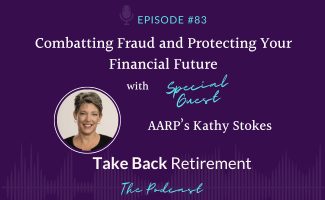
Guest Name: Kathy Stokes
Visit Website: aarp.org/money/scams-fraud/about-fraud-watch-network
“If you know about a certain scam, you’re 80% less likely to engage with it. So, please tell everybody you know.” -Kathy Stokes
Could your loved ones be vulnerable to a $9 billion wave of deception? Kathy Stokes from AARP joins our hosts Stephanie McCullough and Kevin Gaines to unravel the complexities of fraud that’s sweeping the nation, hitting older adults the hardest. With victims often bearing the burden of shame, they’re challenging the stigma and equipping you with the knowledge to identify scams and shield your family.
Amidst the digital age, where swindlers lurk behind screens, this episode takes a hard look at the emotional web of online romance scams, originating from the most unexpected places like vacant Cambodian casinos. The conversation navigates through the tactics of cybercriminals as they exploit trust for financial gain.
Stephanie, Kevin, and Kathy outline the actionable steps every individual should consider, from skepticism towards unsolicited communication to the merits of credit freezes. AARP’s robust network of fraud-fighting volunteers and their educational resources are just a call or click away, serving as your allies in the battle against fraudsters who target your wallet and well-being.
Resources:
- FWN@aarp.org
- Victim Helpline 877-908-3360
- CryptoScam from Wall Street Journal (free podcast): https://www.wsj.com/podcasts/the-journal/pig-butchering-a-texting-scam-with-a-crypto-twist/296e499f-ba82-46f2-ade9-5b70710d558e
- NPR story on crypto scam https://www.npr.org/2023/06/25/1180256165/crypto-scam-senior-victims-spirebit
Please listen and share with your friends who are in the same situation!
Key Topics
- Welcome Kathy Stokes! (03:08)
- Financial Fraud’s Impact on Victims, Specifically Elders (04:57)
- Phone Scams and How to Identify Them (11:43)
- Protecting Seniors from Scams (17:30)
- Law Enforcement Response to Financial Scams (22:11)
- Online Safety and Cybersecurity (31:12)
- AARP, Getting Direct Support (43:20)
- Stephanie’s and Kevin’s Takeaways (47:46)
[Music Playing]
Stephanie McCullough (00:00):
Today’s episode is very important. I don’t want to minimize the seriousness of this issue because we are talking to Kathy Stokes of the AARP on fraud and the danger it poses to all of us, really. Kathy is a nationally recognized leader in the area of consumer fraud. She’s director of Fraud Prevention Programs with AARP. Yes, the American Association of Retired Persons. She leads their social mission work to educate older adults. Yes, that’s all of us on the risks that fraud represents to the financial security, which I mean, how could we get a more pertinent topic?
Stephanie McCullough (00:46):
Hey, dear listeners, we need to let you know that Kevin and Stephanie offer investment advice through Private Advisor Group, which is a federally registered investment advisor. The opinions voiced in this podcast are for general information only and are not intended to provide specific advice or recommendations to any individual. To determine which strategies or investments may be suitable for you. Consult the appropriate qualified professional prior to making a decision. Now, let’s get on with the show.
Stephanie McCullough (01:21):
This is Take Back Retirement, the show that’s redefining retirement for women. Retirement is an old-fashioned cultural concept. We want to reclaim the word so you can make it your own. I’m Stephanie McCullough, financial planner and founder of Sofia Financial, where our mission is to reduce women’s money stress and empower them to make wise holistic decisions so they can get back to living their best lives. Kevin Gaines is my longtime colleague with deep knowledge in the technical stuff: investments, taxes, retirement plan rules. He’s a little bit nerdy and quantitative, I’m a little bit touchy-feely and qualitative. Together, through conversations and interviews, we aim to give you the information and motivation you need to move forward with confidence. We’re so glad you’re here. Coming to you semi-live from the beautiful Westlakes Office Park in suburban Philadelphia, this is Stephanie McCullough and Kevin Gaines of Sofia Financial and American Financial Management Group. Say hello, Kevin.
Kevin Gaines (02:22):
Hello, Kevin.
Stephanie McCullough (02:32):
We are talking to Kathy Stokes on fraud. Since 2019, she and her team have vastly expanded AARP’s leadership in this space, including the creation of a new victim support program, which she’s going to talk about, a multi-year campaign to end the use of gift cards in fraud and the formation of a national effort to fundamentally transform how our country addresses consumer fraud. She also serves on the Advisory Council of the Board of International Association of Fraud Crimes Investigators and the Advisory Council of the Senior Issues and Diminished Capacity Committee of the North American Securities Administrators Association. Let’s dive into our conversation with Kathy. Kathy Stokes, welcome to Take Back Retirement.
Kathy Stokes (03:08):
I’m so glad to be here. Thanks for having me.
Stephanie McCullough (03:11):
Of course. I’m so excited that we get to share with listeners about this issue. How big of an issue is fraud in the U.S.?
Kathy Stokes (03:19):
Well, it’s bigger than we can imagine. It’s bigger than what the data show, but if you look at sort of the agency of record, the Federal Trade Commission, they will tell us that in 2022, reported losses to fraud were $9 billion, and that’s with a B up from 2.4 billion in 2019. So, look at that meteoric rise that happened over the pandemic, and I’m sure we’ll see 2023 being even more than 9 billion reported. But understand, most people don’t report, so it’s much, much bigger than we know.
Kevin Gaines (03:55):
Are there estimates on how big it is?
Kathy Stokes (03:59):
Well, the Federal Trade Commission for the first time, to my knowledge in a recent elder fraud report, said publicly that they believe that somewhere around only 2 to 5% of victims report.
Kevin Gaines (04:10):
Wow.
Kathy Stokes (04:10):
So, I don’t do math, but imagine that $9 billion.
Stephanie McCullough (04:19):
Kevin, you’re our math guy.
Kevin Gaines (04:23):
Yeah. So, what, anywhere between 450 billion to 900 billion? Yeah, let’s go with that.
Kathy Stokes (04:29):
With that we could say definitively that it is the number one crime in our country, but nobody looks at that way because we just don’t know how bad it is. People don’t talk about it when it happens to them because of the shame and embarrassment that we’ve allowed to happen in this country, which has served to deprioritize it as a crime for law enforcement. It’s had many, many implications.
Stephanie McCullough (04:57):
Oh my gosh. So many places to go with the conversation, but let’s jump into that one. The shame and the impact on the victims, and I love your focus on kind of trying to change the language we use around this.
Kathy Stokes (05:11):
So, I work on a program called the AARP Fraud Watch Network, and we focus on prevention through education, but also supporting of victims. I have a colleague who directs that work, Amy Nofziger. She’s been in this space for more than two decades, supporting victims of fraud in various ways. But her team this year will probably end up having spoken to 120,000 people, a large share of who are either victims or victim family members who come to them with, “Oh my God, I can’t believe I fell for it. I can’t believe he duped me.” Or just so concerning is the adult child of the older victim going, “I think my mom’s losing it. Why would she possibly fall for that?” And it was her experience and her team’s experience like four years ago where we said, let’s look at this. Let’s go a little deeper on this. And so, we got some funding, and we did some research with FINRA Investor Education Foundation and this really great consulting organization called Heart & Mind Strategies. We ended up producing a paper that did sort of a deep dive on all of this. It’s called Blame and Shame in the Context of Financial Fraud. I know, great title, but-
Stephanie McCullough (06:30):
Gets to the point.
Kathy Stokes (06:31):
A little clunky. But it gets to the point. And the point is, at every level of society, we blame fraud victims for the fraud they experienced. We don’t do that typically with other crimes. I mean, we might say like, “Well, why did you leave your door unlocked?” But it’s nowhere near what we do with fraud victims because we have these assumptions. And the assumptions are, it only happens to old people because they’re experiencing cognitive decline, would never happen to me. The other thing is that never would happen to me. So, it’s not an issue. I don’t have to worry about it. And what we learned is what I just mentioned a few minutes ago, it has just really served to deprioritize it, it such that law enforcement, they have so much to deal with at the federal, local state level. And so, quite often, because we haven’t really looked at it as a crime and it hasn’t been prioritized, somebody will call local police and say, “Hey, this just happened to me. Somebody calling and they made me believe it was my bank and my money is gone. What do I do?” And they’ll be like, “Well, it’s transnational. We can’t really do anything about it.” Or you gave them your money. Or importantly, we had an experience even just two months ago where a woman had called police after realizing she had lost $80,000 to a crime, a scam crime. And the officer who answered the phone said, “You don’t deserve our help.”
Stephanie McCullough (08:01):
Oh!
Kathy Stokes (08:01):
Yeah.
Kevin Gaines (08:02):
Really? Geez.
Kathy Stokes (08:03):
Yeah. And it’s this assumption, it’s like, how could you be so stupid?
Stephanie McCullough (08:08):
But that’s misplaced. Talk to us about why it’s misplaced.
Kathy Stokes (08:13):
Horribly misplaced. What we know about fraud is that it’s been around since the beginning of time in one way, shape, or form, of course. And it’s always relied on the same playbook. The scams can change, the tactics can evolve, but basically, it’s this, get the target into a heightened emotional state, whether it’s fear, panic, excitement, because they know (and it’s basic brain physiology), if you go right to emotion, it’s really hard to back out and access logical thinking. So, what happens to everybody all the time, because that’s how our brain functions. So, if they can get you scared, “Oh my God, the IRS is coming after me. I have these back taxes I didn’t even know about, and I’m going to be arrested,” or “Oh my God, my grandson’s in really big trouble and I just need to do anything I can do to help him.” We’re not going to back out and go, wait a minute, if this was my grandson, what is your dog’s name? Because those are the kind of the things that we used to say, like, ask some questions that only your grandson would know. Well, no, because we can’t get to logical thinking, so we need something else. But all of this is to say the scammers are really good at what they do. And as long as they can keep the person in that state of heightened emotion, they’re not going to be able to access logical thinking and back out. Importantly though, if you know about the scam ahead of time, you’re more likely than not to go, “Oh, wait,” and not engaged to begin with. So, that’s why education is super important. FINRA Investor Education Foundation, who I mentioned before, they did a study in 2019 that found that if you know about a specific scam, you are 80% less likely to engage with it.
Stephanie McCullough (10:04):
That’s big. 80%.
Kathy Stokes (10:05):
And if you do engage, you’re 40% less likely to have money or personal information stolen from you. So, education is huge, but we’re in a place where we cannot educate our way out of this epidemic.
Stephanie McCullough (10:21):
The other thing is that we think it might be some guy with lots of empty potato chip bags sitting in his basement doing this scamming. But that’s not really the case anymore.
Kathy Stokes (10:31):
Yeah. So much of this now is in the hands of transnational criminal enterprises. They’re all over the country. I mean, all over the world and the country too. But even though they’re all over the world, they have aiders and abettors in the United States, and it’s been proven that if you focus on trying to put like cases together and being able to sort of connect the dots and see, oh my God, this is all the same MO, you can go after the guys on the ground that are helping with money laundering or picking up the money and moving it over here, or whatever it is they’re doing. And that disrupts the fraud business model. So, that’s the kind of thing that we’re hoping that we can try to get enough energy and support for to really start going after the bad guys on the ground, not thinking that it’s only getting the little guys, but it’s disrupting the business model for the big guys. And maybe they’ll go do something else.
Stephanie McCullough (11:28):
Because it’s a business, it’s well organized, they’ve got resources behind them all versus one person alone in their home trying to figure this out. And maybe the person is nervous to share or ask anybody about it because it feels like you said heightened emotion.
Kathy Stokes (11:43):
And they’ll tell you, I mean, some of these scams they can go on for days, weeks, months, years. And all along they’ve been able to get the target to agree that it’s a bad idea to tell anybody, and they stay in that space. And that’s why it’s so harmful. And these guys, the criminals have big buildings, they have employees that are paid to do this on the daily. They have scripts, they have the technology now with artificial intelligence, with the new ChatGPT and all of those resources out there, it just becomes easier than ever to create an email or a text message or a webpage that looks exactly like what you would think it would be from a big business. Easier than ever to take five seconds of somebody’s voice and then use generative AI technology to make that voice say whatever you want it to say. So, that grandparent scam, it really does sound like it’s Jimmy. It’s Jimmy’s voice.
Kevin Gaines (12:49):
So, what steps or what tools do the scamsters use to convince you not to tell anybody?
Kathy Stokes (12:57):
It’s social engineering, and I would just say these guys are criminals, predators, perpetrators. I don’t use scamsters. I don’t use fraudsters because it makes it sound like they’re not really criminals. And it’s social engineering tactics. It’s that heightened emotional state. And when you’re in that space and you have a skilled criminal, then there are levels of criminality here. The first level is the low on the totem pole person that’s supposed to just sort of catch the fish, so to speak. But then it goes up to the next level and maybe even a higher level of the criminals who have developed expertise over a long period of time to be able to make everything seem so much so real. For example, you get a call and it’s your bank or it’s the FBI or it’s whatever, saying, “Hey, there’s something going on right now. So, it looks like someone’s trying to attack your accounts online, but you know what, we can help you. I’m going to connect you with an, with an FBI agent who’s going to call you tomorrow. We’re going to work all of this through.” You get the call from the FBI agent assumingly. The next day he is working with your bank, and now they’re saying there’s an active hack going on. This is what you have to do to move that money. And when you go to the bank and tell them it’s dangerous, because they may be in on it. So, tell them that you’re just taking this money out for, you’re doing a home improvement. And they’re like, “Okay, okay.” Because now they’ve gone from being really scared to being trusting of these criminals and will do anything because they think they’re doing the right thing.
Stephanie McCullough (14:36):
Yeah. They think the person or people on the other end are legit.
Kathy Stokes (14:40):
Yeah. And sadly, when you are socially engineered like this to believe this is true, and you are engaged in the transactions yourself, it is not considered the bank’s jurisdiction to have to make you whole. As long as it’s socially engineered, you had some role in authorizing the transaction, it is not the financial institution’s responsibility to recoup those funds or give you any remuneration. And you can understand why. I mean, how is a financial institution going to create technology like they can with credit cards and stuff like that to stop social engineering? So, it’s like, not their fault, it’s not your fault, but something has to give because people are being financially devastated. People are dying by suicide; people’s families are destroyed. So, we need a solution. It’s just not an easy solution.
Stephanie McCullough (15:39):
Yeah.
Kevin Gaines (15:41):
So, what are some of the things to look out for? I mean, obviously every scam is different, but are there certain similarities that is like, oh-
Kathy Stokes (15:52):
Yeah. Well, if I were to sit here and give you all the red flags, we’d probably be here for like seven hours. Because every scam has its own set of red flags. And they’re important to know. We put together a watchdog alerts by email and text that goes out every two weeks on a specific scam. And we tell you what the red flags are, what to know, what to do. That’s pretty much what you see in a lot of media reporting about this. All that is really, really important.
Kevin Gaines (16:18):
Is that something our listeners could sign up for to just stay in the know?
Kathy Stokes (16:23):
Yeah. Just if you go over to aarp.org/fraudwatchnetwork, you can sign up for the email or the text, or you could just send FWN that stands for Fraud Watch network over to 50757, and you’ll get them in your text every other week. And even if you just scan it, it’s reminding you that fraud is out there. And I would hope if you scan it and think, “Oh my God, I bet my mom doesn’t know this.” Or talk about it around the virtual water cooler, the more we talk about it, the more protective it is.
Stephanie McCullough (16:55):
But I remember when you and I first met, you had talked about kind of three commonalities. And if we could all be aware of these, even if we’re not aware of a particular scam, we’re like, oh, wait a minute, it might help us. Can you tell us that?
Kathy Stokes (17:12):
This is the hallmark; this is the hallmark of a scam. So, do you guys remember, we’re probably in a similar age group. I think I was in second grade when I learned what to do with my shirt or my pants catch fire.
Stephanie McCullough (17:26):
Yes.
Kathy Stokes (17:26):
You guys remember that training?
Kevin Gaines (16:27):
Wait, stop, drop and roll.
Stephanie McCullough (17:28):
Absolutely.
Kathy Stokes (17:30):
We need to stop, drop, and roll for fraud. And I think we can get there if we can come up with something that helps communicate that these are the hallmarks. These are the three things that when they come together, 85% of the time it’s a scam. Maybe even more. But it’s contact out of the blue. It’s immediately putting you into a state of panic. Like, my clothes are on fire, and contains urgency. So, you can apply that to the grandparent scam, three o’clock in the morning, Jimmy calls, there’s a problem. Immediately you go into a state of panic, and you want to protect him. And it’s urgency. I need the money right now, grandma. You can see how that applies across all of these different scams. And it’s like, if you see those three things, that means disengage or don’t engage to begin with. And it just cuts it off right there. So, we’re doing some research in 2024 with a bunch of other organizations to try to get at what would that look like? And then once we have that, working with partner organizations to try to just campaign the heck out of it. Do PSAs and those kind of things. Come on podcasts and talk about it.
Stephanie McCullough (18:45):
Heightened emotion, contact out of the blue and sense of urgency. So, Kathy and I bonded when we first met because I was freshly off my 18-month stint on the federal grand jury for economic crimes and fraud. So, I mean, some of the ones I heard about, they were so complex, so involved and they did go on and on. There was the Publishers Clearing House scam, where out of the blue, you get this notice, heightened emotion. You won all this money urgency, but you have to give us some money so that you can get the money, which seems odd. Wait, I don’t remember signing up for the Publishers Clearing House sweepstakes, but now I’ve won and I have to give them a thousand dollars to get my prize. And then a couple weeks later, you have to give more money and you have to give more money. And they had some folks who gave upwards of $50,000 thinking they were going to get this multimillion-dollar payout. And when you hear it, just like I would described it, it seems crazy. But they are using all these techniques and multiple people and all these layers to, like you said, gain the confidence, gain the trust of the victim that they’re doing the right thing.
Kathy Stokes (20:00):
And there are sort of points of susceptibility, I would say. I mean, this can happen to anybody, but there are certain things that might be going on in your life that would make it more likely that this might happen. And think about what it is when you lose a spouse or someone you care deeply about, there’s increased susceptibility there. Being alone and lonely. That social isolation factor is also big because you don’t — anybody to talk to about it. And so, there are likelihoods, why I’m saying that is if we have a loved one, especially an older loved one in our lives, and they’re experiencing something big, maybe they just lost a job. Maybe they can’t get back into the workforce. Maybe they’ve just lost a spouse. Maybe they’re isolated. Let’s check in on them. Let’s make sure that we have these conversations with them so that they’re aware and think about the person who hasn’t saved enough for retirement, and they’re freaked out and one day they get the letter that they’ve won $2 million and a car, oh my God, this is my solution. I’m not going to be a burden on my kids.
Stephanie McCullough (21:13):
Right, right.
Kathy Stokes (21:13):
And they want to believe it. Or the three o’clock in the morning call to grandma or granddad, it isn’t like they said, okay, so I’m going to send $10,000 to a criminal today. They said, I’m trying to protect my grandson. And by the way, my adult daughter, that’s your son that I’m trying to protect, so don’t call me stupid.
Stephanie McCullough (21:36):
Right. Yeah. There is a lot of family dynamics that can go on. Right?
Kathy Stokes (21:39):
There’s a lot. Yeah. Yeah.
Kevin Gaines (21:42):
So, you were saying that one of the big issues with the shame is worried about what your adult children are going to do is like, oh, you’re not responsible with your money. If you’re the adult child or the adult children, what can you do, if anything, to help mom or dad either feel less shame or feel more open to talking with you about it?
Kathy Stokes (22:11):
We have a webpage that we’re building out, it’s a little bit in its infancy, but it’s aarp.org/wordsmatter. And in 2024, we’re going to really be looking to help the person who may be the family caregiver to an older adult to really focus in on them. And we know who a lot of them are, because we do a lot in the family caregiving support space through AARP social mission work to help them understand, first of all, they need to be talking about this. Yeah, it’s probably a low priority with everything having to do medically and financially and all that. But this is financial. So, when you learn about a fraud, talk to mom and dad about the fraud so that they’re aware of it. If it happens to them, your immediate reaction might be, how could you do this? I can’t believe you did this. How much money did you give them? That’s a protective, like, I need to solve this. Back off of that, say, oh my God, I’ve heard about this. I’m so sorry that happened to you. Let’s figure out what happened. Let’s call the bank. Let’s figure out if they can help. And then call law enforcement, report it, even if law enforcement says it’s not going to do anything about it. You want the record. You want the record. Who knows. I know that there are a bunch of states that are considering these financial victim restitution laws where certain funds would be made available to try to help alleviate the big loss. So, you would want to have the police report. But just help them understand it’s not something they did wrong. They were manipulated by transnational organized crime.
Stephanie McCullough (23:49):
Organized crime. That’s a big word.
Kathy Stokes (23:51):
Organized crime. That’s all you need to say, right?
Stephanie McCullough (23:51):
Yeah.
Kathy Stokes (23:53):
Right. So, it’s not, you got duped, it’s a criminal, stole your money.
Stephanie McCullough (23:54):
Yes. Even if-
Kathy Stokes (23:56):
Those are the kind of things.
Stephanie McCullough (24:00):
You went to the bank yourself and withdrew it, still. Right?
Kathy Stokes (24:05):
Yep. Made you believe something that wasn’t true. And that’s what they’re good at.
Kevin Gaines (24:11):
Well, getting back to the police report, because you made a comment that at some point they start realizing, oh my gosh, this is the same MO as these other incidences. So, even if you do call your local police department, and they said you deserve to lose your money, just by the virtue of having that report filed, maybe somebody who actually is doing his or her job is going to sit there and say, “Wait a second. We had another incident one town over.” And it can help them create I guess, a picture of how this scam is working.
Kathy Stokes (24:47):
Exactly. And I don’t want to put it out there that law enforcement isn’t doing its job, it’s doing the job they’re being told to do, and financial crimes in this space, they’re just not being told to do. But it is really important to be able to aggregate the cases because there are thresholds, I don’t know about local, federal, I think the FBI may have a threshold of a million dollars for a fraud. And not a lot of people lose a million dollar. I mean, right now they are, there’s this whole crazy scam out of Cambodia that I could tell you about.
Stephanie McCullough (25:18):
Yes, please.
Kevin Gaines (25:19):
I want to hear this one.
Kathy Stokes (25:21):
But there’s an emphasis right now and a focus that maybe in the next year we will see a new approach being able to bring the cases, the light cases together to sort of create the investigative package to hand off to federal law enforcement that is above that million-dollar threshold, remains to be seen. But that’s being talked about right now. Cambodia, this is a scam that began a couple years ago during the pandemic, actually lots of vacant casinos in Cambodia, not doing anything, not making any money. Scammers come in, organized crime comes in, uses those buildings to create these complexes, then goes out and lures people to come in, get jobs here, great jobs come on. And mostly Asian, but some in Latin America, some in the United States go and they become enslaved. And there are as many as 220,000 people currently enslaved in what began in Cambodia and is now spreading out all over Southeast Asia where they’re being forced to be the frontline of the scam operation. And typically, it’s them being required to try to build a relationship out of nothing on social media. Or they send what looks like a text, an error. And the example I use is, “Dr. Smith, Fluffy is in really bad shape. Can I bring her in now?” Anybody that would get that text would be like, aww, Fluffy but I’m not Dr. Smith. So, you write back, “I’m really sorry about your pet, but I’m not Dr. Smith. Good luck.” That’s all it takes to begin a conversation. That begins a friendship, that begins a trust relationship that turns into, “Hey, you’ve seen how I’m living my life. I’m doing this because I’ve figured out crypto investing or gold futures investing, but right now it’s mostly crypto. I can teach you too.”
Stephanie McCullough (27:27):
Yep.
Kathy Stokes (27:28):
And they’re like, “Oh, sure, here’s my new bestie going to teach me.” And it plays out over a long period of time. It may start on a legitimate cryptocurrency exchange, but at some point, it moves to another platform, which is entirely fake. And the money, you keep sending the money, you see the returns and you’re ready to cash out and you go to cash out and everything disappears. Or you’re told the only way you can cash out is to first pay 20 some percent in taxes to be able to get the money out, which you can’t, because you don’t have that money to pay those taxes. It’s in that account, which actually it isn’t because it never existed anyway. And people are losing generational wealth to this. Unfortunately, most people across the law enforcement community think that once it’s converted to crypto, you can’t do anything about it. But there are some real Avengers out there that are training people all around the country. If you haven’t heard of Erin West, look her up, she’s a prosecutor in Santa Clara County who was proselytizing saying, look, if you have the right tools, and let me teach you, you can use Blockchain because it’s public accounting and it’s complex because there are a lot of jump points where the money goes 17 different directions before it hits the end wallet. But if you can trace it using the tools that exist today, you can then issue a warrant to the exchange that actually has the money or the wallet, the exchange, and then they can get the money out of that wallet and back. Because they don’t want it happening on their exchange. And so, if there’s $700,000 in that account, and this person just lost $500,000, they can do a search warrant to get the money, the 500,000 back to the victim.
Stephanie McCullough (29:21):
Wow. I just heard this story on it. Some news organization, and the woman had come forward and told her story and gave away her money, and then borrowed from her husband and sorry- Her money was stolen. And then … thank you. She’s yes.
Kathy Stokes (29:35):
Yeah. Housing, wealth, everything. Taking everything.
Stephanie McCullough (29:40):
Yeah. It’s terrible.
Kathy Stokes (29:41):
And the response is, well, how could you be so stupid?
Stephanie McCullough (29:43):
No.
Kevin Gaines (29:44):
I think it’s important because you are talking about they get you with the emotion, they whack you with emotion from the very first moment. But when all of us hear about these scams, whether we’re talking with family member, somebody who was actually a victim or we were watching on the six o’clock news, we’re in a non-emotional state. And we’ve kind of already been tipped off it’s a scam, especially on a newscast. So, it’s a lot easier from a calm distance to say, “Duh, of course it is.” But I think that emotion is not appreciated on how they get you.
Kathy Stokes (30:24):
That is such an important point. You are not under the … of the criminal, of the criminal act. So, sitting back, of course, it’s illogical, of course it is. But move beyond your reaction and try to understand what was happening to that person in that moment. And what their intent was, saving the grandson, getting enough money so that they don’t have to be a burden on their children, and on.
Stephanie McCullough (30:49):
Yeah. I mean, one of the ones we heard about at Grand Jury too was the romance scam. Well, you talked about building a relationship online. This is kind of a romantic relationship and the person-
Kathy Stokes (31:03):
And that’s really impacting older adults more and more. And it’s not just — because it’s not just dating apps.
Stephanie McCullough (31:11):
Right.
Kathy Stokes (31:12):
It’s you’re on Facebook and somebody sends a friend request or whatever it is on Facebook. I don’t even go on there anymore for those reasons. Or you’re playing words with friends. Or you’re in some sort of Listserv group as a hobbyist, and you make a friend with somebody and that begins a friendship, a romantic trust relationship, and then the requests for help start coming. We have a woman, and she would be glad to talk to you, so the audience can hear firsthand. Her name’s Kate. She lives in Philadelphia. And at 68 and after being widowed for many years, having taken care of her husband for many years. During the pandemic she saw on social media, never accepts, never accepts a friend request from anybody that she doesn’t know but this one time. And she thinks it’s because she did kind of feel isolated during the pandemic. She made a friend and he called himself Tony, and he was a surgeon, and he was working under a UN contract in Afghanistan. And oh my gosh, you love dogs. I love dogs, and I love gardening too. And hey, I have these two kids and they’re in boarding school, I’m a widow. Their mom died and they’re really excited to meet you, and we want to become a family. All of this happening over many, many, many months. And they’re going like, I’m not interested in our romantic … are you. But to building that, that relationship over time and then the first request for money came from the daughter, “Hey, mom, I’m sick at boarding school. It’s closed down. I can’t get to the, to the doctor’s office and I need some supplies. Can you send me a gift card? Go buy a gift card, put $50 on it, and just take picture of the front and the back.” And Kate’s like, “Well, I can do that, but how’s that going to help you?” Not understanding that just with that number on the back, the criminals can immediately drain those cards. And so, she’s like, “Well, okay.” And then it was Tony saying, “Well, yeah, but now my son’s feeling bad because you gave his sister something,” and it just went from there. And she had $40,000 and it’s gone. And she borrowed from taxable account or tax referred accounts, and now she’s dealing with the IRS. And it’s just to prove to you that it doesn’t end with that last gift card and that awareness that, oh my God, this happened. Six months later, that’s really hot in Philly. Her air conditioning dies, and she can’t even afford to have somebody look at it. So, she’s using one of those little, the ones on wheels that you can plug in here and there. It caught fire, it burned her house down and killed the six hospice dogs she was caring for in her home. She went to the hospital. She had smoke inhalation, but was okay, but she lost her home. She lost those dogs. She’d lost everything.
Stephanie McCullough (34:12):
Oh my God.
Kathy Stokes (34:13):
And she is a victim turned warrior. She is now willing to talk to anybody and everybody to put that personal story, humanize the victim, and she does it with great impact.
Stephanie McCullough (34:27):
Oh, that’s amazing that she’s decided to use our experience in that way for good.
Kathy Stokes (34:34):
And the police really couldn’t do much. I mean, some tried just as an advisory council to this organization, great organization called the International Association of Financial Crimes Investigators. And some of those guys volunteered to try to help track this criminality down. And they found his pictures that he was using Tony’s pictures all over the internet on fake social media accounts, and they were able to tie it back to Nigeria, but there was not timer interest because it was 40,000. It wasn’t a million. And so, it just kind of got dropped. But Tony’s still out there. And it wasn’t Tony, it was like probably 73 people working her 24/7.
Stephanie McCullough (35:19):
Yep. Oh, man.
Kevin Gaines (35:20):
But also, like you said, this was over a period of months. So, I mean, this is not something it’s like a single moment in time in which, oh my gosh, this is a lot. And you would just naturally think to talk to your family about. I mean, who’s going to mention some random innocent conversation to people who might be able to say, “Hey, take a step back.”
Kathy Stokes (35:43):
And in her case, she’s very close to three sisters, and she wanted to tell them, and he’s like, you know what? Let’s make it a big surprise. I’ll come in, I’m getting out. She even wrote a letter to help him get out of his UN contract. That’s how deep this was.
Kevin Gaines (36:00):
Geez.
Kathy Stokes (36:01):
Yeah. And he says, “And I’m coming right before Christmas, and let’s do a Zoom call with them and tell them, tell them that we’re getting married, and it’ll be so great for all of us.” And that’s where she was in her mind. She was out looking at houses. He told her, “Let’s get a house so that when the kids move in, we have a nice big enough house for all of us to be comfortable in.” I mean, it was deep.
Stephanie McCullough (36:24):
Oh man. That’s so painful.
Kathy Stokes (36:25):
They are deep. All of them are deep.
Stephanie McCullough (36:26):
Right, right.
Kathy Stokes (36:27):
And they’re the one-offs, the fake text, click on a link. And sometimes you know, sometimes you don’t know that it’s fraudulent. But for example, right now, what’s happening, like a doubling of people experiencing getting a text from FedEx or UPS or postal service saying there’s a problem with a shipment. Click this link or call this number. And the least of the problem is you click on it, you think that it’s a problem you’re having and you’re going to fedex.com is what it looks like, but it’s not. It’s FedEx with two Xs or something. And it’s asking you for payment information, and then they steal your credit card and then they go on a spending spree. However, in that situation, your bank or your credit card company is going to make you whole for that, because there are laws that protect you. But worse than that is you just go to the page. Even if you don’t do anything, there could be malicious software on that page. It gets downloaded onto your device and it starts tracking all your logins. So, it can take your username and password to every account that you have that you’re accessing from that device.
Stephanie McCullough (37:38):
So, any contact out of the blue even if it feels like it’s a reputable organization. Be wary.
Kathy Stokes (37:43):
You just can’t think of any communication channel that is safe for us these days, that is technology-enabled. Can’t trust email.
Kevin Gaines (37:50):
Is there one?
Stephanie McCullough (37:51):
Yeah, I was going to say-
Kathy Stokes (37:53):
I really don’t think so. You can’t trust email, you can’t trust text, you can’t trust your phone. We should be kind of mad about this. We should be saying, why aren’t these companies doing more? There’s a person at the Department of Homeland Security who heads, it’s an agency called CISA, it stands for something in cybersecurity. And I heard him talk a few years ago and he was like, “We need tech manufacturers to be bringing technology that is safe by design and secure by default.”
Stephanie McCullough (38:34):
That’s good.
Kathy Stokes (38:35):
Think about that. Don’t send a technology out into the world that you haven’t considered what security protocols might be needed to protect someone. Don’t open up an ability to set up a social media account where all of the privacy and protection settings are off.
Stephanie McCullough (38:53):
Right.
Kathy Stokes (38:54):
Have them be on. And then let that person figure out what she wants to turn on around herself. Even that would go a long way.
Kevin Gaines (39:01):
So, am I being paranoid whenever I get an email, even from a credit card company or somebody else that I actually do business with, and they say, “Hey (even if it’s something harmless), here’s a 0% offer or something like that.” I never click on any email or any of the phone numbers in those emails or call those numbers. I always go to the main website to try to find an actual phone number. Is that overkill or is that prudent?
Kathy Stokes (39:33):
It’s prudent. Right now, since you can’t trust the links, and so many of them by email or text are coming from companies that we already do business with. Amazon’s a big one. They’re aware of it. They’re trying to do a lot of consumer communication and education about it. Bank of America, Wells Fargo, all these big companies, chances are they’re going to hit people that have those accounts and they’re going, “I better check it out.” Go to amazon.com, log in on the website or on the app that you have and look and see if there’s an issue or problem if they’re trying to reach you. And you’ll find that they aren’t. But yeah, you can even google or use Bing to look up a customer support number because criminals have bought ads for those companies with a fake phone number that comes right to them.
Stephanie McCullough (40:22):
Oh shit.
Kathy Stokes (40:23):
Yes. So, if it’s fedex.com that’s sending you something, go to fedex.com, find how to reach them, but type it in yourself. Don’t just google FedEx.
Stephanie McCullough (40:36):
It feels discouraging, Kathy. Should we feel discouraged? Should we feel hopeful? What have you got going on, on the positive side?
Kathy Stokes (40:43):
Well, I think we should feel angry. And demand more, more protections. I mean, there’s a huge multi-billion-dollar industry in cybersecurity protection for businesses, government infrastructure. And I get it. I mean, there’s a lot, but not a lot really in the supporting and protecting consumer space. And it’s largely because it’s hard to monetize because most of us are like, “I don’t need that. That’s not going to happen to me. I’m not going to spend money on X, Y, Z.” We’ve got to figure that out. But we need to demand more from industry. We need to get leaders in law enforcement to understand how bad this crime is and do more about it. But I want to get back to that statistic that we shared earlier. Remember, if you know about a certain scam, you’re 80% less likely to engage with it. So, anybody who’s listening to this, please tell everybody you know not to click on those links. Go right to your web browser and type in the actual address of the company you’re trying to connect with. And then there are things we can do like multi-factor authentication where you get that extra code to make sure it’s you. Use that when you can. Don’t click the links, don’t answer the calls you don’t know. And if you’re in a place in your life where you’re not looking to establish credit or get a loan or anything, freeze your credit. Our identity factors are out there being bought and sold on the dark web on the daily. So, it’s really important that you lock down your credit reports so that somebody can’t use that data and open accounts in your name or take over existing accounts. And if you do need a loan, let’s say, “Oh, yeah, but I’m going to get a car next year,” well unfreeze it. You can do that.
Stephanie McCullough (42:30):
The day before you get the car loan, not keep it unfrozen until then. Right?
Kathy Stokes (42:33):
That’s right. The pain in the butt is you have to do it with each of the three major credit agencies, but you can. And it’s free. Yeah. If you go to annualcreditreport.com, you can get good information on it. And you should also check your free credit report.
Kevin Gaines (42:48):
Well, I was about to bring that up, which is check your credit report and if you see something you don’t recognize.
Kathy Stokes (42:56):
Yeah. So, the things that we can do, none of it is rocket science, but if you don’t think anything’s going to happen to you, you may just not do this stuff. You may not think about it. And that’s just a big vector right there. It’s like, “Well, it’s not going to happen to me. I’m smarter than that.” Guess what? You can be the smartest human in world history and still have it happen to you because you have emotion.
Stephanie McCullough (43:20):
Right. We all do. We’re not robot. So, tell us more about what you have going on at AARP. I have to say, when I went to this conference where you and I met and AARP was a sponsor, I was like, “Wait, what? I did not know AARP did all of this stuff.”
Kathy Stokes (43:36):
Yeah. We kind have a reputational challenge there because most people think of AARP as insurance or discounts or even lobbying for the benefit of older adults, which is awesome. That’s what I want them to know about. But I also want them to know that as part of our social mission, we do a ton of stuff like this. It’s on social security and making the decision on the right decision for you on when to elect social security depending on your life circumstances. It’s about understanding Medicare and making good decisions about signing up for Medicare. It’s about retirement savings and retirement drawdown and safe driving practices that gets you discounts on your insurance if you take them if you’re over a certain age. And importantly in my space, it’s fraud prevention. You want to keep those assets that you’ve worked so hard to collect for yourself and perhaps there’s generations that come after. So, there’s a lot of education going on. If people are sort of inspired and they want to do something, we have a network of fraud fighter volunteers all around the country. We have 53 state offices, and I’m pretty sure that almost all of them have fraud fighter volunteers that get trained and then they go out into community with partners we have that are in law enforcement, whether it’s local or FBI, Federal Trade Commission, Federal Communications Commission, Department of Justice. We have all these great relationships across the country, nationally and regionally. And that gives us the credibility and they get our reach to be able to educate and talk about this stuff. So, if you’re interested in that, you can just email our team at, I think it’s fwn@aarp.org.
Kevin Gaines (45:24):
We’re going to put these links in the show notes. So, don’t worry, as you’re driving down the road listening to this podcast that you got to write this stuff down. We got you covered.
Kathy Stokes (45:33):
And I mentioned the victim support stuff too. If you, yourself have experienced, if you’re not sure if something is or isn’t a scam, we have a helpline. And that number’s 877-908-3360. It’s a helpline, not a hotline. It’s not 24/7, but during your typical business day, they’re there. And we have hundreds of trained fraud fighter volunteers. So, if that interests you, you can get trained to be a volunteer from your home to do this. And we help a lot of people. We have a victim support program online. If you’ve experienced fraud and you’re dealing as most do with a significant emotional impact, get on these small little Zoom sessions and it’s peer led to sort of talk about what happened. Understand that it didn’t just happen to you. It wasn’t your fault. And to begin the healing process.
Stephanie McCullough (46:27):
That’s great. So good. I’m so glad that you’re here to share all that, Kathy.
Kevin Gaines (46:31):
Thank you.
Kathy Stokes (46:32):
I’m one of the lucky people who gets up every day and can’t wait to do something toward my job because we know that we’re having impact and we’re helping people. We’re trying to come up with ways big and small to help impact. And one of the big ways is going to be hopefully having AARP get other companies to agree that we need to do something more and to create a new center, kind of like the National Center for Missing and Exploited Children, but for elder fraud.
Stephanie McCullough (47:02):
That’d be great.
Kathy Stokes (47:03):
So, yeah. So, if that happens, have me back. I’ll tell you about it.
Stephanie McCullough (47:05):
Absolutely.
Kevin Gaines (47:08):
Yeah.
Kathy Stokes (47:10):
You can list aarp.org/fraudsupport. And that’s where you can sign up for those support programs too.
Stephanie McCullough (47:20):
Cool.
Kevin Gaines (47:21):
That would be important.
Kathy Stokes (47:22):
We have our big website, aarp.org/fraudwatchnetwork. You can eventually find all this stuff there, but there’s a lot of content. So, if you can just get right to the number, get right to the fraud support page, get right to aarp.org/wordsmatter. That would be great.
Stephanie McCullough (47:31):
Okay. Kathy, thanks so much for being with us today. We really appreciate you taking the time.
Kathy Stokes (47:38):
I’m super grateful that you gave me the time, so thank you.
Stephanie McCullough (47:40):
Excellent.
Kevin Gaines (47:46):
Well, that was a lot. And I don’t know what the big takeaway is, frankly, Stephanie, because it’s all important. But I’ll probably go with is a phrase I never use, is creating a safe space. Whether we’re talking about your parents or other people in your life, or even your kids. Because one of the stats was younger people are more likely to get taken in. Just the dollar amounts are not that big, is that they need to be able to talk with you about this. Using your parents as an example. If they’re in constant fear that any mistake they make is going to result in you taking over their lives, or them being perceived as less than. That’s going to be a problem. So, we need to be proactive in talking to the people in our lives about this and let them know, yes, this happens. It happens to everybody. It’s constant. And so, if you do get caught into something, it’s not reflective of you.
Stephanie McCullough (48:58):
It’s not an area for shame.
Kevin Gaines (48:59):
It’s not an area for shame.
Stephanie McCullough (49:04):
Her idea of words matter, and changing the way we talk about it, instead of focusing on the victims and making them the ones at blame. It’s the criminals, it’s organized crime that is preying on people. And like Kevin said, it’s constantly out there. It’s everywhere around us. We’re swimming within it, even if we’re not aware. And I love her statistic that if you are aware of a particular fraud, you’re 80% less likely to get taken in. So, people go and sign up for their email, watch alerts on the different frauds that are out there, listen to The Perfect Scam Podcast. Figure out how to talk about these things and spread the word as widely as possible with your people so that they’re less likely to become a victim of this organized crime.
Kevin Gaines (49:52):
And if you have questions or you have concerns or doubts, talk with somebody. I mean, just to illustrate that this really is everywhere. Stephanie, how many sessions a year do we have to go through regarding cyber fraud training and the bogus email training? And all of this stuff. There’s a reason we have to constantly do it. And it’s not just because it’s good for us to stay up on it. It’s because accountants, lawyers, yes, financial advisors. We all get caught in this stuff. Think about the headlines. Think about the headlines we see all the time that local utility or a government agency, sometimes federal, they get shut down or caught up in these different email and computer viruses. It’s not just you that this happens to. We’re all under a constant threat.
Stephanie McCullough (50:51):
We’re being targeted. I just was notified that I failed one of these little tests. One of the organizations that we’re part of sends out, it’s called Phishing with a ph. They have phishing tests and we’re supposed to spot the bogus emails and not engage with them. And I must’ve done something wrong. So, these scammers are good. They make things look legit, look real. So, have your guard up, talk to your people, make sure you are aware of what’s on out there. Keep yourselves safe. Thanks so much for being with us. That’s all for now. We’ll talk to you next time. It’s goodbye from me.
[Music Playing]
Kevin Gaines (51:52):
And it’s goodbye from her.
Stephanie McCullough (51:29):
Be sure to subscribe to the show and please share it with your friends, show notes and more information available at takebackretirement.com. Huge thanks for the original music by the one and only Raymond Loewy through New Math in New York. See you next time.
Voiceover (51:43):
Investment advice offered through Private Advisor Group, LLC, a registered Investment Advisor. Private Advisor Group, American Financial Management Group, and Sofia Financial are separate entities. The opinions voiced in this material are for general information only and are not intended to provide specific advice or recommendations for any individual security. To determine which investments may be appropriate for you, consult your financial advisor prior to investing. This information is not intended to be substitute for individualized tax advice. Please consult your tax advisor regarding your specific situation.