Take Back Retirement

Episode 131
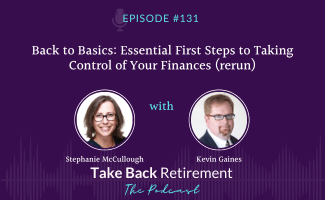
Back to Basics: Essential First Steps to Taking Control of Your Finances (rerun)
“It’s not about deprivation. It’s about balance. It’s about taking care of your today self and your future self.”
Join our hosts, Stephanie McCullough of Sofia Financial and Kevin Gaines of American Financial Management Group, as they simplify the world of financial planning, starting with understanding cash flow. They tackle how to monitor the inflow and outflow of your money, without yet worrying about its source or where it’s going. Learn the importance of observing more than one month of data, as things can fluctuate from month to month.
Stephanie and Kevin further explore the significance of setting up an emergency fund and how much cash you should ideally have available. Listen as they explain why it’s essential to have a cash cushion to cover unexpected expenses. They provide insights on how to calculate the amount you should have in your emergency fund and why it may need to be increased if your future seems uncertain. Also, discover the differences between cash and investments, and why cash is best for emergencies.
They discuss the different retirement savings and investing options available, such as 401(k)s, IRAs, and target date funds. Gain knowledge on the benefits of each, from lower costs to matching options and pre-tax savings. They also touch on setting up a regular investment account with no limits or restrictions. Their ultimate aim is to emphasize the importance of establishing an investment plan that suits you and doesn’t cause unnecessary stress. This episode is your guide to making informed and confident decisions about your financial future.
Resources:
- Take Back Retirement Episode 29: How Much Cash Should I Have and Where Should I Be Putting It?
- Take Back Retirement Episode 12: What Women Need to Know About IRA’s, with Sarah Brenner
- Take Back Retirement Episode 45: What Women Need to Know about Target Date Funds
- Put One Foot in Front of the Other – Santa Clause is Coming to Town (skit)
- HEE HAW Gloom Despair And Agony On Me | Classic Her Haw TV (skit)
Please listen and share with your friends who are in the same situation!
Key Topics
- Cash and Cash Flow (05:15)
- Looking at the Trends (08:13)
- How Much Cash Should I Have and Where to Put It? (10:58)
- How to Invest More Money (20:24)
- Don’t Get Intimidated by the 1099 Form (24:15)
- Savings vs. Investment (25:51)
- Wrap-Up (28:23)
Stephanie McCullough (00:00):
Investments can sound really complicated. It can sound kind of scary because they might go up in value, they might go down in value. And I’m just going to give you the spoiler alert; at some point, they’re going to go down in value, that’s how they work. They go up, they go down.
Stephanie McCullough (00:16):
But over the long-term, our hope, our belief is that they will go up more than that cash in the bank. So, investments are for your longer-term needs such as, oh, I don’t know, retirement? Like someday maybe wanting to hang it up and not work 40 or 60 or 70 hours a week.
Kevin Gaines (00:36):
And again, when we’re talking investments, you made the point, Stephanie, we’re talking longer-term money.
Stephanie McCullough (00:48):
Hey, dear listeners, we need to let you know that Kevin and Stephanie offer investment advice through Private Advisor Group, which is a federally registered investment advisor. The opinions voiced in this podcast are for general information only and are not intended to provide specific advice or recommendations to any individual. To determine which strategies or investments may be suitable for you. Consult the appropriate qualified professional prior to making a decision. Now, let’s get on with the show.
Stephanie McCullough (01:23):
This is Take Back Retirement, the show that’s redefining retirement for women. Retirement is an old-fashioned cultural concept. We want to reclaim the word so you can make it your own. I’m Stephanie McCullough, financial planner and founder of Sofia Financial, where our mission is to reduce women’s money stress and empower them to make wise holistic decisions so they can get back to living their best lives.
Stephanie McCullough (01:47):
Kevin Gaines is my longtime colleague with deep knowledge in the technical stuff: investments, taxes, retirement plan rules. He’s a little bit nerdy and quantitative, I’m a little bit touchy-feely and qualitative. Together, through conversations and interviews, we aim to give you the information and motivation you need to move forward with confidence. We’re so glad you’re here.
Kevin Gaines (02:13):
So, in the Rankin and Bass Christmas classic, Santa Claus Is Comin’ to Town, one of the pivotal songs in that episode is “Put One Foot in Front of the Other.” Well, pretty good parallels with that and financial planning. So, today’s episode is just trying to put one foot in front of the other.
Stephanie McCullough (02:41):
Coming to you semi-live from the beautiful Westlakes office park in suburban Philadelphia, this is Stephanie McCullough and Kevin Gaines of Sofia Financial and American Financial Management Group. Say hello, Kevin.
Kevin Gaines (02:51):
Hello, Kevin.
Stephanie McCullough (02:53):
So, while I do have a soft spot in my heart for the Winter Warlock, I think we might have to actually explain to people what we’re talking about here.
Stephanie McCullough (03:02):
So, when I talk to women, I feel like many people have this idea that, “Oh, financial planning or getting my money in order, or talking to a financial advisor …” all these things feel very big and kind of monumental and hard to tackle because there’s just so many things to do.
Stephanie McCullough (03:29):
And I’ll give it to you that our profession has a gift for making things seem really complicated and complex. And of course, like you need us.
Kevin Gaines (03:40):
Well, if it’s not complicated and complex, Stephanie, then you might not come to us and might not hire us. So, it’s got to be by definition, complex, right?
Stephanie McCullough (03:50):
This is a problem because I don’t know about you all, but when I have a project that feels like it’s going to take many, many, many hours and a lot of brainpower and be super tiring, I’d rather just put it off and I avoid it. But if I feel like, oh, you know what? I can get something really meaningful done in 25 minutes, I can totally handle 25 minutes.
Stephanie McCullough (04:14):
So, our goal today is to break down kind of the essentials, the basics, the fundamentals, the first steps we would recommend to you in terms of getting your finances in order.
Kevin Gaines (04:29):
So, to kind of help to take this into bite sizes, if you will, think of a candy bar. If you get one of those big king-size candy bars, that’s a really big piece of candy to eat, right? But if you get the fun size, the fun size Snickers, oh, you can knock 20 of those puppies out in no time. And next thing you know, you ate the king-size bar.
Stephanie McCullough (04:51):
I think the point is to eat one fun-size bar, not 20.
Kevin Gaines (04:56):
And what’s the fun in that? But from fun-sized candy bars to fundamentals of financial planning.
Stephanie McCullough (05:04):
Very good.
Kevin Gaines (05:05):
Hey, if it wasn’t for bad puns, I would have no jokes at all, Stephanie, you know that by now.
Stephanie McCullough (05:11):
I’m hearing a song from Hee Haw, but anyway. So, listeners, do you think this is actually fun? We’re going to give you the fun-size financial planning, kind of the modules, the essential first steps, if you will, that we would recommend. Because sometimes people are like, “Oh my gosh, there’s so many things I have to do, what should I tackle first?” Well, this is what we’re going to give you today. What you should tackle first.
Kevin Gaines (05:36):
And first, the basic building block of it all: cash and cash flow. We’re not talking budgets here, we’re talking just simply looking at how much you have coming in every month, how much you have going out. Don’t care what we’re spending it on, don’t care where the money’s coming from. Just how much do you have coming in every month, how much do you have going out every month?
Kevin Gaines (06:01):
Answer that question and you’re already going to be ahead of probably 60, 70% of Americans — just making up a completely random stat that has no supporting documentation. But let’s go with it.
Stephanie McCullough (06:15):
Feels about right. So, yeah, I mean, should you eventually, maybe someday look at where you’re spending your money and whether it aligns with your values? Sure, absolutely. But if we’re breaking it down to the bare bones, to the very simple beginnings, how many dollars are finding their way into your bank account?
Stephanie McCullough (06:34):
Whether it’s weekly, every two weeks, every month, every quarter, whatever it is. And if you’re self-employed, maybe it’s totally sporadic when the money comes in, and when it doesn’t, fine. How many dollars are finding their way to your bank account? How many dollars are going out? Do you have a surplus? Do you have a deficit? Is it matching as many dollars going out as coming in?
Stephanie McCullough (06:58):
Remember, anytime you’re doing this type of exploration about your money, we need to set aside the self-judgment, that little shaming voice in our heads. That is not the goal here. Put on your scientist hat, we are investigating, we are gathering data.
Stephanie McCullough (07:15):
It’s just data, the numbers are not judging you. They’re not saying anything about you to your friends and neighbors. This is just data.
Kevin Gaines (07:25):
Literally, it is what it is. We’re not saying it’s good, not saying it’s bad. It is what it is. Once we know that, then we can take the next step. But know this step first.
Stephanie McCullough (07:38):
Yeah, knowledge is power. And if it varies, okay, pay attention to that. It is very often helpful to look at more than one month because things change, right? Whether it’s, oh, I get a bonus in this particular month of the year, or the fall is better for me than the spring, or, you know what? My expenses really go up around back-to-school time. Because I have kids that I’m dealing with, or I’ve got to pay my real estate taxes in March.
Stephanie McCullough (08:05):
Whatever it is, it is valuable to look at more than one month to get a better picture of what’s going on.
Kevin Gaines (08:13):
Because at the end of the day, we’re looking at the trend. What is the average? And also, at the same time as you’re looking at several months, you can see, is there a trend? Am I spending more and more each month, even allowing for back-to-school or annual expenses?
Kevin Gaines (08:34):
Maybe that’s a good thing. Maybe because you’re having more income, you’re able to spend more, or hey, sadly, it could be a bad sign. It’s like, “Oh, my spending’s getting a little out of control.” And then the next question is, is this increasing spending, is it a good thing or a bad thing?
Kevin Gaines (08:53):
Meaning are your necessary monthly expenses going up? Or are you just choosing to have more fun? See, I was getting in the budgeting, that’s why I was trying to spike it.
Stephanie McCullough (09:03):
Okay, dear listeners, Kevin and I are right now, we’re sitting on our hands, we’re biting our tongues, we’re trying not to go down rabbit holes. And as financial advisors may be tempted to kind of show off our knowledge, but also make it more complex than it necessarily needs to be.
Stephanie McCullough (09:20):
So, we’re keeping it super simple. You’re looking at how many dollars come in, how many dollars going out. You’re not judging yourself, you’re catching yourself if you start to hear that nasty voice that’s shaming you, shaking their finger at you as our friend Gretchen says, giving you the finger (she made me laugh).
Stephanie McCullough (09:37):
You’re noticing this stuff and just starting to pay attention. And that’s an essential piece of it. Because if you don’t know how many dollars you’ve got to work with, then it’s really hard to make any other ongoing decisions about it.
Kevin Gaines (09:54):
So, now, that we know how much we have coming in and how much we have going out, question two, how much savings should we have? Well, general rule of thumb is you should be able to cover six months of outflow.
Stephanie McCullough (10:14):
Three to six months, let’s say.
Kevin Gaines (10:16):
Three to six months. I tend to be a little bit more cautious. So, I lean towards the six months.
Stephanie McCullough (10:22):
Kevin, when you say savings, a lot of people equate savings with just any kind of money they’ve put aside for the future. But I think you mean it more specifically, what does savings mean in this context?
Kevin Gaines (10:35):
For this context, and I’m glad you actually asked that question, Stephanie (context), we’re talking short-term savings; money that if you need because the inflow is slowing down that you’re going to grab.
Stephanie McCullough (10:51):
Or the outflow is speeding up.
Kevin Gaines (10:53):
Or the outflow is speeding up-
Stephanie McCullough (10:55):
And it happens, we all know.
Kevin Gaines (10:56):
For some of us, have both things happen.
Stephanie McCullough (11:00):
So, cash in the bank, right? Cash in the bank.
Kevin Gaines (11:02):
Cash in the bank, cash that you’re going to pull out of your account to cover that next bill. Not retirement savings, not long-term investments, or any other fancy terminology that some random magazine is telling you, you need to do. We’re talking about one step away from cash in hand.
Stephanie McCullough (11:24):
So, for those who want a more in-depth analysis of this, we’ll refer you back to our Episode 29; How much cash should I have and where should I be putting it? So, that’s what we’re talking about in the step two, how much cash.
Kevin Gaines (11:41):
And as Stephanie just said, three to six months is typically what most people are going to want to have set aside. Everybody has their own comfort level. Nothing’s written in stone that it’s gotta be this. Or if it’s not, then you’ve completely failed. Absolutely not. It’s going to be what lets you sleep at night.
Stephanie McCullough (12:05):
If it’s really hard to get to three months of spending, get to a thousand dollars, and then get to $2,000. Something is better than nothing. This is the, oh my gosh, the shit hits the fan, and you need money. Whether your job got erased or all of a sudden, there’s super expensive dental work or the car needs repair, whatever it might be.
Stephanie McCullough (12:30):
Cash that you can access quickly, you want no risk that it’s gone down in value. So, some people will complain to us (not so much this past year, but before), “Oh, I have this money in the bank and it’s not earning anything.” It’s sitting there earning nothing. Yes, that’s the point. That’s the point because it’s there for you whenever you want it, you can access it quickly, and it just covers those emergency needs.
Kevin Gaines (12:55):
And think back to the beginning of this episode; one foot in front of the other, that’s what we’re talking about here. Can’t do six months or don’t want to do six months, can’t do three months — get a thousand.
Kevin Gaines (13:07):
Get something in there so that if a problem happens, you’re not stuck using credit cards that you may or may not be able to pay back immediately. Therefore, it may or may not start earning interest and interest rate-earning credit cards ain’t low.
Stephanie McCullough (13:26):
Yeah. So, this is your cash cushion. This is your emergency fund, this is your F-it fund, whatever you want to call it. And that’s just kind of for the what if.
Stephanie McCullough (13:37):
If you have a big expense coming up down the road like, you know what? I’m going to need a new car in about nine months, that money should be in cash too. Or if you have some kind of looming uncertainty like, you know what, I think I’m moving to North Dakota in three months, moves cost money.
Stephanie McCullough (13:57):
So, increase the amount of cash you’ve got. If you’ve got some uncertainty or you know there might be layoffs coming at work — up your cash.
Kevin Gaines (14:06):
Or look at it this way; even if say for example, a thousand dollars might be hard for you to get to or you get to the thousand, but the three months is still kind of far out there, here’s a way to look at it; what are your insurance deductibles? Do you have enough cash to cover your deductibles?
Stephanie McCullough (14:24):
What’s a deductible, Kevin? Remind us.
Kevin Gaines (14:27):
So, the deductible is the amount you have to pay before the insurance company’s going to step in and repair your car, or replace losses in your home. You’ve got to put up a couple bucks first.
Stephanie McCullough (14:41):
So, for example, when my sweet son was learning to drive and he pressed the accelerator instead of the break in the parking lot of the grocery store and smashed into the car in front of him, we were on the hook for the first, I think it was $500. That was our insurance policy deductible. So, if you’re not sure where they’re, take a peek.
Kevin Gaines (15:03):
And then you make sure you have that in the bank. And trust me, this will actually give you comfort knowing if something goes wrong, really wrong, I got it covered. I’m not stuck scrounging trying to figure out how am I going to come up with whatever you need to come up with.
Kevin Gaines (15:25):
Plus, it’s always good to review your insurance policies anyway, but that’s going to be a whole another episode. Not going to go down that rabbit hole.
Stephanie McCullough (15:31):
No, we are not. We’re just giving you a few bite-sized, fun-size, although I’m not sure anybody would call these things fun.
Kevin Gaines (15:40):
No, I’m enjoying myself.
Stephanie McCullough (15:42):
Except for Kevin.
Stephanie McCullough (15:44):
Alright, so step one, looking at your dollars in, dollars out; step two, cash in the bank, how much should you have? Set your goal, work towards that goal. Step three, then this is the other type of putting money away for the future — investments.
Stephanie McCullough (16:01):
Investments can sound really complicated. It can sound kind of scary because they might go up in value, they might go down in value. And I’m just going to give you the spoiler alert; at some point, they’re going to go down in value, that’s how they work. They go up, they go down.
Stephanie McCullough (16:17):
But over the long-term, our hope, our belief is that they will go up more than that cash in the bank. So, investments are for your longer-term needs such as, oh, I don’t know, retirement? Like someday maybe wanting to hang it up and not work 40 or 60 or 70 hours a week.
Kevin Gaines (16:37):
And again, when we’re talking investments, you made the point, Stephanie, we’re talking longer-term money. We’re not saying investments equals putting all this money in the stock market. We’re not going there on this conversation. We’re just literally talking longer-term things.
Kevin Gaines (16:54):
So, don’t get intimidated by that word. When people hear the word “investments,” they think stocks which is probably where they should be. But I’m just saying we’re just using this as a term for your longer-term savings that you’re not going to be touching, your non-emergency savings.
Kevin Gaines (17:14):
So, let’s talk longer-term investments. Let’s talk some of my favorite subject, retirement savings.
Stephanie McCullough (17:19):
Oh, and you use the word savings, I’m confused. I thought we were on investments. This is where it gets a little … right?
Kevin Gaines (17:27):
So, we’re talking about investing for your retirement.
Stephanie McCullough (17:32):
Yes. And some people will use the word savings and that’s okay. But we’re talking if it’s long-term, right?
Kevin Gaines (17:37):
Right. We’re talking about taking this money. Now, for many of us, but not all of us by any stretch, one of the easier ways to do this is through work that they have some sort of vehicle that you can put money into every paycheck to set aside for retirement.
Kevin Gaines (17:59):
And in many ways, that can be probably one of your best options. You know, they tend to have lower costs. More importantly, hopefully, they’ll have a matching option, which means you put in a dollar, they give you an extra dollar that goes into your account
Stephanie McCullough (18:18):
Or 50 cents.
Kevin Gaines (18:20):
Or 50 cents or 25 cents. Every plan has their own-
Stephanie McCullough (18:23):
Either way, it’s free money.
Kevin Gaines (18:25):
It’s free money, it’s extra money you’re getting. And that’s a really powerful savings tool.
Stephanie McCullough (18:31):
Yeah. Even if there’s no match because I’ve heard some people say, “Well, I’m not going to do my 401(k) at work because there’s no match.” It’s still a really good plan to do, even with no match because it’s payroll deduction, you set it and forget it. You sign up, it comes right out of your paycheck. You never see it.
Stephanie McCullough (18:51):
It’s in an account that’s protected by a law. It’s yours, it’s in your name. So, just because you don’t see it, doesn’t mean like there’s anything fishy going on here. This is a protected account in your name, and it goes in on a regular basis, which is a good investing practice to buy periodically, whether the markets are up or down. And then, hey, close your eyes and in a few years, there’s some money there.
Kevin Gaines (19:18):
Putting it in a retirement savings account at work — here’s another benefit; what you actually see disappear from your paycheck will be less than what you put in for many of us. Because in most situations, these dollars can go in what’s called a pre-tax, which means before the government does their tax withholding out of those dollars, it goes into your retirement plan. So, fine, you may see, you may be putting a dollar into this retirement account, but you only see your paycheck drop by 80 cents. Why? You’re not having to pay as much money into payroll taxes and such.
Kevin Gaines (20:05):
So, don’t get worried, “Oh my gosh, if I set aside a hundred dollars a paycheck, I’m not going to have that a hundred dollars that I’m used to seeing.” And it’s not necessarily true, you’ll see a drop, it just won’t be as big as you might fear.
Stephanie McCullough (20:24):
Yeah. So, that’s an extra little added benefit to doing the retirement plans at work. So, we talked about savings vehicles, and it is confusing because people talk about retirement savings all the time. But we are talking step two was cash in the bank. And then this is step three investing.
Stephanie McCullough (20:43):
Super easy investing retirement plan at work. If you don’t have one, you can still save for retirement. One of the great ones that everybody has got available to them if they have earned income in the U.S. is IRAs (Individual Retirement Accounts).
Stephanie McCullough (21:04):
And we talked about this in great detail with our lovely guest, Sarah Brenner in Episode 12; What Women Need to know about IRAs. So, IRAs, you get a tax benefit, you put your money away for retirement. Remember, anytime you get a tax break, there’s a quid pro quo, so you can’t take it out until age 59 and a half without a penalty, and it’s still a good thing to do.
Stephanie McCullough (21:29):
So, the other piece though about these retirement accounts, 401(k) at work, IRA of your own — once you’re in there, you got to pick an investment. And the simplest investment option is going to be a target date mutual fund. That means there is a date like a year in the title, in the name of the fund.
Stephanie McCullough (21:55):
And all you got to do is pick the year closest to the year. You kind of maybe sort of might be retiring like age 67, age 70, somewhere in there. Pick that year and you don’t have to worry about anything else. Again, this is the keep it simple, stupid episode (KISS) — keep it simple, stupid.
Stephanie McCullough (22:16):
So, for more detail on that, we did Episode number 45; what women need to know about target date funds. But Kevin, there’s a big misconception that if I don’t have access to a retirement plan or if I’ve already maxed out my contributions to my IRA, then I shouldn’t do any more investing. Do you agree with that?
Kevin Gaines (22:37):
Well-
Stephanie McCullough (22:39):
The answer’s no.
Kevin Gaines (22:41):
Oh, see I was going to go down with this complicated, “Maybe if this …” Oh, that’s right, you want to keep it simple.
Kevin Gaines (22:51):
No. In all seriousness, yes. There’s always ways you can invest more. Keeping it simple, there are other ways to invest that don’t involve retirement accounts and the restrictions that come with them.
Stephanie McCullough (23:07):
Open up a regular old account.
Kevin Gaines (23:10):
Absolutely. And just like we were talking about with retirement investing, you can set aside 5o, 100 bucks a month.
Stephanie McCullough (23:25):
5,000 bucks a month, there’s no limits.
Kevin Gaines (23:27):
10,000, do I hear 20?
Stephanie McCullough (23:30):
There’s no limits when it’s your own just regular investment account.
Kevin Gaines (23:34):
Right. And in most cases, there’s no minimums either. So, if you’re just trying to get comfortable, you don’t have to start off big. If you want to get bigger, by all means, but we’re not talking about some sort of commitment that’s just going to be like a millstone around your neck like, “Oh my gosh, I go to do this.”
Kevin Gaines (23:57):
No, we’re talking about simple things that aren’t going to stress you out. If putting $10,000 a month into an investment account is stressing you out, as it would with me, guess what? Go a hundred. There’s no laws here.
Stephanie McCullough (24:15):
Right. And it doesn’t have to be monthly either. With your retirement plan at work, you set it up, you do it each pay period, it’s pretty easy to change the amount, but we want you to set it and forget it. With an individual investment account you own yourself, you can plop money in when you feel like it. You can take money out when you feel like it. There’s no penalties, there’s no age restrictions.
Stephanie McCullough (24:36)
So, the only other piece to mention there is that there’s always trade-offs in everything. With an investment account that’s great, you can get it whenever you want. However, it’s not tax-deferred like you have in a retirement account.
Stephanie McCullough (24:49):
Meaning, come January or February, you will get a form from your investment company wherever the money is actually held. So, it’s called a 1099 and it’s going to say, “Oh, you know what? Stephanie made some dividends interest this year, and she had some capital gains or capital loss this year.”
Stephanie McCullough (25:12):
And you got to file those with your tax preparer, you might owe a little bit of tax. If you’re being taxed, it means you made money. So, it’s not necessarily a bad thing, don’t freak out. It also means you can sell that and access that money anytime you want to.
Kevin Gaines (25:24):
And don’t get intimidated that we’re talking IRS form here. This form will literally tell you which boxes to put the numbers in or even easier, just give it to your accountant to do. They’ll give you a list of anything that you may have bought and sold where also you don’t have to worry about tracking all of this stuff. All of this comes into this form. It makes it real easy.
Stephanie McCullough (25:51):
So, keep your 1099s. And we have our upcoming episode on record-keeping. I’m sure that will be a point that will be made.
Stephanie McCullough (25:53):
So, Kevin, let’s say I did step one or I’m doing step one again, I’m looking at my money in and money out, and like I realized, oh I didn’t really need that subscription anymore, and oh, maybe I could cut back here.
Stephanie McCullough (26:06):
So, I realize I have some dollars to put to work. How do I decide? What are the questions I should ask myself to figure out whether I should put them in my savings in the bank or my investments?
Kevin Gaines (26:19):
First thing, get to that three to six months of savings. That’s going to be the first thing you do with this extra money.
Stephanie McCullough (26:29):
How’s my cash cushion? Oh, it’s kind of low. Maybe I’ll top up my cash.
Kevin Gaines (26:35):
Right. And guess what? It even just got easier because you reduced your expenses, you canceled that a hundred dollar-a-month subscription. Guess what? You don’t need to worry about paying that anymore. Therefore, your monthly savings that you’re trying to save goes down by a hundred dollars.
Kevin Gaines (26:59):
So, if your monthly expenses are $5,000, “Oh my gosh, I need to have $15,000 to have three months.” You don’t need that anymore. It just went down by a hundred dollars. You’re only spending 4,900 a month now. It doesn’t sound like a lot, I know.
Stephanie McCullough (27:19):
Makes a difference.
Kevin Gaines (27:22):
So, now, you need to just save a little bit less. Next step, invest a little bit more. Again, we’ll say that a hundred dollars a month. You can take that a hundred dollars, increase how much you’re putting into your retirement savings each month. You can increase it by a hundred dollars.
Kevin Gaines (27:46):
However, don’t want to save that hard. Reward yourself, increase your retirement savings by $50 and have fun with the other 50. We’re not saying you gotta sit here and suffer for the next 20, 30 years just so you can have fun in retirement. Why not have fun all the time? Again, fun size.
Stephanie McCullough (28:14):
Yes, it’s not about deprivation, it’s about balance. It’s about taking care of your today self and your future self.
Stephanie McCullough (28:22):
Well, we hoped we’ve managed to keep this somewhat simple. These are the three steps we would recommend you start with. If you’re feeling overwhelmed with getting your financial house in order, looking at your cash in, cash out, looking at your cash in the bank, how much should you have, and then add your investment.
Stephanie McCullough (28:42):
There’ll be more knowledge coming at you next episode. Thanks so much for being with us. We’ll talk to you next time. It’s goodbye from me-
Kevin Gaines (28:50):
And it’s goodbye from her.
Stephanie McCullough (28:54)
Be sure to subscribe to the show and please share it with your friends. Show notes and more information available at takebackretirement.com. Huge thanks for the original music by the one and only Raymond Loewy through New Math in New York. See you next time.
Voiceover (29:08):
Investment advice offered through Private Advisor Group, LLC, a registered Investment Advisor. Private Advisor Group, American Financial Management Group, and Sofia Financial are separate entities. The opinions voiced in this material are for general information only and are not intended to provide specific advice or recommendations for any individual security. To determine which investments may be appropriate for you, consult your financial advisor prior to investing. This information is not intended to be substitute for individualized tax advice. Please consult your tax advisor regarding your specific situation.