Take Back Retirement

Episode 04
Give Yourself Permission to Plan Your Next Chapter, with Randi Levin
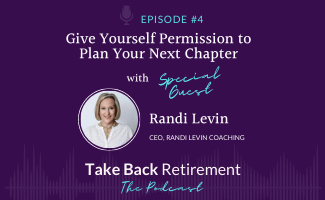
Guest Name: Randi Levin
Visit Website: randilevincoaching.com
Many people picture moving into retirement as: One day you’re working and the next day you’re retired. As we learn from life transition expert Randi Levin, CEO & founder of Randi Levin Coaching,moving into retirement is best done with preparation. It does not have to be an overnight event. In this episode of Take Back Retirement we walk through different ways to approach this major life transition as well as various things to consider that may not immediately come to mind. Most important we understand that this about you and not following a cookie-cutter process that everyone else is doing.
You can find Randi at https://randilevincoaching.com/, and her FaceBook group The Recalibration Network at https://www.facebook.com/groups/recalibration/.
Please listen and share with your friends who are in the same situation!
Key Topics
- Why Randi hates the word retirement (05:19)
- Retirement’s not a light switch (06:56)
- The value of planning ahead (10:17)
- Permission is so important (11:20)
- What are we investing in? (18:52)
- A broader definition of “investment” (25:53)
- What is self-leadership? (33:20)
Stephanie: 00:06 Welcome to Take Back Retirement, the show for women 50 and better facing a financial future on their own. I’m Stephanie McCullough. And along with my fellow financial planner, Kevin Gaines, we’re going to tackle the myths and mysteries of quote unquote retirement, so you can make wise decisions toward a sustainable financial future. Through conversations and interviews. You’ll get the information and motivation you need to move forward with confidence, and we’ll be sure to have some fun along the way. We’re so glad you’re here. Let’s dive in.
Stephanie: Coming at you semi live from the beautiful Westlake’s office park in suburban Philadelphia. This is Stephanie McCullough and Kevin Gaines from Sofia Financial and American Financial Management Group. Say hi, Kevin.
Kevin: Hi Kevin.
Stephanie: We’re excited today because we have a great guest. She has super pertinent information, both for the topic of our show and for our audience. Randi Levin is a coach, particularly focused on life transitions. And retirement, however we define it is certainly a transition. Ideally one where we’re making very intentional decisions.
Kevin: And what I personally like about Randi is that she doesn’t embrace the word retirement for the same reasons we don’t. That is not this arbitrary point in time.
Stephanie: In fact, she says she hates the word retirement. Why? We’ll let her answer that. We’ll jump right in.
Stephanie: So, Randi, welcome. It’s great to have you here.
Randi: Thanks for having me. I’m excited to be with both of you.
Stephanie: Great. Can you tell us briefly what you do and how you came to what you’re doing currently?
Randi: Well, actually it’s my third chapter. So, first chapter was corporate America, better part of two decades and fashion buying and merchandising. Second chapter was a SAHM – stay at home mom and it was a long loving gig. And I hit my fifties and reinvented. Chapter three, founder and entrepreneur. I went back to school, got certified in coaching. And I am now seven years in business. So, I’m a transitional life strategist, reinvention, expert keynote and thought leader, founder of The Recalibration Network. And I support female founders and emerging entrepreneurs, women in various stages of transition and redefining legacy and realigning and redefining success in the moment. And the result of that is that you make powerful, bold choices that really help you to align with today and living to curate for life that you love.
Stephanie: That’s awesome.
Kevin: That’s impressive. Quite a bit. It’s like you do everything.
Randi: Not really. I help people to get out of their own way. As a cut-to-the-chase way of saying it. Get out of your own way so that you do make those choices and you do the things that you want to be doing, not the things that somebody else is telling you that you should be doing. So, kind of an important distinction particularly now.
Stephanie: I would agree. When you say “transition,” right, that could mean a lot of things. And I know when you and I first talked, you told me you hate the word retirement. So here you are in a podcast that has retirement in the name. Tell me a little bit more about why you don’t like that word.
Randi: Hate that word, guys just hate it. To me, it’s, you know, you go with that dictionary definition of, to retire is to go to sleep, it’s to rest, it’s to stop, it’s to abort. I think that we’re not in our parents’ generation or our grandparents’ generation anymore, and we live longer, we’re savvier, we’re better connected, we’re healthier, we’re smarter. And to retire at 60 or 65, it’s a long time to play golf or garden or travel the world. So, I think that there’s this “reinvent” rather than retire that happens or should happen when one’s looking to reposition themselves at the end of a career. It’s not the end of a career, it’s the beginning of what’s next. And I think it’s an important distinction. You know, generations past, you worked for the same place. You did the same thing. Usually 20, 30, 40 years, you got the gold watch and off you went.
Randi: And unfortunately, usually you were dead in a few years. That’s what happened. The mortality rates were different. Now we can live healthy, happy lives, you know, into our eighties and nineties. So, pausing and stopping, so to speak at, you know, 60 or 65 or even 70, there’s still so much more that you can do and achieve and give. And it doesn’t have to be another corporate gig, but that’s certainly, there’s so much momentum that can happen, if you’re willing to explore it.
Kevin: 05:12 Something we come across frequently and really would like your input on how to think this through and changing mindsets is people think of retirement as to use analogy, a light switch. One day you are, and then boom. And it doesn’t work that way very easily just from a mindset. And trying to convince people to transition slowly or start thinking about it earlier, to understand it’s an evolution, not a binary event. How do you talk to people about, and maybe not just retirement, it could be any…
Randi: But you know what? It’s the same for any transition you’re going to make. It’s not the light switch. What happens is there’s an awareness and that’s the difference. And people take that awareness and think it’s the whole piece of the pie, if you would. This awareness that, okay, maybe it’s time for me to step out of this job that I’ve had for 20 years or step away from this company that I’ve worked for. That is the beginning of something, but it’s not the, “Oh, I’m retiring and then life will just happen for itself.” It’s a process. It’s a process of figuring out what’s needed to do that. It’s a process of figuring out what’s next. Okay. So, now that I’m retiring, what does that mean? What are my perspectives on what’s available to me? Not just from a financial standpoint, but what am I going to spend my days doing?
Randi: Where will I make an impact? What will that legacy be that I’m living in creating now? Because people define themselves by their jobs, by their roles, and you can’t flip a light switch on something you’ve done for so long. What you can do is incorporate it into what you’re doing next. So, all of those skillsets, all of those things that you’ve been doing, all those smarts that you have acquired. Where do you then want to take that? So, it may be a side hustle that you’ve started, that you’re looking to do full time. It may be the book you’ve been talking about writing for 10 years, that now you’re going to have the time to do. It may be that you’ve always wanted kids and never had them and now you want to work with children or mentor children, or put together a foundation that will support education or something other. Maybe you want to take all of the skills that you used and mentor others or teach, or maybe you want to go back to school.
Randi: What are those next things that you’re going to do? It’s a transition. Just like when I said I had three chapters. I’m not done. If you got to the next chapter of a book and it went dead, you wouldn’t keep reading. If it was just like that switch that flipped up. Okay, this is the last chapter. It’s not necessarily a last chapter, first of all, but what do you want that story to be? The story continues. It doesn’t stop. That’s why going back to the word retirement. We’re not going to sleep. The stories not stopping yet. What do you want to bring into that next chapter, that next phase? What are you designing?
Stephanie: I love that because we always talk about from a financial standpoint, you’re going to have the best possibility of success from a money side, if you start planning ahead of time, right? If you start positioning things a few years before you actually want to make this transition to stepping away from your current paycheck and having a different situation. And it sounds like you’re saying it’s very similar in your aspect as well.
Randi: It is. It really is. It’s really that awareness that you’re going to do something. It’s the perceptions that have to change around it. Are you already starting it? Is it something that you’ve always wanted to do? Is it something completely different? And then the action steps? What is that? What will it cost me? What do I have? What will they earn? What will I give back? What does this mean for me right now? So, it’s an exploration really.
Stephanie: Yes, exactly. And I think sometimes the women, I talk to feel they’ve done something wrong because they don’t have the answers all off the top of their head. But like you said, it’s an exploration, it’s a process. You have to give yourself permission to think about it.
Randi: Yes. Your permission is very important. We don’t give ourselves enough permission. We stop ourselves. A lot of chatter in our heads. A lot of fears that come up. A lot of us waiting for the right moment for some sign from the heavens. Everything’s got to align in a certain way. As soon as I have this much money or this much time, or, whatever that is. When my kids are this age. But guess what? The clock’s ticking. There’s no rewind on who we are or how long we’re going to be around and productive. So, why, wait? Why not start that process? Start that thing. Have the side hustle, if you want to call it that, or at least put it into motion, explore it, take the classes. You may get the certification you may want. Explore where you may be able to teach or learn or whatever those next connections may be for you, before you jump ship, so that you start to segue into that. And that’s what I work with people on is really taking that bold step from where you are to where you want to be. And it’s not a leap, they’re steps, jump, walk.
Kevin: 10:45 You made a comment about giving yourself permission to do things, to make changes. It’s a big hang up for a lot of people. How do you work through that? To be able to say, Hey, it doesn’t have to be what I thought it was or thought it had to be. It’s what I want it.
Randi: Exactly. So, one of the most important components of that is to be curious, to actually want to explore what could be different or what could change or, what you may like to do. Remember those permissions slips? I’m dating myself, but in elementary school used to get that little pink slip and you’d be able to walk from your classroom to the office and the nurse’s office or wherever you were going. And you felt like, oh my God, this is great. I get permission. Well, what if you mindfully give yourself that little pink permission slip? Write it down on a pink sticky and think about what are those messages you want to give yourself. So maybe you’re stuck on something and you just want to get it done. You want to get past that, or you want to be able to make that decision. Give yourself permission to make that decision. Give yourself permission to explore something or to research something, because that’s where all of these transitions start. They start with us being curious. They start with us being lifelong learners. And not just, as you said before, Kevin flipping that switch and saying, Oh, you know, pretend there’s a dimmer. You know, you can go up and down different variations of radiations, of light if you would. So now I want the bright spotlight or now I want the dimmer on, rather than on or off. So, if you’d give yourself permission to use that switch, to change the lighting a little bit, what’s possible?
Kevin: That’s a really good point because we run into these issues where people just automatically associate one event with another event. Specifically, I turned a certain age, so I must retire or I’ve worked X number of years, I must retire or I’m eligible for social security, I must retire. And there is no connection between the two.
Randi: There’s no connection between the two. And what they do is they stop themselves from living. You’re stopping yourself from transitioning. You’re stopping yourself from whatever that next chapter is. You’ve already made up in your mind that I’m either this or I’m that. There’s no gray area. And what we’re all saying here is, explore the gray area. Explore the piece you don’t know. It’s not this or that. It’s this and that. And Oh yes, you can retire. But what does that next thing? What is that next component that calls to you?
Randi: It’s not a shut-off valve, because that’s overwhelming. And there’s a lot of panic in that, you have to have enough money put aside and you have to want more free time and you have to, you know, what are the things people get caught up into is that the roles that we play, right? So, we identify with having been the director or having been the CEO or having a team to manage. And if we’re thinking of it, we’re flipping that switch to retirement. We’re saying, okay, now I’m not going to have that team to manage, or I’m not going to have that title. What am I going to talk about? Where am I going to show up? And so, they get kind of caught up in it instead of doing and exploring what’s next. They get caught in what they’re telling themselves. It’s going to be this ending to what they know.
Stephanie: I’ll tell you where I think I get stuck on the permission stuff is that there’s some voice deep seated in my head that says, if I’m working on something, that’s just for me, that’s selfish. And I have this, this little voice. I can even hear the particular voice, right? Oh, that’s being selfish. If I want to pursue a hobby, even, and as I shared with you guys, I’m newly minted, empty nester. I have time to do hobbies. And yet I still have a hard time getting over that. What is your suggestion, Randi, for me?
Randi: First of all, let’s find the truth in that. So, are you being selfish or are you making an investment in you?
Stephanie: Which feels selfish, right?
Randi: 14:54 Why? Haven’t you invested in other things? This is what you do for a living. So, you’ve invested in having a family you’ve invested, I’m sure, in actual investments and portfolios, right? You help other people with their investments. You invest your time in different people, in different things that you choose to do. You’re investing in this podcast, right? So, seeing the longest relationship you’re ever going to have Stephanie is with yourself. So being that CEO of your own life, there’s no expiration on that. And there really shouldn’t be any chatter around it because we got to own it. Nobody else can own that role. That’s only something that we can do. And if you can do that, it brings you into the moment. And that’s the key to what you’re saying is really not being selfish or not being whatever, “I’m being.” So how can I use these 24 hours to be best me? And what does that look like?
Stephanie: I like that idea. And I think there’s another similarity in that, if I’m going to invest in myself, it makes me be a healthier person and all the other places where I show up. And where I see a lot of women struggle sometimes financially, is that they want to give to others. And they don’t want to invest in themselves on the finance side too. And I’m sometimes the one that has to say, Hey, if you’re stronger financially, you are going to be a better mother and community member and family member, right? And a lot of women have that worry about being a burden on other people too. So, they get that. But sometimes there is that, just such a desire to give and give and give and not focus as much on their own security,
Randi: Right. But giving to yourself, fuels what you give to others. And so, if you leave yourself high and dry, there’s nothing to water in the well. So, it’s pretty important to make sure that you’re checking in with yourself daily, and that’s an investment you make in you. What are the things that you most want to accomplish today, personally and professionally? And really staying on top of what that is, because that will help me stay more mindful on empowering that and allowing yourself to give yourself permission. As we said, to step into that daily investment in you. It’ll help you to give to everybody else as well.
Kevin: So when we’re talking to people that we’ve just met for the first time, and they ask, how do I know I need a financial advisor? Or when do I need a planner? And we got our little cliche or line that says, you know, can you do it yourself? Will you do it yourself? Do you have better use of your time than doing it yourself? When would somebody want to reach out and get help planning their transition or their next chapter?
Randi: Great question.
Stephanie: When should I hire a coach? Is what you’re saying.
Randi: Hire a coach. Well, first of all, again, there’s an awareness of something’s not working or I want something to change, and I’m not really sure how to do this or what the next steps are, or I’ve tried on my own and it’s not working. Or I know that in reference to what we’re talking about here, I know that retirement is going to come because I’m X years old, what’s next? And I want to explore that. I want to be prepared, as we said. So, there’s the awareness that nothing’s changing, that you don’t want to fall in that gap. You don’t want to be stuck or stay stuck. You want to take action on it, and that’s the best time to hire a coach because it’s a sounding board, it’s a partner in pivoting and recalibrating and allowing you to explore safely what those next steps are, so that you’re actually taking them. So, we work very much in the moment in aligning who you are in the moment. And I think that’s a really, really important piece because we get out of alignment. We do things as we’ve always done them. This year in particular in 2020, we’ve all had a rough lesson in we can’t do things as we’ve always done them, even if you want to.
Randi: With that wakeup call is okay, if things are changing around me, then I have to change. And what are those things that I can empower and make choices on? And so really what I support people on is making choices that really align with who they are, where they are in the moment. Being mindful of those choices, being theirs, not their spouse’s, not their boss’s, not their sister’s, not their kids’, but theirs. We work on fears. We work on limiting beliefs. We work on really stepping into your own space, if you would. And I always tell people too, that you got to be willing to do the work because no coach comes with pixie dust. We just come with lots of really good questions and it’s very question driven. So, that’s a key component of it as well.
Stephanie: When I’ve worked with coaches before, it can feel a little uncomfortable when they ask that question, but it’s such a gift because you have your good friends and you have your family members you could discuss with, but when do you get maybe a full hour where it’s just the focus on you and your stuff and where you are. And it’s brought so many incredible aha moments. The coach doesn’t bring the answers. Like you said, they bring the really good questions.
Randi: 20:11 The answers are yours. And that’s where you take action. You take action on things that belong to you, right? You set a goal and if it’s not truly your goal, and you’re not really invested in it, you’re not going to take action on it. If you sit with your best friend and have coffee, and she tells you to do X, you may be totally involved in it and say, this is the greatest thing. And you’re going to go home and go to sleep, wake up the next morning and be like, what did she say? Because it doesn’t really resonate with you the same way, because it’s her best suggestion, her advice on something and as good as it is, it may not be yours. In order to really get those action steps and really be able to achieve the goals that you want and transition the way you would really like to all of those choices and decisions have to really come from you. They can’t come from outside sources. And so coaching is a way to get to that pretty quickly.
Stephanie: Do you have stories or have you seen people who haven’t done this work and have tried to, because we focus on retirement, kind of make that big transition from working to whatever, not working looks like and struggled?
Randi: Yes. Yes. Very often you see that because they think they’re doing it, but they’re not really in the doing during the thinking and the thinking we get into overthink and you get into overthink, and then we shut ourselves down. And we say, well, next year, after the pandemic, when my kids graduate from college, and you know, I have another, a hundred thousand dollars in the bank account. When whatever that parameter is. And so, they’re in the thinking, but they’re not in the doing. And so, the difference when I started working with somebody is, they become in the doing. So, we’re firing not just from our head, which we get into overthink, but we’re also from our heart, which is passion. There has to be a little emotion in it. There’s got to be a little bit of heartfelt purpose in whatever you’re doing.
Randi: Even after retirement, especially after retirement. We want to have purpose in what that next thing is. And I think that’s where the fear gets in for people is that they don’t necessarily, from the get go, know what that is, or they think they know what it is. They think it’s just going to hang in the garden and I’m going to see my grandchildren I’m going to… Those are all great things, but you’re doing those things anyway. Is there some other piece that you identify with because thirty years of being in the garden could be a really long time?
Stephanie: And that gets back to something that you mentioned too, that I found so interesting. And you mentioned it briefly earlier, this idea of investment. And thinking of it in a broader sense. Can you talk a little bit about that?
Randi: Well, sure, because you are investing not just in the financials, but you’re investing time. You’re investing energy. You’re investing the 24 hours. You’re investing all of these precious components of your life. And every single day we all have the opportunity to do, it’s like a power tool you have in your back pocket, you can pull it out and say, what am I investing in today? How am I going to show up in today? What are the things that I want to accomplish? What are the successes I want to experience today? Big and small. And so, when we bring that back, we’re making an investment in the moment in all of these resources that make us who we are and the financial thing is certainly a part of that, but all of these elements of what brings you into best you.
Kevin: Do you approach things differently if you have time to transition versus being forced into a transition?
Randi: That depends on the person. I mean, there are people who naturally will procrastinate. So, if you’re not forced and it’s not eminent, you may not really be willing to explore what’s next or to take significant action on knowing what that next chapter is going to be. For some people they’re better when their hair’s on fire. So, I think it depends on the personality of the person involved. So, for some people, you know, 2020 may have been a year where, okay, your hair’s on fire. This just happens. You know, it didn’t happen to me. Maybe it happened for me, maybe this is like the door opened, didn’t close.
Randi: And then there were some people who could have known for five years that something’s happening. And they’re so in their head that they’re not seeing the door open. So, I think it depends on the person, in terms of whether they need more time or less time, or an abrupt change versus a premeditated change. But change is change and, it’s not easy. It’s unknown. And that’s where people get caught because we experience the unknown. We get scared. How do I know it’s going to work? What if it doesn’t work? What, if someone says something about it and judges me? What if I don’t make any money doing it? What if I do make money doing this and I can’t keep up with all of it? There’s a lot of noise going on. And so, I think it’s really kind of getting out of your own way enough to realize that whether this happened, because of the moment or whether it happened, because, okay, now I’m 65 and it needs to happen. You always have choices. You always have choices. There’s never a situation where you’re really going to say, there’s no choice. You may be limited in your choices. You may not like some of your choices, but there’s always choices.
Stephanie: 25:51 One of the other things that you mentioned that I really love is the concept of legacy. And I think, again, you kind of have a little bit of a broader definition than what most people think of.
Randi: Right. So, most people think about the dictionary definition, which is the heritage of where you’ve been and what you’re leaving behind. For me, the concept of legacy is my purpose. And it is what transitioned me into my third chapter. And when I started to think about it, the question I was asking myself, so, all right, Randi, you know, kids are getting older, you’ve done the stay-at-home mom thing. You’ve done the corporate thing. Where will you bring this forward and what do you want your legacy to be? And then I said, well, wait minute. What do I want it to be like when I’m dead? I was really poking holes in it.
Randi: And I said, this next chapter is not what I want it to be when I’m gone or what the dictionary says, legacy is, this is what I’m creating. This is what I’m curating. This is what I’m driving right now. And so, if you look at legacy as a catalyst to the current moment, it all changes because all those possibilities, all those opportunities that might be there for you, good and bad. Things you’re going to try things you’re going to like, and not like they’re in today and not yesterday. Cause we can’t impact that. They’re not in tomorrow. We’re not out there yet. We’re in today. And so, we can live a legacy. We can drive decisions and choices and when we drive decisions and choices, we self-lead. And that is the key.
Stephanie: Self lead.
Randi: That’s the key to everything we’ve been talking about, right there. I’ve just given you the key to the castle. If you can self-lead, then you can be that CEO of your own life. You can make those investments in yourself. You can lead yourself through good days and bad days, through things that work through things that don’t, through success or failure. When we can self-lead, we can self-lead ourselves past our fears. Doesn’t mean we don’t see the fear. Just the opposite. We can call it out. Hey, I know I’m afraid of that, but I’m going to do it today. I’m going to lead myself. I’m going to make this decision to do something that I haven’t done.
Stephanie: It sounds like something, we talk to our clients about a lot too, which is being intentional about your decisions and your things and your spending and your saving and your investing and all that kind of stuff. Instead of just letting it happen. And all of a sudden one day waking up like, Oh, how’d I get here, right? To really, like you said, grasp these 24 hours and figure out what you’re going to do with it.
Randi: Yes. It’s intentional. It’s with the mindset of being in the doing of taking action and making choices, good and bad, and not wigging out from that. Where people get stuck and where they procrastinate and where they slow themselves down is when they aren’t making choices. When they’re kind of stuck on making decisions about things or they let other people make those choices.
Randi: So, the spouse is making the choice or, the kids are driving the show or whatever’s going on. This is your life, every one of us. So, we got to make some choices in it always. And I think that as we get older, I think the realization that we can do this, is even larger and greater and bolder. And that’s something that I have great joy in helping people to make choices and to realize that the choices are theirs to make. So, you have the intention, but then there’s the second piece of that, which is really important. Intentions are where goals are, but we don’t get goals just by sending them. We get goals when we put commitment to it. So first we have to be willing to make the choice and then we have to do something about it.
Stephanie: Yep, no results until you actually take the steps.
Randi: Good or bad. That’s correct. You don’t know until you do. And you’ve got to get out of your head long enough to be able to do that sometimes.
Kevin: And that may involve giving yourself permission to get out of your head.
Randi: It totally involves giving yourself permission to get out of your head, because we’re all in there. Especially times like now where there’s so much unknown. Everyone’s kind of like walking on coals. You don’t know. Woah, that’s hotter over there. I don’t know. Should I just stay where I am? No one knows.
Stephanie: Yea, we can’t know.
Randi: We could poke holes in that. If no one knows, and no one knows anything right now, no one knows. Then we’re all exploring by default. So, if we’re all in this period of change in a way that we’ve never changed before and everything around us is changing, then why not embrace it?
Stephanie: 30:18 And I love your point that we always have a choice and maybe our choices here in late 2020 are different than in January, 2020, but that’s okay.
Randi: Right. 2021 choices are even different than those.
Stephanie: Yeah. Maybe our range of options has changed, but taking action and making a choice as opposed to being passive, I think feels so much better.
Randi: Correct. I agree.
Stephanie: Awesome. Randi, thanks so much for being with us. How can people find you if they want to learn more?
Randi: So, you can find me at Randilevincoaching.com and if you hit the let’s talk tab on the homepage opens to my calendar. So, that’s always a great place to schedule a call and get in a conversation. I’m now offering, also, Take Back Today sessions, because I love that whole take back concept. You can join me also in The Calibration Network, which is my online virtual community. And you could Google that on Facebook or go into Randilevincoaching.com and it’ll pop up for you. It’s a virtual community with Zoom recalibration circles and candid-conversation events and a really nice support system for recalibrating and changing your life.
Stephanie: I have spent some time in The Recalibration Network and I can vouch that it is a really great community, a lot of fun things going on.
Randi: Thank you. Thank you for having me on.
Kevin: Appreciate you taking the time. Thank you.
Stephanie: I really enjoyed our conversation with Randi and we would just wanted to take a couple minutes to share our big takeaways. I love some of the questions she suggested that we all start asking ourselves and of course, giving ourselves permission to focus on those questions so we can get into the right mindset for retirement.
Kevin: Yeah. What I really enjoyed was her using the image of the light switch or more importantly, not the light switch. Retirement isn’t just something you switch. It’s a transition, much like a dimmer switch. So, don’t think of it as on, off. This is a process and this is what we’re trying to talk about. And this is why bringing people in like Randi helps create a richer conversation around the process, not the event.
Stephanie: Exactly. Because even though we’re financial planners, it’s not just about money. I loved her concept that the story continues. It doesn’t just stop, right? It’s not flipping the switch. It’s just moving into a new phase of life.
Kevin: Absolutely. Things continue and evolve. So, embrace it.
Stephanie: My other favorite quote of hers was, “What are you designing?” And this idea that we really need to check in with ourselves, not what other people say we should be doing, whether it’s family or society, or even voices from our past or our parents. This is the time where we get to focus on what we want to build.
Kevin: Right. This is our retirement. This isn’t the Jones’s retirement. Or like you said, your parents’ retirement. This is your life. This is the rest of your life. How do you want to go out? Having fun, doing the stuff you’ve wanted to do that you put off. Why put it off any longer? There’s no need to.
Stephanie: Yup. Yup. She says, “There’s no rewind on who we are.”
Stephanie: With that, we’re going to sign off for today. We’ve given you a lot of food for thought. Look forward to talking to you next time. It’s goodbye from me.
Kevin: And it’s goodbye from her.
Stephanie: Be sure to subscribe to the show and please share it with your friends. Show notes and more information available at TakeBackRetirement.com. Huge thanks for the original music by the one and only Raymond Loewy through New Math in New York. See you next time.
Disclaimer: 34:08 Investment advice offered through Private Advisor Group, LLC, a registered investment advisor. Private Advisor Group, American Financial Management Group, and Sofia Financial are separate entities. The opinions voiced in this material are for general information only and are not intended to provide specific advice or recommendations for any individual security. To determine which investments may be appropriate for you consult your financial advisor prior to investing. This information is not intended to be substitute for individualized tax advice. Please consult your tax advisor regarding your specific situation.