Take Back Retirement

Episode 01
What the Heck is Retirement Income Planning?
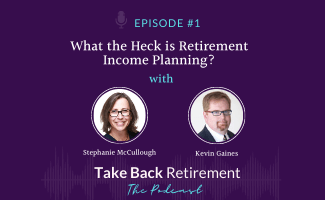
When you were young, you wanted to do everything! You had the time but not the money to do it all.
When you started working and maybe raising a family, you had more money, but not the time.
Now that you’re nearing “retirement,” whatever that means, you ideally have the money AND time to do what you want.
But now what? How do you turn savings into income that is going to support everything you want to do?
Please listen and share with your friends who are in the same situation!
Key Topics
In this episode Stephanie and Kevin want to help you Take Back Retirement by discussing these key topics:
- What exactly is Retirement Income Planning? (01:30)
- Should you work in retirement? (03:00)
- Making the unknowns known (06:35)
- The dangers of committing to a plan too early OR Designing your perfect retirement is always evolving(08:13)
- Prioritizing what you want to do (12:21)
- Be wary of salespeople (17:16)
00:06
Welcome to Take Back Retirement, the show for women 50 and better facing a financial future on their own. I’m Stephanie McCullough. And along with my fellow financial planner, Kevin Gaines, we’re going to tackle the myths and mysteries of quote unquote retirement, so you can make wise decisions toward a sustainable financial future. Through conversations and interviews. You’ll get the information and motivation you need to move forward with confidence, and we’ll be sure to have some fun along the way. We’re so glad you’re here. Let’s dive in.
I want you to imagine you’ve been working your whole career. You finally made it to your last day of work. You’ve just had the office party. There was cake. There were well wishes and cards, maybe a bottle of bubbly. It’s been a wonderful day. On your way out the door. You’ve already packed up your desk, you zip into your computer and just take a peek at your 401k website and you find that you’ve made your goal. You’ve got a million dollars in that account. Congratulations. That’s amazing. Now what? Now that you’ve retired. That paychecks aren’t coming in anymore, that million dollars has to take over the goal of paying your bills. How do you do that? You’re on your own trying to figure that out. Welcome to episode one of Take Back Retirement. I’m Stephanie McCullough here with my cohost,
Hi. Kevin Gaines. Glad to talk to everybody and hopefully we’re going to be able to entertain and educate.
We’re going to today, try to answer that question. What the heck is retirement income planning and how will it help you solve that million-dollar question? Kevin, what does retirement income planning even refer to?
So, retirement income planning is a really long phrase with a really bad acronym that describes, how you take everything you’ve done over your life to this point and turn it and convert it to support the lifestyle you want to live for the rest of your life. You’ve spent all this time saving and building this big pot of money, and now you got it and you got to figure out what to do with it. So, retirement income planning is thinking through how to turn the lump into a steady stream of income that’s going to support everything you want to do. Because this is your time. You know, when you were young, you wanted to do everything and you had the time to do it, but you didn’t have the money. When you started working and raising your family. Hey, guess what? You’ve got this career. You’ve got this money. Didn’t have a whole heck of a lot of time. Now that you’re entering retirement, you have this money and you have the time to do everything you want to do, you just got to make sure you figure out how to pay for it, so you’re prepared when something bad happens. Right. And you often talk
about the difference between planning for retirement and planning in retirement, right? Our whole careers we’ve been told save for retirement, which is kind of this nebulous idea. You put money in your retirement plan at work. Maybe you’ve got a Roth IRA over here. Maybe you’ve got some other stuff over here. You’ve been working hard to balance the needs of today with your needs of someday in the future. So now, like you’ve said, you’ve built some things up, maybe you know, you’ve got some social security, maybe there’s a pension in the picture. Now there’s all these different pieces. How do you make them work together to pay your bills?
Exactly. Exactly. You know, saving for retirement is, relatively speaking simple. All you got to do is just save as much as you can for as long as you can, you know? Yes, you’re creating these different pieces of the puzzle. You know, whether it’s a Roth or 401k or pension or whatever, but you don’t have to fit them together. You just have to make sure they’re really good pieces. Now we’re talking about how do we fit them together and that’s where it gets tricky. Social security, Medicare, retirement accounts, just regular savings. You have a home, you know, where do you want to live both geographically and, you know, do you want to move to a retirement community or do you want to stay in your home? You know, what do you want to do? There’s a lot of questions and this is the part that intimidates I think everybody the most or most people at most is you’re on your own for the most part. You know, again, as you know, family’s growing and you’re working. If something goes wrong, Oh, I’ll just work longer or I’ll just work more, or you know, maybe try to find a different job that pays more. You may not want to
Take a second job right there. Yep.
Exactly. You have all these options. Now you’re retired. Yes. You know, going back to work, it’s an option for some, might not be an option for you and it may not be an option you really, you want to, you want that to put to be last cause you don’t want to go back to work. So how do we make these, how do we have plan A, B, and C in the order that you want to do them?
05:39
Well, and that’s a good point, right? When you bring up the idea of what you want, one of the things we talk about all the time is that there is no monolithic definition of retirement. To me, retirement should mean that you are free from the need to work for money. That doesn’t mean you’re not going to maybe pursue some other passions. Maybe do some volunteer work, maybe work to bring in an income, but you don’t want to have to be doing it out of obligation.
Right, this is about doing what want to do, not what you have to do. I mean, you and I both know plenty of people who have continued to work into their eighties. Not because they have to, but because it’s something that they really enjoy. It gives them meaning. I mean quite frankly, you know, there’s a school of thought that says you want to work just to keep mentally sharp. To stay engaged. Both, you know, socially and mentally. You know, there’s been several studies that have shown the benefit of that. It doesn’t mean you have to do it or you want to do it. You may have other options. And that’s what makes retirement so difficult is it’s so individual.
Well, and it’s individual, but we also have all these unknowns, right? Because we, for number one, we don’t know how long it’s going to last, which is a nice way of saying we don’t know when we’re going to pass away. So how long do you have to make your money last? Well, that’s an unknown. I think that’s the biggest one. And then there’s other things that impact it, of course, what the investment markets are going to do, what inflation is going to do. Your health, your, you know, your spending needs. We can try to make predictions but we don’t know everything. So, there are just so many unknowns which make it further complicated.
Yeah. I mean, you know to channel Donald Rumsfeld, you know, we have no knowns and unknown unknowns and different combinations thereof. And the simplest thing retirement income planning does for you is because you’re having all these conversations and thinking about these things, whether you do it yourself or you’re working with somebody, but just flushing this stuff out, is hopefully at least you’re taking the unknown unknowns into known unknowns. So, I was like, listen, I still don’t know what the answer is, but I’m aware there’s this question. So, let me at least think of some contingency, so if it happens, I’m not going to freak out and make a really bad choice.
Right. So, one of the first things we do when we work with clients on this question is number one, tell them we’re making guesses. We don’t know what the future is going to hold, but we can make educated guesses, informed guesses and then adjust them as life goes forward. Right?
Exactly. That’s, the beauty of the being planning as opposed to a plan. A plan is a single point in time. It’s a one and done thing. But guess what, life isn’t one and done. When you are living your life, things are going to change. I mean, if you design your perfect retirement when you’re 25, I’m willing to bet that by the time you’re ready to retire, that plan is garbage because what you want to do is now different. So, what would you think at age 65 that what you want to do is still going to be the same at 75?
And then of course we’re talking about what you want to do but most of us aren’t completely free of obligations to others, so people might be in a caregiving role, they might still have kids that need help financially. They might have parents they have to keep an eye on or you know, full on care for or a spouse or siblings. I mean, the list goes on. So, you know, we’re talking about what you want, but we have to plan for the contingencies. There are things that could happen to others or ourselves of course, that will throw things off course. So, we’re always trying to at least talk about what would we do if things go wrong, as opposed to trying to predict what’s going to happen.
09:35
That’s important because predictions are just, I mean, you’re just predicting, but being aware and thinking through the what ifs and what steps, and again, not necessarily what steps do I need to take, but what steps am I going to have to think about at least. So, you’re not, you get that deer in the headlight expression and just paralyzed. You don’t want that. Especially in retirement. You don’t want stress. There’s enough stress from reality. You don’t need it from this. So, the American college, which is the, I guess you call it the leading, learning institution for practitioners, people actually in the financial services industry, it’s one of the top colleges for that. They actually put a list together of the 18 risks in retirement and you know, each risk is somewhat broad. And, so it kind of captures everything that could happen or combination of.
It could actually be two or three risks, but it at least kind of focuses the conversation of saying, okay, so these are the things I need to think through of what happens if I live much longer than I thought. Or what happens if laws change? You know, some of these things, not a whole lot you can do about, but at least say Hey, I mean, cause quite frankly, one of the biggest dangers and a lot of people fall in this trap is pensions. Because you know, nowadays, you know, if you’re in the public sector, you have pensions. Most of us in the private sector really don’t anymore. But you know, I would say at least once a year you see a headline of some county, city or state trying to do something to reduce the benefits. And if you haven’t thought through the idea of what happens if my benefits are cut 10 20% how am I going to adjust? You can find yourself in a lot of trouble. I mean, you know when this happens, it’s not hard to find stories of teachers who have worked all their life. They counted on this pension and now all of a sudden, they got to find a second job just to cover the expenses they thought they had.
Okay, but let’s stay on the positive, not go to the scary stories, right? Let’s go back to our retiree who’s just came out of her party and she’s feeling good, but now she’s feeling some seed of anxiety. What is our recommendation to her? What are the first steps? Because we don’t, yes, it’s a complicated picture, but we don’t want to make people think it’s impossible. Right? We can get our arms around it; we can tackle it. You can make smart decisions. Kevin, what’s step number one for our retiree?
Step number one is the fun part when you say, what do you want to do? We figure that out. Everything you want to do, let’s, you know, brainstorm. Everything you want to do. We prioritize and we say, okay, how are we going to make this happen? And we figure that out.
It’s amazing, all the conversations we’ve had with people, people are totally unique. What they want to come up with, what they want to do, what they prioritize, things that are super important to one person mean nothing at all to someone else. So, like you said, that’s the fun part. And then I will say step two is to take an inventory of what you got to work with, right? Look at what income sources you’ve got that you know are coming in. Make sure you’ve got that social security statement if you’ve got some other resources for income and then look at your assets, right? That’s the next thing. And I have to say, a lot of women especially are a little intimidated to look at those numbers cause maybe they didn’t quite get to the million dollars, maybe they’re not exactly where they want them to be. What would your advice be for people who are a little bit nervous about looking at the numbers?
You got to do it. I mean it’s, it’s a binary thing. Either you are going to put your head in the sand and just hope it works its way out or you know, you strap in and say what are the numbers? Because a lot of times people are surprised. They don’t think they have the money to do everything they want to do. But then when we look at it and say well these are your options, these, you know, if we do this, that or the other, all of a sudden, a lot of the wishes become realities or had the potential to become realities
They could. And I think when I talk to people, I think flexibility is important. And like you said, you got to look at the reality, right? I mean taxes is a reality. Certain moves you could make, you know, money you could take out of some accounts could impact taxes, which have ripple effects on other things. So, you know, it is a complicated picture.
Yes. I mean, and that’s where I mean it gets back to the puzzle analogy. You know you have all these moving pieces. If you have a simple retirement of only two or three accounts, it’s like a 250-piece puzzle. You know you got a few things but they’re bigger pieces and it’s kind of easier to fit together. You may not have as much fun doing it but it can get done and you just hope stuff doesn’t go wrong. If you’ve got a lot of moving pieces, you have a lot more flexibility but it takes a little bit more work to get them to all work together. But having these different pieces gives you more flexibility. You can time things differently as far as when to access one account versus the other. And you know, as things change, all of a sudden you say, well wait a second, I don’t want to use this account as much. I want to use this because tax laws changed or my spending plans have changed or whatever. And it gets back, like you said, flexibility. The more flexible you can be, the easier time you’re going to have, but you won’t have that flexibility unless you look at the situation.
15:10
Right. So, what I would say is ideally for our retiree, we would roll back the clock a few years and then sit down and look at everything. Because you do have more flexibility to make adjustments before you’ve retired, right? Maybe you’re going to beef up that Roth IRA more than your regular 401k as one example. There’s plenty of other things to take into consideration. So that’s, of course the best time to start planning is five years ago. The second best is today. So, no worries if you haven’t, but we would encourage everybody to start now.
Yes. I mean I couldn’t, I couldn’t say that any better. It’s, you know, there’s no time like the present, the past is already too late. But you know, and you know the other thing about starting, you know, because you could say, well wait a second. Well, if starting at 55 is good, why not start at 45? And that’s true except, and there’s no reason you shouldn’t, but you know, be aware of the danger of starting at 45 or 35 or whatever is things can change and if you’ve committed to one path to, if you’re too concentrated on one path and something changes, now you may have to make some shifts that you don’t necessarily want to or could be costly to adjust. So, it’s, you know, it’s, you ramp up into retirement, making these changes. The closer you get, the more committed you can be to decisions.
The other thing I would say is that for everyone, including our retiree, leaving her office party, be wary of salespeople. Be wary of someone who’s telling you one particular solution that is the be all and end all and you must have it. Number one, if they say to put all your money in anything, run screaming the other direction. Number two, if there’s any type of pressure involved, step back, take some time right there. That’s probably a red flag. And number three make sure if you are working with someone in the professional field that they have your best interest at heart, that they’re asking you tons of questions to get at the particulars of your situation and that they’re looking at your whole picture, right? If they’re too focused on one product, that’s a sign that they’re not really looking at the whole picture and, in the end, yes it might be a good product for you, but you’ve got to see how it fits into the whole situation.
the more people that salesmen is talking to at one time, the less likely that is a solution for your particular situation. And I say that is, you know, you’re going to start, especially as you get closer to retirement. People get ahold of lists and such and they just say, Hey, come to this great dinner, free dinner and I’m going to tell you how you can have the greatest retirement in the world without any stresses or dangers. They don’t know your situation. It may turn out to be, like you said, it might be the right solution for you. It’s, Possible. Not probable but possible, but at least make sure they understand your situation and if they continue with the same answer the entire time, chances are they’re not listening to you.
Exactly. You want to be listened to and heard. All right. As we wrap up, again, this is Stephanie McCullough of Sophia Financial and Kevin Gaines of American Financial Management Group. We would invite you to follow us on social media. Check out our blogs. We’ll include the links in the show notes. We’d love to hear from you. What do you want to hear about on the Take Back Retirement Podcast? What are the stresses that you’re facing when you think about the financial side of retirement and how can we help?
We’re here. We’re here to help. This is what we do. Let us do it, please. All right. See you in episode two. Episode two, it is. Bye bye. Bye.
Be sure to subscribe to the show and please share it with your friends. Show notes and more information available at TakeBackRetirement.com. Huge thanks for the original music by the one and only Raymond Loewy through New Math in New York. See you next time.
19:24
Investment advice offered through Private Advisor Group, LLC, a registered investment advisor. Private Advisor Group, American Financial Management Group, and Sofia Financial are separate entities. The opinions voiced in this material are for general information only and are not intended to provide specific advice or recommendations for any individual security. To determine which investments may be appropriate for you consult your financial advisor prior to investing. This information is not intended to be substitute for individualized tax advice. Please consult your tax advisor regarding your specific situation.