Take Back Retirement

Episode 31
What the Heck is a Trust, and Why Might I Need One?
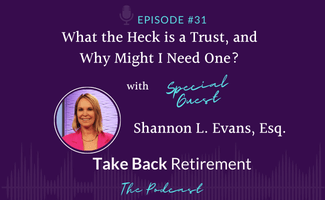
Guest Name: Shannon L. Evans
Visit Website: evans-associates.com/
Trusts.
What the heck are they and why might it be a good idea for you to have one?
Most people believe that trusts are this elusive thing reserved for the uber-wealthy…
…or have only heard of it as being a sort of plot device in a movie or murder mystery.
Joining us today is attorney Shannon Evans, a recognized expert in the area of trusts and estate planning. She practices out of Las Vegas and is a frequent speaker on the conference circuit.
With so much confusion around trusts, Shannon is a refreshing presence that gets to the heart of the matter real quick. She demonstrates that trusts are a lot more pedestrian—and a lot more useful—than most would think.
Resources Mentioned:
Please listen and share with your friends who are in the same situation!
Key Topics
So… What is a trust, exactly? (3:27)
Who should have a trust? (8:06)
What is an “irrevocable trust”? (14:39)
What you should take into consideration if someone asks you to be a trustee. (18:40)
In which state should you set up your trust? (22:48)
Why should you NOT have IRAs in trusts? (25:33)
Who is the fiduciary of a trust? (29:31)
Updating beneficiaries (33:51)
Stephanie and Kevin’s closing thoughts (40:49)
Stephanie McCullough (00:06):
Welcome to Take Back Retirement, the show for women 50 and better, facing a financial future on their own. I’m Stephanie McCullough, and along with my fellow financial planner, Kevin Gaines, we’re going to tackle the myths and mysteries of “Retirement,” so you can make wise decisions toward a sustainable financial future. Through conversations and interviews, you’ll get the information and motivation you need, to move forward with confidence. And we’ll be sure to have some fun along the way. We’re so glad you’re here. Let’s dive in.
Stephanie McCullough (00:40):
Coming to you semi-live from the beautiful Westlakes Office Park in suburban Philadelphia, this is Stephanie McCullough and Kevin Gaines of Sofia Financial and American Financial Management Group. Say hello, Kevin.
Kevin Gaines (00:52):
Hello Kevin.
Stephanie McCullough (00:52):
Today we have an interview with Shannon Evans. Shannon is an attorney recognized expert in the area of trusts and estate planning. She practices out of Las Vegas and she is a frequent speaker on the conference circuit. In fact, that’s how Kevin got to know her at some of his tax-geeky, retirement-geeky conferences. They’ve become friendly, which is why she’s decided to join us on the podcast today.
Stephanie McCullough (01:18):
I’m excited because this is an area that is a source of a lot of confusion for a lot of people. And I think Shannon does a very good job of getting to the heart of the matter, telling us the way it is and the way it isn’t with trusts. And hopefully she’s going to give you some really helpful tidbits.
Kevin Gaines (01:36):
That’s what I’m looking forward to. Most of us, we know trusts one of two ways. Either hearing about this thing that only the uber-wealthy use or it’s some sort of plot device in a movie or murder mystery. So, hey, here’s an opportunity to actually learn what these things really are. And like many things it’s probably just going to be, it’s a lot more pedestrian than we think of it as.
Stephanie McCullough (02:00):
Well, and a lot more useful than a lot of people think it is – a lot more applicable to more of us. So without further ado, let’s get in to our talk with Shannon.
Kevin Gaines (02:14):
Welcome Shannon. Although before we get started, I do want to say one thing. I appreciate everybody listening to a podcast with the title of trusts in it. Because, let’s face it, they’re probably not perceived as all that exciting, but I do got a quick little, not sure if I’d call it a story or just a way to introduce Shannon. So anybody who’s been to conferences and especially if you’ve ever put conferences together, you understand that the hardest time slots are going to be right after lunch or right before the end of day.
Kevin Gaines (02:44):
Because everybody’s, Hey, just had lunch, whatever. And at the end of day, everybody’s ready for the after meetings, shall we call them? Well, you need to have an engaged speaker in order to fill those slots. And at the conferences I go to, whenever Shannon is speaking, she always seems to get those slots. And it’s not because they’re finding a way to dump her. She’s just entertaining and engaging as hell.
Shannon L. Evans (03:11):
Thank you.
Kevin Gaines (03:11):
Now that I’ve tried to set up a high bar, Shannon Evans. Hello.
Shannon L. Evans (03:15):
Hi everyone. Great. I’m glad to be here and help you. It’s wonderful.
Kevin Gaines (03:21):
So there’s a lot to know about trusts, but there’s also a lot of confusion about trusts. So let’s go with the simple basic, what is a trust?
Shannon L. Evans (03:30):
A trust is a legal written document that you sign and notarize, and it should hold title to most of your personal assets like property, bank accounts, investment accounts, generally not retirement accounts, not IRA, not 401k, but personal accounts. So I segregate personal accounts and retirement accounts because they have a different answer.
Shannon L. Evans (03:54):
One of the reasons for a trust is to provide for your heirs and control the distributions over time so they don’t just get everything lumped on them when they’re 18 if you pass away. Another thing for trusts that people forget, is what if you become incapacitated? Like right now it’s on people’s minds. What if you get sick and for a little while you’re incapacitated. Then you name a trustee who could take over and handle things till you get better, or you pass away.
Shannon L. Evans (04:19):
And once you pass away, that trustee passes things out to your kids. So it’s a very useful tool to make things smooth without any court, and no legal fees, no guardianship court, no probate court. It’s just quiet and smooth. That’s why you do it.
Stephanie McCullough (04:30):
So Shannon, what does a trust not do? Because I think people have all these ideas of maybe tax benefits or all these other things that a trust might do for them. What do you see as some of the most common misperceptions?
Shannon L. Evans (04:46):
Stephanie, that’s a really good question. And even attorneys get this wrong. Okay. A normal revocable trust, wherever you live, it doesn’t matter, it does not give you asset protection. It does not. It’s meant to pass things along without court, without probate and reduce the cost. It’s not a tax saving device. It’s more of a structural tool, like a vessel to hold things. That’s what it does. It holds things. And you can pull out whenever you want.
Shannon L. Evans (05:12):
You could buy a new house, you could sell your house. You don’t have to change the trust when you change what’s in it. It holds things. And if your kids grow up and they change their personalities, you can add more controls or less controls to the rules. So it gives you flexibility in how things are held for your family. Everybody has different kids, good kids, bad kids, good brothers, whatever.
Shannon L. Evans (05:30):
And you can omit people in your family that are particularly not able to handle money or you don’t want them to inherit. You don’t have to give them a dollar. You just say, “I’m omitting you.” And no one cares why, it doesn’t matter. It’s your choice. It’s your assets. There are different kind of trusts if you’re married than if you’re single. And if you’re married and you have a trust together, it’s much more complicated than if you’re single.
Shannon L. Evans (05:50):
If you get divorced, you do not keep the same trust. You split them up into separate trust and you don’t keep the same one. You just junk it and make a new one. So people always forget, “Oh, I got divorced. I’m keeping the trust.” And I think generally that doesn’t work. You have to make a new trust for a single person.
Kevin Gaines (06:06):
So what happens if you become single and you haven’t updated the trust?
Shannon L. Evans (06:12):
If you don’t have a trust, make one. If you have one, change it. So if you’re divorced, you have to make a new trust. But this is really important. People, especially single people. I know we have all kinds of people here. If you’re single and you’re over 18, and you get in a car accident or have an injury, you have to designate who will handle money and who will handle finances.
Shannon L. Evans (06:31):
Money is a successor trustee, executor, financial power of attorney. That’s who handles money. Medical emergencies, and medical power of attorney. And that’s a different answer. So you might have different skill sets. Who’s going to handle medical emergencies versus who’s going to handle money. And you get to pick first choice, second choice. So that’s how you do it.
Shannon L. Evans (06:48):
And it’s really important. If you have power of attorneys, every state has their own. If you have medical and financial power of attorney, even if you got Alzheimer’s or you had a head injury, you never have guardianship court, or family court because you already picked who would handle emergencies.
Shannon L. Evans (07:05):
So it avoids court, and it’s useful. Because you get pick who handles things the way you would prefer for yourself. So medical power of attorney, every state has their own form. But generally it says, who will handle medical emergencies, first choice, second choice. And what do you prefer regarding end of life and things? So one thing people forget and I had this happen. I’ll tell you a story.
Shannon L. Evans (07:23):
Power of attorneys means you’re hurt and somebody has to do something quickly to avoid a probate, to avoid a problem, right? Once you die, a power of attorney is over. It’s over. So I had a lady once who was older, and she named her daughter to be power of attorney, otherwise her son, and then she became sick and then she passed away. And the daughter tried to go to the bank and use that power of attorney to take out a bunch of money. Well, guess what? You can’t.
Shannon L. Evans (07:48):
First of all, she’s passed away. It’s over. The power of attorney is done. It’s just to help things in emergencies. So people get mixed up. But generally it’s like a puzzle. A trust and a will go together. Medical power, financial power kind of go together. So it’s kind of a combination puzzle of how you set things up so it’s the same people making decisions.
Stephanie McCullough (08:07):
So at what point should someone consider a trust? Are there certain levels of wealth or levels of family complication? Like what are the triggers for you?
Shannon L. Evans (08:16):
If you have a house, you own a house, you should have a trust. If you have a bank account, you should have a trust. If you have a savings account, you should have a trust. [with Shannon Evans name as speaker] There’s ways to avoid probate that are not a trust. And I’ll tell you that because it’s useful. All right, you can have an account and you know this, Kevin knows this. You can have an account, not IRA, but a personal account. You can have it POD, Pay On Death or TOD, Transfer On Death. That avoids probate.
Shannon L. Evans (08:40):
But here’s something that people don’t think about. I just had this happen today. That people who are in their nineties and they’re totally sharp. They’re clear, they have money. Everything’s fine. And they had their accounts TOD. Quite a bit of money. And I said, “That’s fine, if you’re dead.” But what if you’re not dead? What if you got in an accident and your kids have to get in there and pay for things and help you?” TOD, you have to bring a death certificate to the broker, and close the account.
Shannon L. Evans (09:03):
A trust, you could be hurt and they get in there and help you. When you’re deceased, it says how things pass out. So it’s more complete, and also trust has more levels of complexity. POD, it’s going to your son and your daughter, period. What if they’re in an accident and they have kids who are under 18? Or what if you have complications and someone has special needs? What if someone’s not responsible?
Shannon L. Evans (09:24):
So the trust has a lot of levels about who can handle things and what ages and what responsibility levels can the trustee consider. So I like it. It’s more complete.
Kevin Gaines (09:32):
So like a TOD is really simple, really convenient, but it’s pretty much binary. Either it’s going to kick in because you’re dead or it’s not because you’re still alive, but the trust is going to give you the layers.
Shannon L. Evans (09:43):
Both are better than nothing. The worst is to have your name on their period. Also here’s a good one Stephanie, you probably know this. A lot of people when they’re older, put their adult children on joint. That’s fine. Joint means you’re an owner. What if the joint person goes bankrupt? Or what if they get in a car wreck or what if they get divorced or what if they get sued? Then it makes it very difficult.
Shannon L. Evans (10:05):
No one’s perfect. Even the best. So putting someone on joint makes them an owner. Instead, a trust, they’re not the owner.
Stephanie McCullough (10:11):
That means they could vacate the account and head off to Mexico. Right? I mean, I’m not saying your kids would do that, but it’s possible.
Shannon L. Evans (10:20):
Right.
Stephanie McCullough (10:21):
And legal.
Shannon L. Evans (10:22):
Yeah. So I don’t like joint unless it’s absolutely the most stable person you’ve ever met. Which we all know how that changes, doesn’t it?
Kevin Gaines (10:29):
Yeah.
Shannon L. Evans (10:30):
Someone might seem stable and they’re not. They go to the sun coast and guess what? They cleaned up the account.
Kevin Gaines (10:40):
Yeah. Well, but they were due to hit. So, yeah. It’s only temporary.
Stephanie McCullough (10:43):
Oh. And everyone always tells me, “My family won’t fight. There won’t be any disputes about things after I’m gone.” And then you hear stories of families that get very dysfunctional.
Shannon L. Evans (10:53):
So here’s something too, that’s interesting. People think you have to leave someone a dollar. No, you don’t. If you’re confident and you want to omit someone, you just say they’re omitted, and no one cares why. And they can’t contest it. All trust have a no contest clause. Which means if you fight the trust, you get zero. You’re disinherited. So it causes people not to fight.
Shannon L. Evans (11:11):
But there’s a caveat to this. This is a big one. No contest means you can’t fight the trustee terms, and say they’re wrong. But you can say that the person who wrote the trust was incapacitated or under influence of someone when they signed that thing. So people sometimes if it’s an older person, try to take charge and say, “Oh, but the son made her sign that.” And they try to challenge it. That’s not a no contest clause. That’s saying they lacked capacity when they signed the trust or amendment. Those are different issues.
Shannon L. Evans (11:37):
So when someone’s even a little bit older, or had an accident, and they’re going to change the trust to do significant changes to who gets it, I have them get a doctor letter saying they’re competent, or they have mental capacity at the time that roughly when they’re signing and then they can’t challenge it. For parents that’s a really good one. If your parents are going to change something.
Stephanie McCullough (11:55):
Yeah.
Shannon L. Evans (11:56):
Yeah.
Stephanie McCullough (11:57):
So you’ve seen a lot of these things go wrong. I’m guessing.
Shannon L. Evans (11:58):
Oh, more often than not. Yes.
Kevin Gaines (12:00):
Right. And you practice in Nevada and California, so there’s definitely…
Shannon L. Evans (12:08):
A lot going on.
Kevin Gaines (12:09):
A lot going on.
Shannon L. Evans (12:10):
Yeah. I’ll just give you a story because it’s interesting. And I never say clients details or names of course. I had a client and they operated, they didn’t own them. They operated some car washes in another state, kind of far away. But they lived in Nevada, which a lot of people do. And they had a condo here for their address, which is fine. And their daughter was visiting and she’s an adult. And she was visiting, and they let her use the condo. They’re not here.
Shannon L. Evans (12:34):
And she used their car, of course. That’s what she did. And she killed someone. And she was drunk driving. Well, all right. She doesn’t have any money. She’s in her twenties. I don’t know. Well, they went after them because they were the owners of the car. Right? And the daughter drove the car and she was drunk driving. And they thought they had a lot of money because they thought they owned these car washes. They didn’t own them. They operated them.
Shannon L. Evans (12:55):
So we had to go to great lengths to show them financial information saying they don’t have anything. So sometimes another thing that’s interesting for me is, and this is a segue, but it’s interesting. A trust is a private document. It just exists and nobody knows what it says until you… And even if you die, it doesn’t get filed. Unless there’s a fight. It’s quiet, quiet, quiet. So, I’m a little more secrecy-oriented, privacy-oriented because I’m from the West coast. But you can name your trust The Smith Family Trust, fine.
Shannon L. Evans (13:24):
Or you could name it, The Sunshine Trust or The Smart Girl Trust. No one cares. And you don’t pick a name and you don’t register it. It’s just quiet. So I like to name a random names for a privacy tool. It’s not asset protection, but if it’s hard to find your stuff, it’s an extra layer, make it hard to find things. Makes sense, huh?
Stephanie McCullough (13:44):
Yeah, absolutely.
Kevin Gaines (13:45):
Plus, you get to come up with a fun name.
Shannon L. Evans (13:46):
Fun name. Have a cocktail and figure out what would make your kids laugh. It could be your dog or your cat. But it shouldn’t be someone else’s name. It shouldn’t be the Churchill Trust. Because there’s Churchills. It should be some Zuma Beach Trust. No one cares. The next level for secrecy, which is privacy, which is interesting, is you can have your address on there, or you can have a PO Box.
Shannon L. Evans (14:06):
I prefer PO Boxes. I have never ever had anyone with a subpoena to find a PO Box. Now I’m not talking tax fraud. I’m just talking privacy. So if I were the people and I have the Sunshine Trust, I will get a PO Box address for my account in the trust. So it’ll be a fidelity account, Sunshine Trust, PO Box, the address and your name can be on as even trustee. That’s how I like to do things ideally. PO Boxes are powerful.
Stephanie McCullough (14:33):
Interesting.
Kevin Gaines (14:34):
Never thought of that.
Stephanie McCullough (14:35):
I know.
Shannon L. Evans (14:36):
See, I find out people’s mistakes, and I know what works. Yeah.
Stephanie McCullough (14:39):
So you mentioned a word earlier that I wanted to ask about. You mentioned a revocable trust. Could you say a little bit more about that versus the other kind?
Shannon L. Evans (14:49):
Okay. A normal trust is revocable. It’s your stuff. You can change your mind your whole life as long as you’re confident. That’s what everybody has. That’s normal.
Stephanie McCullough (14:55):
Okay.
Shannon L. Evans (14:56):
There are irrevocable trusts that you set up for grandchildren or kids’ educations and their needs that you gift to it. And it’s not yours anymore. It’s not your stuff. And it’s held for their benefit. They can’t just cash it in. That’s called an irrevocable education trust, but it could be for anything. It could be for living expenses, school, whatever. Then there’s a different kind of trust that most people don’t need that are more exotic called an asset-protected trust. And there are irrevocable asset-protected trusts in a lot of states now. I think there’s like 20.
Shannon L. Evans (15:23):
California is not. Nevada, Alaska, Delaware, South Dakota. They all have it. These kind of trust give you asset protection with a statutory time after you fund it. You have to transfer something with a trust name and then the trust has it. Right? So if you’re already being sued or you already hurt somebody, you’re being sued from malpractice, it don’t work. It has to be done way before anything happens.
Shannon L. Evans (15:42):
Every state has their own seasoning period. Nevada’s is six months for most things. You can’t be in trouble within six months. Those trusts are not good for everyone because they’re irrevocable, you have to have an independent co-trustee for distributions. So you’re not in charge of everything. And that has to usually be a resident of the state where the trust is. It’s only for liquid accounts that are not protected by homesteads or anything.
Shannon L. Evans (16:06):
So large investment accounts that are not retirement accounts are good for that kind of a trust. But the other bells and whistles, is not so easy. So I do those sometimes.
Stephanie McCullough (16:14):
So I think that’s what people think about when they think of trust. Right? They think big, fancy, complex, super wealthy people. You mentioned that asset protection. Right? Which is protection if someone sues you or bankruptcy or that kind of thing. You’re saying like an everyday normal trust is a very handy tool for most people.
Shannon L. Evans (16:30):
Yes. The standard thing is you have a house and a money market in it. Let’s just say your average person. And let’s say the house is worth $250,000. You can have a house in a trust, even if it has a mortgage. That’s fine. The bank has a deed of trust on the house. So you have to pay off the mortgage obviously, but if you die, and the house is not in the trust, let’s say you have a trust, but it’s not deeded to the trust. Or you have it in your name. There’s a probate.
Shannon L. Evans (16:56):
Everyone differs on probates. But like in Nevada or California, a probate is going to take you eight months for an easy one. Maybe a year. And it’s going to cost five, six grand for the baby one. And that’s nothing. If you had a trust, it would be free. So a probate of a house is a pain in the butt. Because then it’s tied up for six months. You can’t sell it without the court supervising it. There’s a lot of problems. And so, just for that alone, I think it’s really, really useful.
Stephanie McCullough (17:20):
And a lot of people push back on the attorney fees. Right? Oh, it’s going to cost me money to have the attorney drop the trust. But you’re saying it could save you money.
Shannon L. Evans (17:26):
Usually, now I can’t say for everyone. The average fee is roughly $1500, $2500. And that includes a trust, a will, medical power, financial power, deed. It’s the whole thing. Then you have no problems. Versus five, six grand on a probate. And things are tied up.
Stephanie McCullough (17:43):
Right. The time, the privacy, the fees, it’s the hassle. Right? I’ve got lots of friends who’ve been executors on family members of states. It’s not fun.
Shannon L. Evans (17:54):
Also in a probate, you’ll file the will and no will. And all the creditor is going to know what you own. And all the people are going to file a claim saying what you owe them. And everybody knows your business. And in a trust, nobody knows anything. It’s very quiet and there’s nothing involved. So it’s really useful.
Shannon L. Evans (18:11):
Here’s something that people forget about the house. Speaking of this, this isn’t really trusts, it’s a federal rule. But if you are inheriting a house that’s going to be your primary residence, and it has a mortgage. Your parents had a mortgage and you can’t qualify for a refi, federal law, the St. Garn Act, lets you keep that mortgage if you want to as long as it’s your primary residence. That’s a big deal.
Kevin Gaines (18:32):
Wow.
Stephanie McCullough (18:33):
That is good.
Kevin Gaines (18:34):
I had not heard that one before.
Shannon L. Evans (18:36):
These are pearls of wisdom.
Kevin Gaines (18:38):
This is it.
Stephanie McCullough (18:40):
Thank you.
Stephanie McCullough (18:41):
So Shannon, what if someone asks you to be a trustee for them? What should you take into consideration if someone wants you to be a trustee?
Shannon L. Evans (18:50):
Generally, that’s a pain in the butt, and you would say no. If you take a trustee fee, it’s income tax. It’s taxable income. So most people name one of their kids. The most responsible one. Right? To be the trustee. That’s fine. If they do that, usually I tell them don’t plan on taking a trustee fee because your inheritance is tax free. And the trustee fee you can take is going to be income taxable. So just skip that.
Shannon L. Evans (19:13):
So sometimes people name a person in the family who’s responsible, and they name a backup trustee who might be an institution like a trust company. That’s fine. I like there to be a trust company in there somewhere, in case people are not able to do it. I prefer to name private trust companies, where the people live instead of giant banks. If you name a giant bank as a trustee, they lock it and they often not always, they sell all the assets and put it in their stock, they control it and they won’t let you get rid of them.
Shannon L. Evans (19:41):
So I don’t like big institutional trustees. I like small private trust companies where the people live, and in my trust and most people’s trust, I have somebody who can fire the trustee. They don’t like them, and they’re unhappy with them, you better have somebody who has the ability to get rid of them.
Kevin Gaines (19:55):
Is that a trust protector?
Shannon L. Evans (19:56):
It can be. See, Kevin knows. A trust protector is a person who can fire a trustee, but they’re not a fiduciary. They’re not a trustee, they’re not paid. They’re just someone you trust.
Stephanie McCullough (20:06):
Oh, I like that.
Shannon L. Evans (20:07):
Or you can say, the beneficiaries can fire the trustee if they vote. So here’s a story, a really good story. Okay. You ready? So I had a trust. I inherited a law firm in 1997. I bought it from a lady. And she had clients. So I got some of her clients. And she had very complicated trusts, which are fine. They’re probably better than mine, but they were very complex. And there’s something called generation skipping. Which is really boring, but it just means, your kids have it for their life, and then it goes to the grandkids. That’s what it means.
Shannon L. Evans (20:34):
Well, the father died and the mom committed suicide. So they had quite a bit of money and the trust and it’s for their son. One son. Fine. Generation skipping. The rest is held for him and his children for their lifetime. Well now, he’s supposed to get it when he is 60. But Wells Fargo is the trustee. And they said, “No, the generation skipping part is held for your children’s lifetimes, and you don’t have any right to do anything.”
Shannon L. Evans (21:00):
So he was counting on getting this money at 60 and his kids are adults and they’re fine. But they cannot get rid of Wells Fargo. They’re stuck with the trustee and they’re stuck with the fees they’re charging. And I’m not saying they’re charging too much or anything. But they’d rather have someone else, and they cannot have anyone else. They’re stuck for a long time.
Shannon L. Evans (21:15):
And even if they’re doing a good job, I like people to have freedom. As long as they’re reasonable adults, you should have some choices over who handles your money. So, that’s a little warning.
Shannon L. Evans (21:25):
There has to be a paragraph in the trust saying the beneficiaries can vote to remove and replace a trustee, or a trust protector can pick a different trustee or there has to be some paragraph and they’re giving some ability for someone to watch dog the trustee and get rid of them. For any reason, not just theft or anything. Just because they don’t like them.
Stephanie McCullough (21:42):
Yeah. We have a family friend who has a family trust, and the bank has been bought five different times and now they’re stuck with this bank that they don’t want.
Shannon L. Evans (21:52):
Right. Are they deceased or they still alive?
Stephanie McCullough (21:54):
Still alive. I think they’re the second generation of the skipping.
Shannon L. Evans (21:56):
See, it’s a generation skipping so they can’t get rid of them. Those are older trust too. Yeah.
Stephanie McCullough (22:02):
Yeah.
Kevin Gaines (22:03):
Now, there was a big thing in the news, I want to say back in the summer when Congress was talking about tax bills and finding ways to get money to pay for all the stuff they wanted to spend on. And one of the things they were trying to target were trusts. I seem to remember certain states were mention saying to paraphrase the politicians, these are evil states that have trust that allow everybody to hide and avoid paying their fair share, which is always a fun phrase to throw out there.
Kevin Gaines (22:35):
Like I said, I seem to remember South Dakota was mentioned, Delaware. I think Nevada is where-
Shannon L. Evans (22:42):
All the good states.
Kevin Gaines (22:43):
So that’s going to be my question. How do you get your trust in a good state? Is it worth the effort?
Stephanie McCullough (22:48):
And do you need to?
Shannon L. Evans (22:50):
So, you can have a trust anywhere, but if you live in Florida and you have one in South Dakota, you should have at least an account there or a successor trustee from there. It has to be some nexus probably. But let’s say you set a trust in Nevada, and then you move to Texas or you move to Washington. You can keep the Nevada trust. So you can keep a trust and it can hold property anywhere.
Shannon L. Evans (23:08):
It can hold assets anywhere. It’s just a holding tank. I think those trust, first of all, I don’t hold my breath on them agreeing to any tax changes. Right now they can’t even agree on what day it is. So I don’t even study that stuff until it comes through because it’s a waste of time. But if they do, they’re talking about those generation skipping trusts. And that’s not an income tax issue that’s an estate tax issue.
Shannon L. Evans (23:27):
So there’s two kinds of taxes. Income tax and estate tax. Most of us do not have estate tax. Estate tax means, what is the estate tax credit on the year you die, and how are you more than that? Right now that’s $11,700,000. If you have more than that, there’s an estate tax. If you have less than that, there’s not.
Shannon L. Evans (23:40):
So thinking it maybe, and Kevin knows this, so thinking maybe it’ll go down to six million in 2026. Maybe it will. Who knows? But still, six million’s more than most people have. If you married, you can have two. Six million, six million. Right now, 11.7 million, 11.7 million. That’s 23 million.
Shannon L. Evans (24:04):
So if you’re over that amount, there’s a tax. So that’s what they’re targeting. And generation skipping is not IRAs, but it’s for personal stuff in an estate. And it’s not estate tax until the generation down dies. Or multiple generations down die.
Shannon L. Evans (24:19):
Let’s talk about the beneficiaries. So let’s say you have younger children. Who knows how they’re going to turn out? You think they’re going to be fine, but who knows? And who knows if you’re going to be around? You probably will. But who knows? So the trust is flexible unless the trustee holds it for the children. And as they grow up, it says general rules. Like the trustee could pay for anything they need, and then when they graduate from college, they could have a third. And then five years later they can have…
Shannon L. Evans (24:45):
So the trust kind of has parameters as to when they could pass things out. It’s not iron. It’s just general preferences. So there’s a lot of flexibility in all trust for the beneficiaries. If kids have any kind of disability, then you have to have special language in your trust. And that’s called special needs.
Shannon L. Evans (25:00):
If there’s any chance they have autism and they might not be able to support themselves, and they might be on SSI or Medicaid, you have a whole different kind of trust language for those people. And that’s really important. And Kevin knows this. On IRAs, you do not leave an IRA to anyone on SSI or Medicaid, unless you have a special, weird, funky IRA trust. It will not work and will ruin their aid. So it’s a really big deal when people on SSI or Medicaid or they have a chance of being on that, you’re not picking on them. You’re just saying, you have to protect their share differently than anyone else. And people forget that. Kevin, I’m sure you’ve seen that.
Kevin Gaines (25:33):
We’ve come across it more than once.
Shannon L. Evans (25:35):
Yeah.
Kevin Gaines (25:37):
Getting back to something you said at the beginning that you don’t want IRAs in trusts. Why not? Or what are the pros and cons?
Shannon L. Evans (25:45):
That’s a really good question. Okay. The IRAs go by their beneficiary form. Right? And obviously, the IRA cannot be owned by a trust. It’s owned by the person whose IRA it is. Their social security number. So there’s primary beneficiary, contingent beneficiary. Primary is the main person or person’s, contingent is if they’re dead, the next one’s up. You should always have both by the way. Both.
Shannon L. Evans (26:08):
But, if you name a trust, several bad things happen. First of all, if you name human beings or charities, they go straight to the people you name. And Kevin knows this. They have 10 years to take it out. Not charities, but people. 10 years to take it out. Since January.
Stephanie McCullough (26:20):
Right.
Shannon L. Evans (26:21):
It doesn’t have to be each year. It can be all at the end. It could be in the beginning. People can do whatever they want. As they take it out, they pay income tax. So the game is to let it grow. But, whatever, they can do what they want. If you name a revocable trust, the IRA already avoids probate. You name beneficiaries. The court’s not going to get involved unless you mess it up and don’t name a beneficiary.
Shannon L. Evans (26:43):
If you name a trust, several bad things happen. One, and this is complicated. There’s new case law that just came down in this past year. If you’re the owner of IRA, and you name your trust as the beneficiary, and you die, there’s case law that says your own creditors can dip into that IRA and it opens it up to creditors of the owner. That’s ridiculous.
Shannon L. Evans (27:03):
And why you should ever do that? And the trust already… It doesn’t need it. You already avoid probate.
Shannon L. Evans (27:08):
To me, that means lawyers. Cha-ching. Because the lawyers can meet it with probate after you’re dead. Why not have it now? Once you’re dead, they can go to town on what they charge. Right? There’s still going to be a probate and then there’s a trial. So it just doesn’t work.
Kevin Gaines (27:23):
Mm-hmm. It sounds like you want to talk to somebody to get a trust done, but, say you’re like me and cheap and you’re so tight you can make a nickel scream, but, why not use legal Zoom to do this? Or one of those other online services?
Shannon L. Evans (27:39):
You can. Do you ever buy flip flops from Target? And then you buy Birkenstocks. It’s different.
Stephanie McCullough (27:47):
I bought a pair of flip flops in Las Vegas of all places because, we decided to walk back from dinner to the hotel and I had fancy high heels on and halfway back my feet were killing me. And I went to a tourist shop and I still have my Las Vegas flip flops. They cost like three bucks and they’re not comfortable.
Shannon L. Evans (28:08):
I’ve heard since the pandemic no one’s wearing high heels anymore. We were all revolting.
Stephanie McCullough (28:11):
I’m getting rid of mine. I look at my closet, like what are they doing here?
Kevin Gaines (28:14):
I haven’t worn heels since the pandemic started.
Shannon L. Evans (28:16):
Well Kevin, you shouldn’t. It’s just not your look.
Kevin Gaines (28:20):
Yeah. I just can’t pull it off. I don’t know. Yeah.
Shannon L. Evans (28:22):
Hey, here’s is something not important, but it might be to some people. People have pets. I have four horses, a donkey, chickens and cats. Okay. If you have pets and you die, they take them to the pound and they kill them. A lot of times. Who gets the pets? So your trust can say, if I have pets at the time I die, they go to this person or this person, or the trustee picks a good home. And guess what? However many pets I have. They each get a thousand bucks. Or 50,000 bucks or whatever you want. Then you take care of your pets.
Stephanie McCullough (28:50):
I like that.
Kevin Gaines (28:52):
I’m glad you mentioned pet trust. I actually think I brought that up in an earlier episode maybe.
Shannon L. Evans (28:58):
I think you did. Pets are good.
Kevin Gaines (29:00):
I’m trying to remember. But yes.
Shannon L. Evans (29:01):
You should take care of them.
Kevin Gaines (29:03):
Yeah. Because our regular listeners are well aware that, yeah, I’m a big dog guy and frequently talk about my morons. That’s a consideration especially for my wife and I that what happens if something happens to us, who’s going to keep care of the boys?
Shannon L. Evans (29:20):
And so, you don’t say, “Oh, only this dog.” You just say any pets I have at the time of die, they go to these people if they want them or these people or a good home and they get so much money per pet. Because you don’t know what you’re going to have when you’re old, who knows. But I think that’s really important.
Stephanie McCullough (29:32):
There’s another word you mentioned that I want to make sure we touch on. When you were talking about a trustee, you mentioned the word fiduciary. Can you explain what that means if you are serving as trustee.
Shannon L. Evans (29:42):
Okay. If you’re a trustee or an executor, an executor means there was a probate instead of a trust. And then it goes to the trust or the people or whatever. Either one, you’re a fiduciary meaning you are taking care of that estate. And you are responsible. If you pass out all the money and then there’s income tax, guess what? You can be hit for the income tax. Because you passed all the money.
Shannon L. Evans (30:00):
So fiduciary has very strong rules. And also, as a fiduciary, if you treat one person differently than the other, and you’re favoring someone, you’re not being a fiduciary. Think of it as being a judge. You have to be fair and responsible and not pass everything out until everything’s taken care of. And it’s an obligation more than an honor, if you ask me.
Stephanie McCullough (30:20):
Yeah. Yes.
Kevin Gaines (30:22):
So trustee and executor basically sounds like a thankless task.
Shannon L. Evans (30:24):
Yeah. But if you have a trust properly funded, there’s no executor. You don’t even… I’ll tell you another story. Because stories are good. So I had this man who was maybe in his eighties, maybe when I met him he was in the seventies. And he was self-made. Big money. All made himself. No kids, had a wife late in life, and had nieces and nephews that were wonderful and helped with the business. Very successful.
Shannon L. Evans (30:46):
And so we set up a trust, and he had many, many corporations and LLCs. Well, you have to have the LLC member be the trust. The owner. You have to have the shares of the corporation be in the trust. That has to be the owner to avoid probate. So if you have an LLC that owns apartment buildings, the member better be your trust. If the member is you and you die, guess what? There’s a probate of the LLC, and thus the apartment buildings.
Shannon L. Evans (31:09):
So, he didn’t want to fund his trust. He didn’t want to change the title of his companies. And I said, “You have to, or it doesn’t work. There’s going to be a giant probate in multiple states and it’s not going to be a good thing.” Well, he didn’t want to, years went by, and he’s just stubborn and that’s all right.
Shannon L. Evans (31:24):
Well, maybe he was in his mid eighties. I don’t know. Finally he funded everything because I kind of made him. And then he had a stroke and luckily they had power of attorney. They could fix the rest of the ones that weren’t in the trust yet. And then he died about six months later, and there was no probate, no filing. There was an estate tax. It was big, quiet, quiet, quiet. Nobody knew a thing. And it worked exactly like I said. But he resisted me. Resisted me and I’m like, “Come on, come on.” And finally I was like, “Oh thank goodness he did it.”
Stephanie McCullough (31:51):
And if he hadn’t, that would’ve been sticky, messy in all the states and-
Shannon L. Evans (32:00):
Ching, ching, ching. Lawyers, lawyers, lawyers, everyone makes money.
Stephanie McCullough (32:04):
Yeah.
Shannon L. Evans (32:05):
Let’s talk about Tony Hsieh. The Zappos guy. He was a big shot. Zappos in Vegas. And he died of some weird fire drug thing who knows in Connecticut. He didn’t have a trust. He didn’t have kids. He didn’t have a spouse. People are crawling out of the woodwork saying, “Oh he owed me $17 million.” “Oh, we had a verbal agreement that I was going to make him this sculpture of a brain for his ceiling. That was an art piece worth $50,000.”
Shannon L. Evans (32:23):
He has all these people coming after him ,and it’s not right. Because he didn’t plan. And he’s a big shot. Same with Prince.
Stephanie McCullough (32:34):
Oh yeah.
Shannon L. Evans (32:38):
All those people, big shots. They didn’t have anything in place. And you think, Aretha Franklin had wills, multiple handwritten wills in her couch. Stuck in the couch seat. Well that was good.
Stephanie McCullough (32:44):
That’s not going to cut it, huh?
Kevin Gaines (32:48):
Yeah. Can pretty much always count on at least one celebrity death per year that provides at least one fabulous lesson for estate planning or money management because it comes out of the woodwork that they’re just like the rest of us. They don’t always think of this stuff.
Shannon L. Evans (33:06):
Right. They think they’re invincible. And then what does that mean? Lawyers make tons of money. It takes years and who’s making the money? Lawyers and experts. And it’s just ridiculous.
Kevin Gaines (33:15):
I mean, and I’m not sure very many of us want 30, 40% of our estate to go to people we don’t even know.
Shannon L. Evans (33:24):
No. Or even like.
Kevin Gaines (33:30):
Or like.
Stephanie McCullough (33:31):
Right. That’s the point. And when I talk to people like, “Oh, I don’t have enough to worry about these things.” But you do. Right? You still have your loved ones. You have your people.
Shannon L. Evans (33:40):
At least have power of attorneys where if you’re hurt, someone could do something quickly to avoid a problem. Power of attorneys you can make a trust, if you’re not dead. So that’s better than nothing.
Stephanie McCullough (33:45):
Yeah.
Shannon L. Evans (33:46):
Or at least make your bank accounts POD, if there’s nothing, at least there’s no probate.
Stephanie McCullough (33:50):
Yep. The key is if you’ve got these documents, read them. Understand what they say and see if they need to be updated.
Shannon L. Evans (33:59):
Update them. So if whoever you named as power of attorney, you named your mom. And now she’s older and can’t really handle the money. Then you pick someone else.
Stephanie McCullough (34:08):
Yeah.
Shannon L. Evans (34:09):
Update them once in a while. If you get divorced, Kevin knows this. If you get divorced, take your spouse off of everything. Your IRA, take that persons name off.
Stephanie McCullough (34:16):
Yes.
Shannon L. Evans (34:17):
There’s a lot of laws in the estates saying automatically the person’s off, but sometimes they’re not. So just be careful, retitle things if you’re divorced. People do this all the time. They have a boyfriend or a girlfriend or whatever and they put them on, that’s okay. But I don’t like it. This boyfriends and girlfriends come and go. Right?
Stephanie McCullough (34:33):
Yeah.
Shannon L. Evans (34:34):
Oh, here’s something interesting. The opposite. All right. This happens. There’s something called living apart together, which all the older people are doing now. They don’t get married. They just cohabitate and why do you have to get married? You’re older. Your kids are grown. Right? That’s a big thing now. All right. If you live together 20 years in the same house, and you don’t have power of attorney and you’re not married, guess what, you have no say in that person’s life at all.
Shannon L. Evans (35:00):
So sometimes when there’s long term relationships, I say, “Hey, make each other medical power of attorney. You trust each other. You’ve lived together forever. You’re just not married.” So sometimes it’s the opposite. You shouldn’t include your partner as power of attorney even if you’re not married. Especially if you’re not married. Otherwise they have no say at all. And the family just comes and kicks your ass out of the house. Right?
Stephanie McCullough (35:19):
Yeah.
Kevin Gaines (35:20):
Yeah. We’ve all heard those, not just heard those stories. We’ve all seen it happen with clients or friends. If you’re in this business long enough-
Shannon L. Evans (35:26):
Right. A good story. I have a client, and she’s some kind of fancy chef. Fancy chef. Vegas they have fancy. Right? And she had some Italian lounge singer guy as a long-term boyfriend. Not famous but a singer. And they were together a long time, maybe 10 years. I don’t know. And she lived in his house, and she was in LA and really she supported him. Because the singer didn’t make much money. You know how that is.
Shannon L. Evans (35:50):
But he’s good looking and he’s popular but she made the money. So she’s supporting him and he didn’t have a will of trust or anything, and he died suddenly of a heart attack. Well, since he didn’t have a trust or will or anything, guess what? His sister and his dead brother’s felon son were his heirs.
Shannon L. Evans (36:06):
Now, they’re coming to Vegas and they think he’s got all this money. Right? And they’re kicking her out of the house. Her stuff’s in that house too, by the way. They’ve lived there a long time. Kicking her out. And she really paid for everything. They kicked her out. And it wasn’t fair. She supported that guy for a long time. She bought him hair transplant. She got him new outfits, so he could do the shows. And she got her ass kicked out the second that felon niece, nephew, and the sister came to town. So I don’t like that either. That wasn’t fair.
Stephanie McCullough (36:38):
Yeah. That’s one of these things. Right? The unintended consequences. The stuff that we don’t think through because we were trying to live in the moment and be present and all that stuff. But we also do have to think about the legal implications of what happens when.
Shannon L. Evans (36:52):
Mixing your assets. Yeah.
Kevin Gaines (36:53):
I mean, it’s not the stuff of Hallmark movies, but it is stuff that needs to be considered.
Shannon L. Evans (36:58):
Yeah.
Stephanie McCullough (36:59):
Right.
Shannon L. Evans (37:00):
Yeah.
Stephanie McCullough (37:01):
Often, in all this stuff, there’s a point at which it’s too late. So you got to have it in place before you need it.
Shannon L. Evans (37:06):
That’s true. And also, as people age and their children become adults, you can make them the trustees. You just don’t want them to be the trustee before they’re responsible. So, maybe they’re not responsible till they’re 35. I don’t know about you, I became more responsible in my thirties and up. So if I was 25, I was smart, but I don’t think I should have gotten like all the responsibility. So, it’s up to each person to consider who’s qualified as they age. You can change things.
Kevin Gaines (37:28):
Well, yeah. I mean, there’s that, I think it’s an Instagram account. What is it called? Rich Kids of Instagram or whatever. And it’s these trust fund kids, sitting and enjoying the fruits of their ancestors’ labors. You get the impression. I mean, that’s probably a good argument for a trust that they might not be in the best position to be making sound financial choices, shall we say.
Stephanie McCullough (37:53):
But that’s a point too. Right? You talk about a trust fund kid. Sometimes the trust is set up. You hear about this phrase control from beyond the grave, right? It’s not necessarily meaning that the kid’s a spoiled brat. It means the family wanted to set it up so that they didn’t have all this wealth dump on them at one time. Right? I mean, it could be parceled out over time.
Shannon L. Evans (38:16):
The opposite actually. If they do the trust right. In fact, some trust, and this is mean, but everybody picks for themselves. I’ve had trust drafted before, where the kid gets an amount equal to his or her W2 earnings for the year. And of course, they’ll pay for health insurance if in the hospital, of course. Basic life. But they don’t get any cash unless they show they made a hundred grand, they get a hundred grand. That’s kind of mean, but I’m just saying, that’s totally an option that people can do.
Stephanie McCullough (38:39):
If they choose to make 20,000, they make 20,000.
Shannon L. Evans (38:45):
Some people say something like this, “They get a W2 matching for what they earn, unless they’re in a profession, which is helpful to society, which we think is beneficial.”
Stephanie McCullough (38:51):
Oh, like school teacher.
Shannon L. Evans (38:52):
There’s a little wiggle room. Yes. There’s wiggle room for the trustee. Which I think they should always have wiggle room for the trustee. If the person’s a good person, the trustee can decide how much. If they want to buy a house, let them buy the house. So I like to have a little flexibility always, but that’s an option.
Kevin Gaines (39:04):
So when you put subjective clauses in a trust, it’s the trustees discretion how to interpret that or enforce.
Shannon L. Evans (39:11):
And that’s why you have to have someone who can pull the trigger on the trustee. Not the kids, but someone else. The best way to protect a kid, let’s say they won’t get a prenup. They’re in love and whatever. And they’re going to inherit some money. The best way to protect your inheritance is hold it in the trust, and the trustee has sole discretion on how much to get them. Sole discretion. That’s a prenup right there.
Stephanie McCullough (39:34):
I’m making notes.
Shannon L. Evans (39:36):
Yeah.
Stephanie McCullough (39:38):
Oh, that’s a good point. Because when you’re young and love, that’s the last thing you want to do. Put down legal documents about it.
Kevin Gaines (39:48):
Yeah.
Shannon L. Evans (39:49):
Right.
Kevin Gaines (39:50):
Prenup, man, that’s not romantic.
Stephanie McCullough (39:55):
Right.
Shannon L. Evans (39:56):
No.
Stephanie McCullough (39:56):
All right Shannon. Thank you so much for your time today.
Shannon L. Evans (39:58):
Thank you so much.
Stephanie McCullough (39:59):
Any last tidbits you think that people should walk away with?
Shannon L. Evans (40:00):
Okay. Today, check your IRA beneficiary forms, check your bank accounts for POD, at worst. And maybe even hand write on a piece of paper, who gets stuff and date and sign it. No printing. Just hand write it for now. It’s better than nothing.
Kevin Gaines (40:12):
Yeah.
Stephanie McCullough (40:13):
And make sure somebody knows where to find it.
Shannon L. Evans (40:15):
Then you have time to think about what you want to do.
Stephanie McCullough (40:18):
Awesome.
Shannon L. Evans (40:19):
Thank you, Stephanie.
Stephanie McCullough (40:20):
Thanks for being with us.
Kevin Gaines (40:22):
Oh, real fast. How can people find you if they need to… For our west coast listeners especially?
Shannon L. Evans (40:24):
Well, they really can’t find me because I’m secret and I have a secret trust. But they can find my professional person online, Evans & Associates. But they can’t find anything about me because I don’t even have social media.
Stephanie McCullough (40:38):
Quiet, quiet.
Shannon L. Evans (40:39):
Yeah. I take my own advice.
Kevin Gaines (40:40):
Well, thank you very much.
Shannon L. Evans (40:41):
Thank you very much.
Stephanie McCullough (40:42):
Thanks.
Kevin Gaines (40:43):
See you next time.
Shannon L. Evans (40:44):
Bye Stephanie, bye Kevin.
Stephanie McCullough (40:50):
Well, I certainly enjoyed that conversation with Shannon. I know I learned quite a bit. And one of the things that she really reinforced is that, your basic, what she called normal trust, a revocable trust, is just a vessel that holds things. It’s an everyday item. It’s not for the uber wealthy, and it doesn’t get you out of taxes or protect you from creditors. It allows control of the distribution when you die but also if you’re incapacitated.
Stephanie McCullough (41:20):
So thinking back to our episode 14 with Cathy Sikorski, she was talking about the importance of those legal documents that give someone the power to handle your affairs if you’re still alive. Right? That’s also very much what Shannon was talking about. In the case of a trust, where if something happens to you and your assets, not your retirement assets, your other assets are held in the name of the trust, a successor trustee could step in for you and take care of things very smoothly.
Stephanie McCullough (41:51):
And also the privacy. She kept saying quiet, quiet. Quiet, quiet. What a lot of people don’t realize is, when there’s an estate and it goes to probate, the court decides who gets what, and the will gets read. That’s all very public. So if you would for whatever reason prefer the world not to be able to know your business, then a trust can be very useful.
Kevin Gaines (42:13):
Yeah. It could be as simple or as complicated as you want to make it. If you wanted to do a lot of things, it can, but it doesn’t need to be this multi chapter tome. The big thing I appreciated hearing was a trust lawyer saying, “Hey, here’s stuff you don’t put in a trust.” Such as most importantly, your retirement accounts. As she alluded to, there are specific rules if you do try to put a retirement account in a trust, and if you don’t follow those rules, you can blow the IRA up.
Kevin Gaines (42:50):
So, I think that was really important to emphasize. Stuff that has a beneficiary form doesn’t necessarily need to be in a trust. Depending on what your goals of the trust are. Like you took away Stephanie, as far as control and distribution. If you don’t need control, then yeah, stuff with beneficiary forms don’t necessarily need to be in a trust.
Stephanie McCullough (43:12):
And I like that she emphasized the flexibility. Right? You have flexibility in that, during your lifetime, you can change the provisions. You can disinherit someone if you want to, you can do whatever you like to make adjustments. And when she’s crafting a trust, she writes in some flexibility for the trustee. Right?
Stephanie McCullough (43:34):
So let’s say you have now passed on, and the trustee needs to make a judgment call. It doesn’t say exactly or the trust says this, but really the situation feels like it calls for that. If it’s written to give that person flexibility, that is certainly a good thing. And also her point about having some type of institutional trustee in there. Meaning, a trust company that specializes in this stuff.
Stephanie McCullough (44:00):
Because it can be very hard to ask cousin Sally to say no to her maybe niece and nephew, about when they get money. Right? So if you have a family trustee, that can be sticky. So sometimes having an institutional trustee in the mix, or if that individual throws up their hands and says, “I’m out of here. I’m moving to Chile, you guys handle it on your own.” At least there’s more backup plan.
Kevin Gaines (44:22):
Well, yeah. Because I think we established in this episode. Being a trustee or even an executor, it’s not a fun job. It’s not some fancy title you use just to get a better reservation at a better restaurant. You know? This is in many ways a thankless task. And not everybody wants to do it.
Stephanie McCullough (44:40):
It brings in that F word, fiduciary. Right? It’s used when we’re discussing financial advisors and Kevin and I are fiduciaries when we talk to clients about our investment management and financial planning. And if you are a trustee for someone, even for yourself, or if you are executor of their estate, you are a fiduciary. Which means you are held to a legal standard of best care for the people you’re looking after. Right? And you’ve got to be fair and equal as Shannon was pointing out.
Kevin Gaines (45:08):
Yeah. And to spell it out even more, as a fiduciary, you have responsibilities. And if you don’t fulfill those responsibilities, as other people may try to interpret it, you therefore have liability. And hey, let’s get sued for doing a favor for a friend or a parent or something because hey, that just sounds fair. Right?
Stephanie McCullough (45:30):
Oof. Right? And then probably we’re going to have to talk about liability insurance at some point and umbrella policies and all that kind of stuff.
Kevin Gaines (45:40):
Yay. And to paraphrase what Shannon was saying, insurance salesmen love that. Cha ching, cha ching, cha ching. But my favorite point that she made was, if you’re trying to keep care of your family and everybody with the trust, remember your family is more than just the humans. Don’t forget about the dogs, the cats, the horses. It’s fun to talk about and it may sound frivolous, but being responsible for your pets is actually a serious issue.
Kevin Gaines (46:11):
It’s not just a joke that there’s a chance that they’ll just get turned over to some shelter and not every shelter is going to be concerned with their best interests. Or your preferred interests for your animals.
Stephanie McCullough (46:29):
Or on the other hand, maybe more than one family member’s going to fight over them. Right? Or would they get split up if there’s more than one? Yeah. I mean, there’s a lot of considerations you want to take account of. And as we say, like a lot of these things, you got to put it in place before you need it. Because the day that disaster befalls you, it’s too late.
Kevin Gaines (46:45):
Yeah. You can’t do this stuff once you’re incapacitated. You’re kind of stuck. So, do it when you can, not when you have to.
Stephanie McCullough (46:55):
All right. We’ve bent your ear for long enough today, dear listeners. Thanks so much for being with us. We’ll talk to you next time. It’s goodbye from me.
Kevin Gaines (47:00):
And it’s goodbye from her.
Stephanie McCullough (47:04):
Be sure to subscribe to the show and please share it with your friends. Show notes and more information available at takebackretirement.com. Huge thanks for the original music by the one and only, Raymond Loewy through New Math in New York. See you next time.
Disclaimer (47:19):
Investment advice offered through private advisor group, LLC, a registered investment advisor. Private advisor group, American Financial Management Group, and Sofia Financial are separate entities. The opinions voiced in this material, are for general information only and are not intended to provide specific advice, or recommendations for any individual security. To determine which investments may be appropriate for you, consult your financial advisor, prior to investing. This information is not intended to be substitute for individualized tax advice. Please consult your tax advisor regarding your specific situation.